



Maxim's digital ambient light sensor that reduces power consumption by more than 100 times
 Published2011.02.23 19:36
MAX44007/MAX44009: Maxim's digital ambient light sensor that reduces power consumption by more than 100 times
* MAX44007/MAX44009 is a digital ambient light sensor that combines two light sensors, an ADC, digital functions, and an I2C interface in an ultra-small 2mm x 2mm x 0.6mm package.
These ICs extend battery life by consuming 100 times less power than the nearest competing products.
The interrupt function continuously measures ambient light and reports it to the microcontroller when it exceeds a threshold. This feature further reduces power consumption by decreasing the frequency of I2C communication.
These ICs are suitable for tablet PCs, smartphones, laptops, TVs, digital lighting management systems, and light intensity monitoring applications.
Maxim's digital ambient light sensor that reduces power consumption by more than 100 times
Maxim's 2nd Generation Digital Ambient Light Sensor that Maximizes Battery Life and Simplifies System Design
Maxim Integrated Products (NASDAQ: MXIM) has launched the MAX44007/MAX44009 digital ambient light sensor (ALS) ICs, which feature an integrated proprietary adaptive gain block. Designed with Maxim's proprietary BiCMOS technology, these ICs integrate two light sensors, an ADC, and digital functions into an ultra-small 2mm x 2mm x 0.6mm package. This integration delivers industry-leading performance while saving valuable board space.
The MAX44007/MAX44009 consumes 100 times less power than the nearest competitor, significantly extending battery life. In addition, these devices provide a unique interrupt function that continuously measures the amount of light and reports it to the microcontroller when the measurement exceeds a threshold. This feature further reduces power consumption by decreasing the frequency of I2C communication.
MAX44007/MAX44009 is suitable for tablet and laptop PCs, smartphones, TVs, digital lighting management systems, and light intensity monitoring applications.
Giving more meaning to the sensor
In light sensing systems, differences in the path of light cause measurement differences. These differences are caused by the position of the sensor on the board, the distance tolerance between the top of the sensor and the glass surface, the transmission characteristics of the glass covering the sensor, and many other factors. When component-specific variations in the sensor are added to these factors, the reading error can reach 50%. This leads to false triggers, which can result in a decrease in production yield.
The all-in-one integrated solution provided by the MAX44007/MAX44009 features a maximum total gain error of only 15%. In addition to these highly precise optical measurements, Maxim's optical sensor digital communication is resistant to parasitic elements present in the communication interface. These two features achieve stable and reliable optical measurements, providing excellent production yields.
Perceiving light as the human eye sees
It is difficult to perfectly replicate the human eye's light response using electronic components. Conventional light sensors measure the amount of light present in the environment regardless of wavelength. Such designs are excessively affected by ultraviolet and infrared light, which is imperceptible to the human eye. This leads to inaccurate ambient light readings and significant discrepancies in brightness adjustment. This problem is further exacerbated by the fact that light sources possess different spectra. For example, incandescent bulbs contain more infrared components than fluorescent bulbs.
Maxim's BiCMOS technology eliminates ultraviolet and infrared light by integrating two photodiodes along with an optical filter. Through this implementation, the MAX44007/MAX44009 accurately measures visible light in various environmental settings by replicating the light response of the human eye. Enhanced algorithms correct for all spectral deviations between light sources, ensuring a highly accurate lux response.
Furthermore, the sensor's ADC integration time can be adjusted between 6.25ms and 800ms. The default integration time of 100ms ensures excellent 50Hz/60Hz rejection.
Improvement of black glass properties
Portable devices often use colored or black glass on the top of the sensor. Black glass presents many problems for optical sensors because it alters the response to various light sources with different radiation spectra. Generally, measurement errors occur when these different spectra combine with the spectral profile of the glass.
The MAX44007 provides access to two types of light sensors: visible + infrared photodiodes and infrared photodiodes. Once the designer knows the response of black glass, they can incorporate it into the light sensor measurements to achieve excellent accuracy and sensitivity (as low as 0.025 lux).
Increased dynamic range and precision
The ambient light sensor covers a wide range of light conditions, including all intermediate changes from direct sunlight to complete darkness.

관련뉴스

Intel Unveils Next-Generation 'Core Ultra Series 3' and vPro Platform for Enterprise PCs
Intel has officially unveiled the "Intel Core Ultra Series 3" for next-generation enterprise PCs and the latest vPro platform, addressing a wide range of demands from enterprise notebooks to high-performance workstations.
2026.03.26by 배종인 기자

ROHM Launches ESD Protection Diode Compatible with High-Speed Interfaces of 10Gbps or Higher
반도체 전문 기업 로옴(ROHM)이 10Gbps를 넘어서는 차세대 고속 데이터 통신 환경에 대응할 수 있는 ESD(정전기 방전) 보호 다이오드 ‘RESDxVx 시리즈’를 개발하며, 고속 인터페이스에서 요구되는 신호 품질 유지와 IC 보호 성능을 동시에 끌어올렸다.
2026.03.26by 배종인 기자
ST Launches 75V Drive IC Targeting 48V Industrial Motor Driving
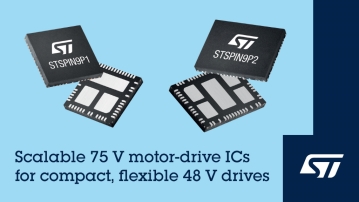
ST마이크로일렉트로닉스가 48V급 산업용 구동 시스템 설계에 맞춘 75V 모터 드라이브 IC ‘STSPIN9P’ 시리즈를 공개했다. 새 제품군은 하프 브리지와 풀 브리지 구조로 구성돼 모터 종류와 출력 조건에 따라 설계를 확장할 수 있도록 한 것이 특징이다. 전원 회로와 보호 기능, 전류 감지 회로를 칩에 통합해 시스템 구성을 단순화했으며, 최대 500W급 애플리케이션까지 대응하도록 설계됐다. 회사는 레퍼런스 디자인과 데모 보드도 함께 제공해 산업 자동화, 로보틱스, 펌프, 팬, 조명, 섬유 기계 등에서 개발과 평가를 지원할 계획이다.
2026.03.26by 배종인 기자

Nordic supports security updates for the entire lifecycle of IoT devices at a single fixed cost
Nordic Semiconductor, a global leader in low-power wireless connectivity solutions, has unveiled a single fixed-cost licensing model that delivers FOTA (Firmware Over-the-Air) and device management capabilities throughout the device lifecycle via nRF Cloud, and introduced a new firmware update solution to prepare for the enforcement of the European Union's Cyber Resilience Act (CRA).
2026.03.26by 배종인 기자

Practical Training in Low-Noise, Low-Power Circuit Design All in One Place… Training Fee Support
고감도 아날로그 회로와 센서 기반 시스템 설계 역량을 강화할 수 있는 ‘2026 고급 엔지니어 실무 마스터 클래스’가 오는 4월16일 서울 가산동 e4ds 컨퍼런스 센터에서 열린다. 이번 과정은 온라인이 아닌 오프라인 유료 실습 교육으로 진행되며, 현장 중심의 심화 학습을 원하는 엔지니어를 대상으로 한다. 이번 교육은 텍사스 인스트루먼트(Texas Instruments)가 교육비를 지원해 정가 25만원에서 10만원 할인 된 15만원에 참가할 수 있다.
2026.03.26by 배종인 기자











