



[Kim's e-Column] Artificial Intelligence vs. Human Go Match, Which Side Would You Bet On?
 Published2016.02.15 14:43
First Match Begins on March 9!
A Battle Between Human and Computer for Approximately 1.2 Billion Won in Prize Money
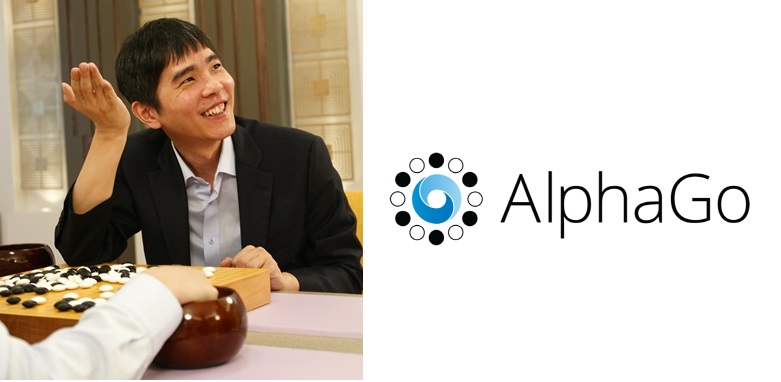
Last year, Google's 'AlphaGo' played against European Champion Fan Hui, 2-dan, and secured five consecutive victories. This caused a global sensation, though compared to IBM's 'Deep Blue' defeating a chess champion in 1997, it came at a slower pace. However, Go, with its 10 to the power of 170 possible moves, was expected to be difficult to win easily.
Google has already issued a challenge to South Korea's Lee Sedol, 9-dan, and plans to hold a total of five matches, identical to those with Fan Hui. The century's matchup, beginning next month, will take place on March 9, 10, 11, 13, and 15, and will be broadcast live on YouTube. The prize money is set at 1 million dollars (approximately 1.2 billion won), and Google has announced that if AlphaGo wins, it will donate the entire prize amount to charitable organizations.
As befits this century's matchup, predictions about the outcome are also heating up online. As opinions on the result of the human versus artificial intelligence battle vary, we examined diverse public discourse.
First, most netizens on domestic portal sites predict and hope for Lee Sedol's victory. A user ID 'goldwing' said, "This is funny. A computer beats a professional Go player? For Lee Sedol, it will be five losses," while 'euni****' left a comment saying, "I hope Master Lee wins."
Netizens Say "Lee Sedol Will Obviously Win, but It's Surprising and Frightening"
to "It May Be Difficult Now, but It Will Soon Surpass Human Ability"—There Are Also Minority Opinions
On the other hand, there were many comments expressing fear about the advancement of artificial intelligence. User ID 'dtb****' wrote, "This is a serious problem. We are entering an era where computers will dominate humans," while 'pens****' expressed surprise, saying, "I can't believe it has already reached this level. In 10 years, computers will be competing against each other for the world Go championship."
Though the recommendation counts were not high, considerable numbers of opinions from those who sensed AlphaGo's victory also appeared. User ID 'nani****' said, "AlphaGo is not merely a machine that calculates possible moves through algorithms," and explained, "It is an artificial intelligence that mimics the human cerebral cortex, using parallel processing devices to simulate the electrical action of neuronal synapses, acquiring in a day or two experiences that a human could never obtain in a lifetime." Continuing, "There is absolutely no possibility of Lee Sedol winning," the user stated. Additionally, 'gold****' warned Lee Sedol not to underestimate AlphaGo at all, saying, "Right now a professional Go player will win, but like chess, it will achieve a complete victory within five years."
With Go as a Powerful Nation—Korea, China, and Japan—Interest in Go Is Hotter Than Ever
Lee Sedol Victory Predicted, but Some Comments Say "We Don't Know the Result Yet"
Interest in this matchup appears to be significant not only in Korea but also in China and Japan. A user ID 'hxu2[Shanghai]' who left comments on the Chinese site Sina.com asserted, "Google's computer lacks the ability to think; no matter what, it will never be able to beat humans," while a contrasting opinion came from user ID '光慧[Chengdu, Sichuan],' who revealed they work in the artificial intelligence field, saying, "It's interesting how many people seem to think AlphaGo only played against Fan Hui. Those who make artificial intelligence conduct extremely extensive testing before launching an AI. This program has probably faced many skilled players on internet Go sites in Korea, China, and Japan," speculating that "the AI has probably undergone extensive training on the internet."
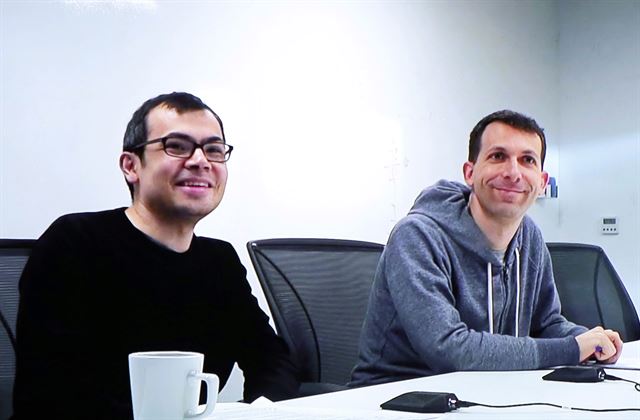
<Demis Hassabis, co-founder and chief executive officer (CEO) of Google DeepMind, a subsidiary of Google that developed 'AlphaGo,' held a press briefing on the 28th at Google Korea in Yeoksam-dong, Seoul, via video conference system from London, England. Provided by Google Korea>
In fact, DeepMind CEO and Google Vice President of Engineering Demis Hassabis stated during a video press conference on January 28, "'AlphaGo' has played approximately 1 million Go games so far. If we assume that a typical Go player plays about 1,000 games per year, AlphaGo has received training equivalent to nearly 1,000 years in a single session."
Other opinions included user ID 'WifitCSA' saying, "I hope the Go powerhouses of Korea, China, and Japan would conduct joint research for the advancement of artificial intelligence."
Japanese netizens also left their own comments, expressing anticipation for the match. User ID 'EHa1Oewk' on a Japanese 2-channel Go thread wrote, "Sedol will win decisively and people will say how great Sedol is, and that will be the end of it, but I'm looking forward to it," while user ID 'ZN3lpHC3' stated they saw the game record provided by Nature magazine, saying, "Even with Lee Sedol at 9-dan, it seems risky. I personally love Sedol's Go and hope he wins. But it does seem risky for Sedol."
Experts: 'This Time It Won't Defeat Lee Sedol'
However, 'It Is Much Superior to Existing Go Programs'
Experts are also making their own match predictions. On January 28, Professor Kim Dae-shik of KAIST stated to Hankyung.com, "Lee Sedol, 9-dan, will obviously win," adding, "Google probably doesn't think AlphaGo will win either." Additionally, he explained, "Rather, for Google, it would be advantageous for AlphaGo to lose and obtain data from the highest-level player."
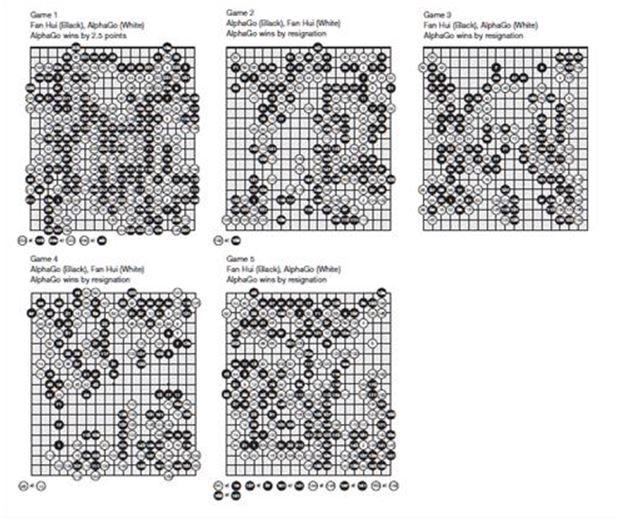
Game Records of AlphaGo versus Fan Hui <Provided by Nature & Google DeepMind>
Yang Jae-ho, Secretary General of the Korean Baduk Association, also predicted, "Lee Sedol, 9-dan, has never played against artificial intelligence computers, so he may win one or two games, but won't be able to win all matches," while Lee Ha-jin, Secretary General of the International Go Federation, stated, "After looking at the game records, I didn't get the feeling that a computer played," adding, "Existing Go programs place stones through calculation, so if a miscalculated value occurs, they place stones in strange locations, but AlphaGo doesn't seem to do that."
AlphaGo connects 1,202 CPUs to reduce the number of possible outcomes, inputs 30 million games worth of big data, and then AlphaGo itself conducts games to find the best moves and accumulate data. Additionally, it can recognize images, so in situations without data, it eliminates all possible scenarios related to that situation.
After 'Deep Blue' won in chess in 1997, it was speculated that Go would be more difficult to win because it had far more possible moves. Now, this may seem like a foolish thought. Indeed, only computers could handle calculations with such vast numbers of possibilities, could they not?
Now, only the readers' choice remains. Will it be a human victory or a machine victory? Or should the question be changed to 'Whose victory are you hoping for?'

5 Comments:
Related news

Artificial intelligence, virtual reality, sensing homes… consumers consider them the near future
According to this report, consumers expect to be able to interact with objects without looking at smartphone screens in the not-too-distant future through the use of artificial intelligence (AI). Approximately half of smartphone users anticipate that smartphones will become outdated devices within the next five years.
2015.12.22by 신윤오 기자

[it-Movie] The present and future of artificial intelligence as seen through movies. Is 'Jarvis' from 'Iron Man' our friend?
At CES 2016, IBM Chairman Virginia Rometty forecast that artificial intelligence (A.I.)—technology that thinks and makes judgments like humans—will lead the future of the IT industry. In her keynote address, she explained that "digital alone cannot create differentiated value in the massive Internet of Things market," and emphasized that "artificial intelligence technology capable of understanding and reasoning about data is necessary for data analysis that brings business insights." Artificial intelligence has always been a topic of interest, as seen in many films up to now. But why is it being discussed in this way this year?
2016.01.25by
Domestic push for autonomous vehicles on actual roads is in its infancy, while overseas markets are racing to fully apply artificial intelligence.
As the government has decided to implement autonomous vehicle road tests, attention is once again focusing on core autonomous driving technologies. The Ministry of Land, Infrastructure and Transport (Minister Kang Ho-in) announced its '2016 Business Plan' on the 28th of last month, selecting autonomous vehicle industry development as one of the seven new industries in land, infrastructure and transport. This development plan includes technology development support projects such as real-road testing of autonomous vehicles, designation of pilot operation zones, and construction of experimental cities.
2016.02.01by 신윤오 기자
[Interview] Outstanding Domestic AI Technology Needs Regulations Lifted and Ecosystem Established to Develop
After IBM's 'Deep Blue' defeated a human opponent in chess in 1997, there were predictions that Go would still be difficult. The reason was that Go has far more cases and is much more complex than chess. However, on January 19th, at 'e4ds,' the words of Kim Jin-hyung, Director of the Software Policy Research Institute, differed. "Artificial intelligence will win at Go before long. If we make up our minds and invest money intensively, we will win," he said. Starting with his words, "don't get excited and don't be cynical," we were able to hear candidly about the current state and future of artificial intelligence in our country.
2016.02.01by 명세환 기자
ST Microelectronics and NUS Establish Joint Research Center 'HELIX' for Edge AI
ST Microelectronics and the National University of Singapore have established the 'HELIX' joint research center aimed at implementing embedded AI in edge environments. Over a four-year period, the center will conduct research across the entire technology stack from algorithms to silicon, focusing on memory-centric architecture leveraging ST's 18nm FD-SOI technology and embedded PCM. The core objective is to implement intelligence directly in physical devices such as robots and drones while minimizing energy consumption.
2026.08.28by 배종인 기자












포인트 올리려고 별걸 다쓰네요..
당연히 알파고에
딥러닝
AI의 서막을 알리는 사건 입니다.
알파고