



Will Mass Production of Next-Generation Lithium-Air Batteries for Electric Vehicles Become Possible?
 Published2016.02.18 10:28
A research team led by Il-Doo Kim of the Department of Materials Science and Engineering at KAIST has developed a technology capable of mass-producing catalysts, a key component of lithium-air batteries.
Lithium-air batteries are attracting attention as a next-generation battery to replace lithium-ion batteries used in electric vehicles, and the source technology developed by the research team is expected to bring us one step closer to the commercialization of lithium-air batteries.
The research team secured a core technology to easily mass-produce double nanotube structures in which ruthenium oxide (RuO2) and manganese oxide (Mn2O3), two materials with excellent catalytic activity, are uniformly distributed, and succeeded in applying this to lithium-air batteries.
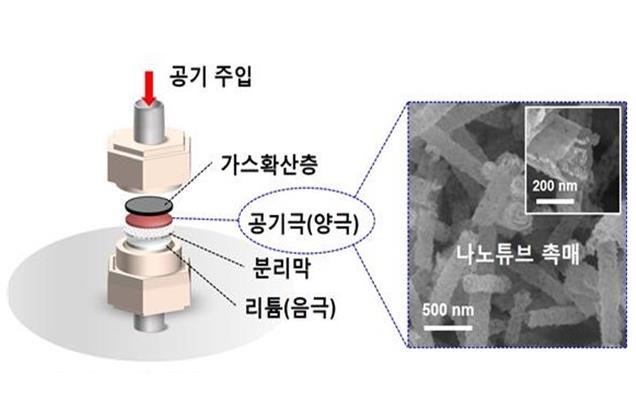
▲ Composition of a lithium-air battery using a nanotube catalyst
This study was published in the online edition of the international academic journal 'Nano Letters' on the 3rd. (Paper title: One-Dimensional RuO2/Mn2O3 Hollow Architectures as Efficient Bifunctional Catalysts for Lithium-Oxygen Batteries)
Lithium-air batteries are receiving great attention as energy storage devices for electric vehicles because they have a capacity more than 10 times higher than lithium-ion batteries and utilize oxygen from the atmosphere as fuel.
However, commercialization faced difficulties because the solid lithium oxide (Li2O2) generated during discharge did not decompose smoothly during the charging process, leading to reduced efficiency and lifespan characteristics of the battery. Therefore, the development of a catalyst that stably facilitates the formation and decomposition of lithium oxide within the carbon-based cathode was essential.
For lithium-air batteries, it is important to have catalysts that are lightweight, highly durable, and have a surface area that is maximized. Currently, materials capable of mass production at a commercial level and possessing excellent catalytic activity have not yet been developed.
To solve the above problem, the research team electrospun a polymer solution containing dissolved ruthenium and manganese precursors. This is a technology that synthesizes ruthenium-manganese precursor-based polymer composite fibers by drawing out threads from a polymer solution, much like a silkworm spinning silk.
Subsequently, when this fiber is heat-treated at high temperature, the polymer template acting as a mold burns away, and a double-tube structured catalyst is completed in which heterogeneous materials of ruthenium oxide and manganese oxide form a complex together.
The double tube developed by the research team consists of an outer tube with a diameter of 220 nanometers and an inner tube with a diameter of 80 nanometers, allowing the inner and outer walls to participate in the catalytic reaction simultaneously, and has the advantage of being lightweight due to the large amount of empty space.
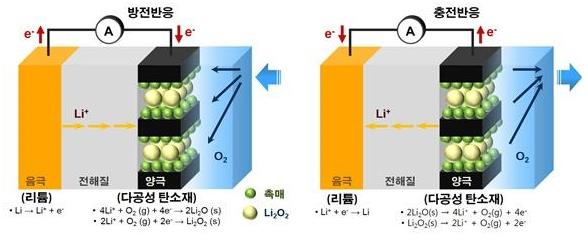
▲ Operating principle of a lithium-air battery
The research team achieved an effect where the difference in overvoltage during initial charging and discharging was reduced to within approximately 0.8V. When using conventional carbon materials, the overvoltage is approximately 2.0V or higher. In addition, stable lithium-air battery characteristics of over 100 cycles were confirmed under a capacity limit of 1000 mAh/g.
The reason the above technological improvement is possible is that the manganese oxide catalyst, which assists in the formation reaction of lithium oxide (oxygen reduction reaction), and the ruthenium oxide catalyst, which assists in the decomposition reaction (oxygen evolution reaction), are uniformly present at the nanoscale in the inner and outer tubes.
Electrospinning, a core technology of Professor Kim's research team, is a technique that produces nanofibers with diameters ranging from tens to hundreds of nanometers by stretching a solution containing polymers and metal precursors using electrical attraction. Because this technology enables the easy mass production of functional nanofibers, it is being actively used in applications such as water treatment filters, yellow dust masks, mask pack materials, and biofilters.
The research team announced that they have succeeded in designing a catalyst structure ideal for the charging and discharging of lithium-air batteries through a simple process that controls the temperature rise rate of two solvents with different boiling points. Professor Kim stated, "This technology features a very easy production process and is capable of mass production," adding, "The catalyst's excellent performance will contribute to accelerating the commercialization of lithium-air batteries, which are gaining attention as next-generation batteries."
This research, conducted in collaboration with Professor Sang-Wook Kim of the Department of Materials Science and Engineering, involved doctoral student Ki-Ro Yoon as the first author and was carried out with support from the Korea Carbon Capture and Storage R&D Center and Hyundai Motor Company.
관련뉴스
TI, 고속 충전 기술로 리튬이온 배터리 수명을 극대화하는 칩셋 2종 출시
2013.06.12by 명세환 기자
.png)
Maxim Integrated Supplies Lithium-Ion Battery Monitor ICs to Nissan Vehicles
2014.06.13by 명세환 기자
.jpg)

A single misaligned light means 'defect'… Vehicle interior lighting now guarded by semiconductors and software
Automotive interior lighting is moving beyond its role as 'auxiliary lighting.' As it becomes a core element of user experience (UX) that expresses brand identity through color and animation while reflecting driver preferences, the LED interior ambient lighting market is growing rapidly. In connection with this, we met in advance with Choi Young-jae, Research Director at Dabo Corporation, who will present a technical webinar session on "Intelligent LED Interior Lighting Solutions Illuminating Future Vehicles," to hear about market trends and changes in design requirements.
2026.08.28by 명세환 기자
TI, HEV·EV 트랙션 인버터용 다축 코어리스 전류 센서 TMCS2100-Q1 공개
Texas Instruments가 HEV·EV 트랙션 인버터용 다축 코어리스 홀 효과 전류 센서 TMCS2100-Q1을 공개했다. 수평·수직 자기장을 동시에 측정하는 다축 센싱 기술로 기존 단일 축 센서 대비 최대 20배 높은 정확도를 달성하며, 버스바 무개조 설계로 기계 설계 유연성을 확보했다. 800V 아키텍처 확산에 따른 고정확도 요구 충족과 소형화를 동시에 구현한다.
2026.08.27by 배종인 기자











