



SII Semiconductor Launches Automotive EDLC Protection IC
 Published2016.02.29 16:54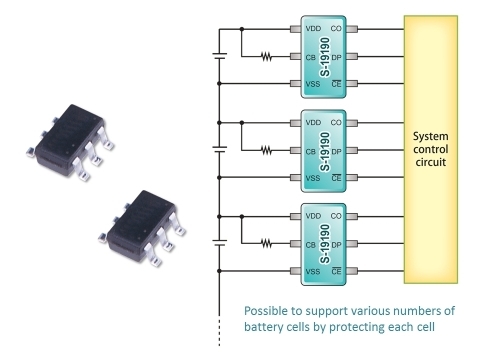
Suitable for EDLC cell balancing and overcharge protection
Applications include EDLC modules and rechargeable battery modules
SII Semiconductor Corporation, a semiconductor manufacturing subsidiary of Seiko Instruments Inc., announced the launch of the S-19190 series, an automotive electric double-layer capacitor (EDLC) integrated circuit (IC) with cell-balancing and overcharge protection functions. Typical applications for this series include EDLC modules and rechargeable battery modules.
The S-19190 series protects EDLC cells by detecting overcharge conditions in individual cells and evenly adjusting the cell voltage levels. While conventional EDLC protection ICs can only control a fixed number of cells, the S-19190 series is the industry's first product capable of flexibly protecting any number of cells required for the design. This flexible design approach enables the optimization of circuit configurations for various applications.
As the automotive industry expands the supply of electric vehicles (EVs) and fuel cell vehicles (FCVs), the adoption of EDLCs is surging. EDLCs not only improve design efficiency but also provide functions that enable flexible design by meeting the requirements of high-current designs, such as restarting the engine when idling, storing renewable energy during braking (by converting kinetic energy into stored electrical energy during deceleration), and managing sudden or immediate drops in system voltage. Each EDLC cell must be balanced to prevent performance degradation when multiple EDLCs are connected to increase voltage. The S-19190 series is small in size with an SOT-23-6 package (2.8 x 2.9 x 1.3 mm) and can control multiple EDLCs.
The S-19190 series is suitable for use in the growing automotive environment because it incorporates rigorous automotive manufacturing processes optimized by SII Semiconductor Corporation through years of experience. The cell balancing voltage can be selected in 5 mV increments from 2.0 V to 4.6 V, and the overcurrent detection voltage can be selected in 5 mV increments from 2.0 V to 4.6 V; the current consumes up to 2.0 μA at a temperature of +25°C. Additionally, AEC-Q100 certification is currently being pursued, and PPAP (Production Part Approval Process) documents are available upon request.

관련뉴스
Toshiba Launches MOSFETs for Automotive Applications
도시바가 오늘 자동차 애플리케이션용 40V N-ch 전력 MOSFET(40V N-ch Power MOSFET)을 비롯해 DC-DC 컨버터, EPS(electric power steering)용 고용량 모터드라이버, 반도체 릴레이를 출시했다고 발표했다. MOSFET 라인업에 최근 추가된 “TKR74F04PB"는 오늘부터 출하된다.
2016.02.01by 명세환 기자

Automotive Industry Adopts GSMA Embedded SIM Standard for 'Connected Car' Market
The GSMA announced today that leading companies in the automotive and transportation industries have agreed to support the GSMA embedded SIM specification to accelerate growth in the connected car market. Global brands supporting the interoperable specification include General Motors, Jaguar Land Rover, Renault Nissan, Scania, and Volvo Cars, and the specification enables automakers to remotely provision internet connectivity to vehicles in conjunction with their chosen mobile operators.
2016.02.11by

Experts Put Their Heads Together to Discover Automotive Convergence Business Models
The Ministry of Industry announced in December a "transition to convergence-focused automotive industry policy" to bring together the capabilities of domestic related companies in response to paradigm shifts in the future automotive market, and launched the Automotive Convergence Alliance, a corporate consortium related to the future automotive industry. The Automotive Convergence Alliance was initially established with six companies including Hyundai Motor, LG Electronics, KT, Naver, Hanwha Advanced Materials, and Obigo, but has expanded to approximately 50 companies with strong response from companies seeking to enter the future automotive market.
2016.02.18by 신윤오 기자

A single misaligned light means 'defect'… Vehicle interior lighting now guarded by semiconductors and software
자동차 실내조명이 '보조 조명'의 자리를 벗어나고 있다. 색상과 애니메이션으로 브랜드 아이덴티티를 드러내고 운전자 취향을 담아내는 사용자 경험(UX)의 핵심 요소로 올라서면서, LED 실내 앰비언트 시장도 빠르게 커지는 중이다. 이에 관하여 '미래 자동차를 밝히는 지능형 LED 실내 조명 솔루션' 이라는 내용으로 기술 웨비나 세션을 발표하는 최영재 다보코퍼레이션 연구위원을 앞서 만나, 시장의 온도와 설계 요구의 변화를 들었다.
2026.08.28by 명세환 기자
TI, HEV·EV 트랙션 인버터용 다축 코어리스 전류 센서 TMCS2100-Q1 공개
Texas Instruments가 HEV·EV 트랙션 인버터용 다축 코어리스 홀 효과 전류 센서 TMCS2100-Q1을 공개했다. 수평·수직 자기장을 동시에 측정하는 다축 센싱 기술로 기존 단일 축 센서 대비 최대 20배 높은 정확도를 달성하며, 버스바 무개조 설계로 기계 설계 유연성을 확보했다. 800V 아키텍처 확산에 따른 고정확도 요구 충족과 소형화를 동시에 구현한다.
2026.08.27by 배종인 기자











