



Is ARTIK to be Samsung's successful IoT platform?
 Published2016.03.21 06:27
Open platform suggested to encompass module, cloud and ecosystem
With enhanced specifications, validation and convenience expected, the key is future expansion of IoT ecosystem
Samsung Electronics, which officially announced ARTIK, its IoT platform, last month, held a product demonstration for engineers from small and medium companies on March 3.
ARTIK is a micro IoT module composed of processors (APs), memories, communications, sensors, and other components. Integrated into the single module are software/drivers, storage, security solution, development board and cloud features. Developers can use ARTIK to quickly and easily commercialize IoT devices. Myung-Koo Kang, Samsung's Senior Executive, said that "ARTIK is Samsung's very first IoT platform which is suitable for developers who have ideas but find it difficult to implement them."
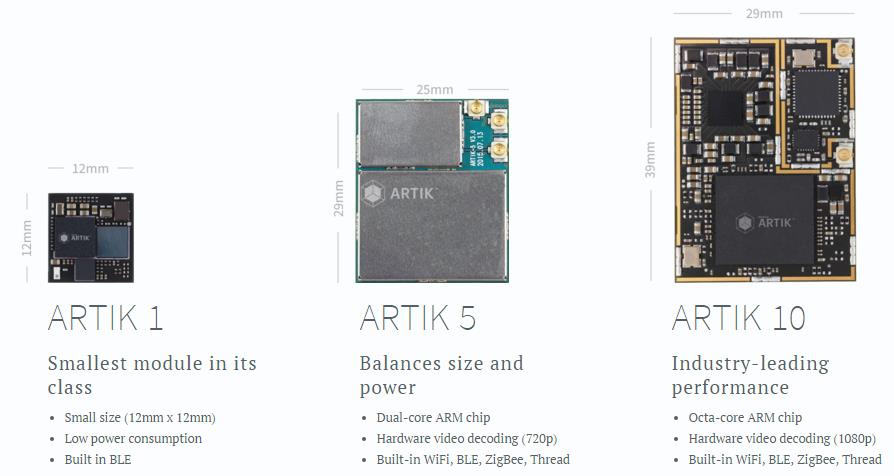
▲ Main specifications of ARTIK1, ARTIK5 and ARTIK10.
ARTIK aims to achieve time-to-market through one-stop shopping. Comprising ARTIK module, ARTIK cloud and ARTIK ecosystem, the ARTIK platform definitely reduces time to market for commercialized products, Myung-Koo Kang emphasized.
Taking a modular approach, ARTIK will be offered initially as ARTIK 1, ARTIK 5 and ARTIK 10 according to application. Dae-Hwan Kim, Samsung's Principal Engineer, pointed out that "ARTIK hardware differentiates itself with stability of full line-up modules, open platform and expanded ecosystem."
ARTIK also supports various networks including Ethernet, WiFi, ZigBee, Bluetooth, BLE, Z-Wave, cellular, and others, as well as TCP/IP which provides every device with its own unique address. Regarding network security, it supports OpenSSL using private keys existing only in the security element.
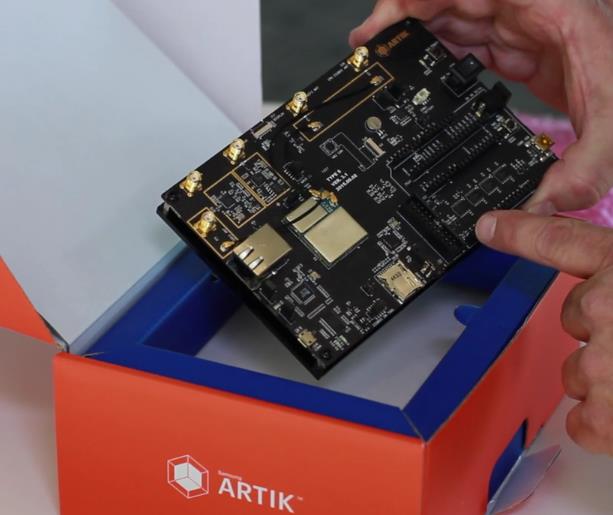
▲ARTIK product out of box (Source: home page)
Cloud service is also a differentiating factor offered by ARTIK. Min-Soo Kim, Samsung's Principal Engineer, explained that "while general cloud service uses separate cloud and app by device, ARTIK cloud is a single data bank accommodating all devices and clouds through data-oriented service."
He said that "we plan to gradually expand it regarding its compatibility with various OSes, and we are also working on Arduino expansion mode to enable it by June."
Though ARTIK is currently focusing on indoor products for smart home or building applications, it will be extended to industrial applications in the future, according to Dae-Hwan Kim. ARTIK unifies IoT module, cloud and ecosystem and lessens the difficult burden of validation for developers. What matters now is just how fast its ecosystem will be established. Samsung plans to continue increasing its portfolio by addressing shortcomings of the released version through June.
Related news

Road to wearable's popularity plagued with hurdles
It is pointed out that, for wearable market to overcome 'Chasm' and succeed in popularization, solving compatibility issue and establishment of standardization is urgently required. Viewing that "smart wearable market still has many unsolved issues and discussion of its standardization is just at its beginning stage," Dr. Chun, Jong-Hong of ETRI said that "aggressive standardization strategy and response is demanded and we should approach the standardization from the user's point of view."
2016.03.10by

[Interview] Cypress: “Differentiation through complementary synergy of memory and MCU
Cypress, renowned for its SRAM and PSoC processor lineups, was merged with Spansion, which is strong in memories and automotive MCUs, in early 2015. We met Hyung-Joon Kim and Hwan-Kook Cho, managers of Cypress Semiconductor, to glimpse into the future of the company's MCUs.
2016.03.21by
Ecolab and K-water Discuss Innovation Collaboration in Advanced Industry Water Management
Ecolab and the Korea Water Resources Corporation jointly discussed cooperation directions for maximizing water use efficiency in advanced industries such as semiconductors and data centers and establishing sustainable water circulation. The two companies agreed to gradually develop a long-term cooperation model that combines water resource infrastructure and water management technology to promote water efficiency optimization, water reuse, and carbon reduction.
2026.08.28by 명세환 기자
H.Energy Obtains Green Technology Certification…SolarOnCare Operating at 99.82% Uptime
H.Energy has obtained green technology certification from the Small and Medium Business Administration for solar power generation forecasting and I-V curve anomaly diagnosis technology. The AI-based asset management platform SolarOnCare is deployed across more than 3,000 power plants nationwide, achieving a system uptime of 99.82% and a 3.7% improvement in power generation performance. Through real-time data analysis, it protects power generation revenue by detecting and managing minor losses such as module degradation and partial shading early on.
2026.08.25by 명세환 기자
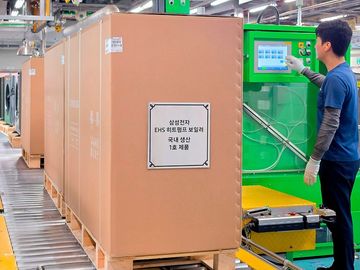
Samsung Electronics Establishes Domestic Production of EHS Heat Pump Boilers in Gwangju…Annual Production Capacity of 100,000 Units
Samsung Electronics is establishing a domestic production system for EHS heat pump boilers at its Gwangju business site in line with the promotion of heating electrification. The company will begin trial production this month on a dedicated line spanning 2,132㎡ and is scheduled to commence full-scale mass production by the end of September, with annual production capacity exceeding 100,000 units. This product generates approximately 5 times the heat relative to input power, recording a seasonal performance coefficient of 4.9, and offers higher energy efficiency compared to fossil fuel-based boilers while reducing carbon emissions.
2026.08.24by 명세환 기자











