

.png)

Development of 10 Key Materials Projects Shows Results in Aiming to Become One of the World's Top 4 Materials Powerhouses
 Published2016.04.08 17:36
The Ministry of Trade, Industry and Energy, under the auspices of the Korea Institute for Industrial Technology Evaluation and Management, held the 'World Premier Materials (WPM) Phase 2 Project Achievement Exhibition' at COEX in Samseong-dong, Seoul, on the 7th and 8th, with approximately 300 materials experts in attendance.
The World-Class Materials Development (WPM) project is a large-scale technology development initiative that has been underway since 2010 with the goal of developing 10 key materials to become one of the world's top four materials powerhouses. It involves the participation of over 200 companies and research institutes centered around 10 project groups, including magnesium, secondary batteries, and silicon carbide (SiC) semiconductors.
Considering the long duration of material development, this project will proceed in stages, including Stage 1 core technology development ('10~'12), Stage 2 applied technology development ('13~'15), and Stage 3 commercialization ('16~'18), and will begin full-scale commercialization starting this year.
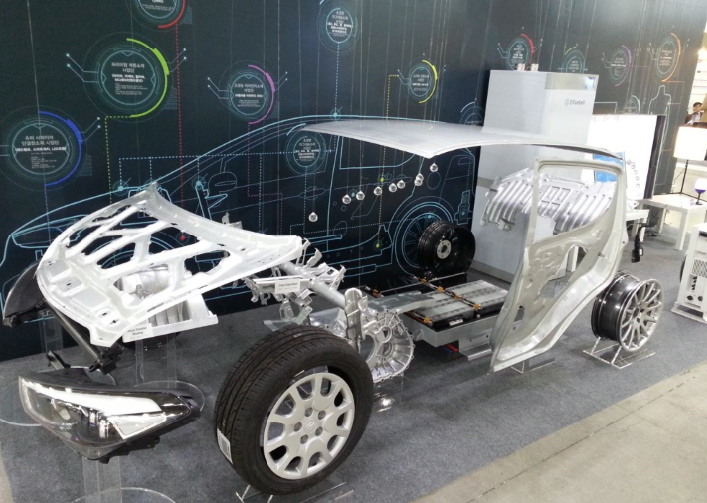
▲ The 'Ultra-light Magnesium Material' project team exhibited automotive magnesium sheet metal that weighs only 25% of steel but is stronger than steel.
According to a survey by the Korea Institute for Industrial Technology Evaluation and Management, 1,776 patent applications and 415 patent registrations have been achieved so far through the World-Class Material Development (WPM) project.It was expanded and created 5,120 new jobs.
In addition, despite being in the applied technology development stage, early commercialization generated 590 billion won in sales and 3.6 trillion won in private investment by February of this year. If the third phase of the project proceeds without setbacks, the World-Class Materials (WPM) project is expected to contribute to job creation and the expansion of private investment in the field of new materials.
In his congratulatory remarks, Park Won-ju, Director General of Industrial Policy, stated, "In response to the industrial trends of intelligence, mobility, and energy efficiency, the World-Class Material Development (WPM) project is expected to enhance the competitiveness of our industries by providing optimal material solutions." He added, "The government will step forward to resolve investment obstacles and eliminate regulations, so I hope companies will also strive for active technology development, expanded investment, and job creation."
Each project team showcased the latest materials incorporating cutting-edge technology at the exhibition.
The 'Ultra-light Magnesium Material' project group exhibited automotive magnesium sheet metal that weighs only 25% of steel but is stronger than steel. At the Geneva Motor Show in March 2015, POSCO’s ultra-light magnesium sheet metal was installed on the roof of the latest Porsche '911 GT3 RS', and mass production is currently underway.
The 'Premium Ketone' consortium showcased automotive wheel covers and engine covers made of polyketone, which has an impact strength more than 230% superior to that of nylon, a conventional plastic material. This is an eco-friendly new polymer material manufactured using carbon monoxide, a major culprit of air pollution, and Korea has succeeded in mass-producing it for the first time in the world.
Display substrate material applied to Samsung SUHD Quantum Dot TV
The 'Flexible Display Substrate Material' project group exhibited display substrate materials that can be bent or curved, as well as barrier films that block oxygen and moisture. An actual application example is the Samsung SUHD QD (Quantum Dot) TV 50/55/60-inch product.
In addition, the nanocarbon composite materials business has developed multifunctional (ultralight, electromagnetic shielding, and high heat dissipation) composite materials by combining nanocarbon materials with polymers or metals, and the intelligent membrane materials business is developing membrane materials applicable to eco-friendly water treatment, hydrogen fuel cells, and gas separation.
The high-performance secondary battery materials business focuses on the development and commercialization of positive and negative electrode materials for lithium-ion secondary batteries used in automobiles and energy storage, while the biomedical materials business aims to develop biomedical materials such as non-natural amino acid fusion materials, protein materials for healing tissue diseases, and implant materials.
The ultra-high purity SiC material business is developing materials for next-generation power semiconductors, while the super sapphire single crystal material business is developing large-diameter sapphire single crystal ingots and substrates for LEDs, and ingots and windows for front protection windows for IT devices.
관련뉴스
Trade Surplus in Materials and Components for Two Consecutive Years; Competitiveness of the Materials Industry Remains a Challenge
Last year, materials and components exports surpassed 50% of total exports for the first time in history, and achieved trade surpluses exceeding $100 billion for two consecutive years, demonstrating that they have served as a solid foundation for our economy despite challenging conditions such as low oil prices, weak yen, and sluggish emerging market economies.
2016.01.11by 신윤오 기자
Development of ITO alternative materials for smartphone touch panels is gaining momentum.
The Korea Intellectual Property Office (Commissioner Choi Dong-gyou) announced that patent applications related to technology using ITO alternative materials as materials for transparent electrode films show a high average annual growth rate of 26.4% over the past five years, increasing from 37 applications in 2010 to 92 applications in 2014.
2016.01.11by 신윤오 기자
해외 수요 발굴부터 금융 및 마케팅까지…소재, 부품기업 종합 지원
산업통상자원부(주형환 장관)는 "2016년도 글로벌 파트너링사업(Global Partnering 사업, 이하 GP사업)" 시행계획을 확정하고 중소 소재 부품기업의 해외시장 진출지원에 시작했다.GP사업은 코트라 해외 무역관을 통해 외국 유수의 기업들의 수요를 발굴해 우리 소재, 부품기업을 소개하고, 해외기업의 요구수준에 부합할 수 있도록 기술력 향상과 품질관리 등을 지원하는 사업으로 2010년부터 시행하고 있다.
2016.02.11by 신윤오 기자

Intel Unveils Next-Generation 'Core Ultra Series 3' and vPro Platform for Enterprise PCs
Intel has officially unveiled the "Intel Core Ultra Series 3" for next-generation enterprise PCs and the latest vPro platform, addressing a wide range of demands from enterprise notebooks to high-performance workstations.
2026.03.26by 배종인 기자

ROHM Launches ESD Protection Diode Compatible with High-Speed Interfaces of 10Gbps or Higher
반도체 전문 기업 로옴(ROHM)이 10Gbps를 넘어서는 차세대 고속 데이터 통신 환경에 대응할 수 있는 ESD(정전기 방전) 보호 다이오드 ‘RESDxVx 시리즈’를 개발하며, 고속 인터페이스에서 요구되는 신호 품질 유지와 IC 보호 성능을 동시에 끌어올렸다.
2026.03.26by 배종인 기자











