



Announcement of Low-Power Receiver for Ultrasonic System Design Innovation
 Published2011.01.13 20:17
InMedica, the medical research arm of market research firm IMS Research, predicts that global ultrasound sales will increase from $4.9 billion in 2009 to over $6 billion in 2010. In particular, as the need for more sophisticated ultrasound equipment to provide accurate diagnostic images is increasing in hospitals, medical facilities, and emergency medical institutions, there is a growing need for small, fast, and low-power ultrasound equipment.
Accordingly, Analog Devices ( www.analog.com ), a global specialist in signal processing data converters and high-performance semiconductors and a leader in the global data converter market, announced two fourth-generation 8-channel ultrasound receivers (AD9278 and AD9279) that reduce system size, complexity, and power consumption in high-end, mid-range, and portable ultrasound systems. The award-winning AD9728 and AD97929 are industry-leading, low-power, compact 8-channel ultrasound receivers that not only feature ADI's industry-leading data conversion technology but also integrate improved low-noise TGC (Time Gain Control) mode performance, Continuous Wave (CW) Doppler processing capabilities, and a high dynamic range I/Q demodulator. Based on an industry-leading Signal-to-Noise Ratio (SNR) of up to 67 dB, ADI's new 8-channel ultrasound receivers can improve the sensitivity of diagnostic ultrasound systems while reducing board space by up to 40%.
Patrick O'Doherty, Vice President of Analog Devices Healthcare Group, stated, “Ultrasound equipment designers must be able to continuously balance evolving system requirements to improve image quality and power efficiency,” adding, “With ADI’s newly released AD9278 and AD9279 8-channel ultrasound receivers, designers will be able to more easily resolve various design issues that arise during the system improvement process.”
The AD9278 8-channel ultrasonic receiver is designed for portable ultrasonic systems, while the AD9279 8-channel ultrasonic receiver is suitable for high-end and mid-range systems. These devices are mutually pin- and package-compatible and are designed to utilize a common PCB (printed circuit board) layout applicable to various ultrasonic platforms, which can reduce development time and costs.
Meanwhile, Analog Devices' 8-channel ultrasound receiver family includes the AD9271, which was the industry's first to integrate a complete 8-channel ultrasound receiver onto a single chip in April 2007 and is currently widely used in ultrasound equipment worldwide, as well as the AD9272 for high-range and mid-range cart-based ultrasound equipment, the AD9273 for portable ultrasound systems, and the AD9276 and AD9277, which implement high-quality CW Doppler processing capabilities.
Key Specifications and Benefits of AD9728 and AD9279 8-Channel Ultrasonic Receivers
ADI’s AD9278 and AD9279 8-channel ultrasonic receivers are based on an analog-to-digital converter (ADC) with a variable gain range of 54 dB, a fully differential signal path, an active input impedance stage, a gain of up to 52 dB, and a maximum sampling rate of 80 MSPS. In addition, each IC is optimized for low-power operation and dynamic performance for package-size-sensitive applications. When operating in CW mode, the AD9278 consumes an extremely low power of 25 mW per channel, while the AD9279 consumes a low power of 50 mW per channel. In TGC mode, the AD9278 consumes only 88 mW per channel at a sampling rate of 40 MSPS, and the AD9279 consumes only 139 mW per channel at a sampling rate of 40 MSP. For higher-specification systems, the AD9279 provides an input referred noise of 0.67 nV/√Hz and a configurable low-noise amplifier (LNA). Further details can be found in the AD9278 or AD9279 datasheets, and samples are currently available for order.

Additional information on AD9728 and AD9279 8-channel ultrasound receivers
· 8 providing the entire TGC path contained in a 144-ball, 10 mm x 10 mm BGA (Ball Grid Array) package
Channel, ADC, and I/Q demodulator
· High dynamic range integrated I/Q demodulator with programmable phase rotation
· Data clock output supporting a maximum operating speed of 480 MHz and DDR (Double Data Rate) operation
· Required for all video modes through SPI (Serial Port Interface) control with diverse and flexible specifications
Optimize specific power, noise, distortion, and gain
· ADC front end

관련뉴스

Intel Unveils Next-Generation 'Core Ultra Series 3' and vPro Platform for Enterprise PCs
인텔이 차세대 기업용 PC를 위한 ‘인텔 코어 Ultra 시리즈 3’와 최신 vPro 플랫폼을 공식 발표하며, 기업용 노트북부터 고성능 워크스테이션까지 폭넓은 수요 충족에 나섰다.
2026.03.26by 배종인 기자

ROHM Launches ESD Protection Diode Compatible with High-Speed Interfaces of 10Gbps or Higher
반도체 전문 기업 로옴(ROHM)이 10Gbps를 넘어서는 차세대 고속 데이터 통신 환경에 대응할 수 있는 ESD(정전기 방전) 보호 다이오드 ‘RESDxVx 시리즈’를 개발하며, 고속 인터페이스에서 요구되는 신호 품질 유지와 IC 보호 성능을 동시에 끌어올렸다.
2026.03.26by 배종인 기자
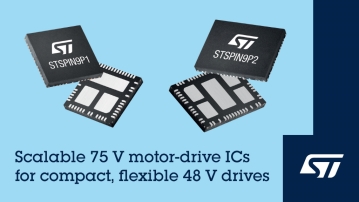
ST Launches 75V Drive IC Targeting 48V Industrial Motor Driving
ST마이크로일렉트로닉스가 48V급 산업용 구동 시스템 설계에 맞춘 75V 모터 드라이브 IC ‘STSPIN9P’ 시리즈를 공개했다. 새 제품군은 하프 브리지와 풀 브리지 구조로 구성돼 모터 종류와 출력 조건에 따라 설계를 확장할 수 있도록 한 것이 특징이다. 전원 회로와 보호 기능, 전류 감지 회로를 칩에 통합해 시스템 구성을 단순화했으며, 최대 500W급 애플리케이션까지 대응하도록 설계됐다. 회사는 레퍼런스 디자인과 데모 보드도 함께 제공해 산업 자동화, 로보틱스, 펌프, 팬, 조명, 섬유 기계 등에서 개발과 평가를 지원할 계획이다.
2026.03.26by 배종인 기자

Nordic supports security updates for the entire lifecycle of IoT devices at a single fixed cost
Nordic Semiconductor, a global leader in low-power wireless connectivity solutions, has unveiled a single fixed-cost licensing model that delivers FOTA (Firmware Over-the-Air) and device management capabilities throughout the device lifecycle via nRF Cloud, and introduced a new firmware update solution to prepare for the enforcement of the European Union's Cyber Resilience Act (CRA).
2026.03.26by 배종인 기자

Practical Training in Low-Noise, Low-Power Circuit Design All in One Place… Training Fee Support
고감도 아날로그 회로와 센서 기반 시스템 설계 역량을 강화할 수 있는 ‘2026 고급 엔지니어 실무 마스터 클래스’가 오는 4월16일 서울 가산동 e4ds 컨퍼런스 센터에서 열린다. 이번 과정은 온라인이 아닌 오프라인 유료 실습 교육으로 진행되며, 현장 중심의 심화 학습을 원하는 엔지니어를 대상으로 한다. 이번 교육은 텍사스 인스트루먼트(Texas Instruments)가 교육비를 지원해 정가 25만원에서 10만원 할인 된 15만원에 참가할 수 있다.
2026.03.26by 배종인 기자











