

.png)

Optical transceiver module with low-cost implementation and easy design!
 Published2016.04.26 12:36
Maxim SFP28 Transceiver IC Supports Mass Production of SFP28 Modules for Data Centers
The increasing demand for smart devices due to the spread of the Internet of Things (IoT) will inevitably lead to an increase in mobile data traffic.
Cisco projected that mobile data traffic would increase tenfold to 292 EB (exabytes) by 2019. This is due to the increase in mobile users, faster mobile connection frequency and network speeds, and the explosive growth in video usage in mobile environments.
Accordingly, data center optical links have been coping with the surge in traffic using 100G-class ultra-high-speed optical network technology. This is also the reason why the commercialization of 100Gb/s optical transceivers is progressing rapidly now that the 100G Ethernet technology standard has been completed.
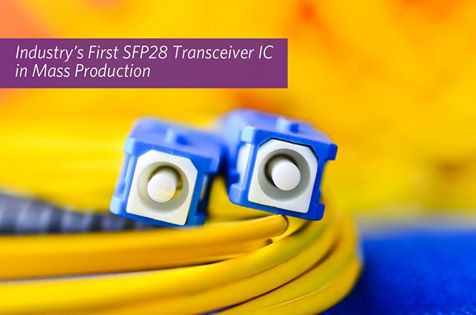
Unlike existing 10Gbps and 40Gbps optical transceivers, 100Gbps optical transceivers require the interface, operation, and control of ultra-high-speed optical and electrical signals. Currently commercialized or scheduled to be commercialized, 100G-class long-distance optical transceivers (OIF-MSA-100GLH) and 100G-class short-distance Ethernet optical transceivers (CFP series, CXP, CPAK, QSFP28) are solutions that address these issues.
Representative products of 100G-class short-distance Ethernet optical transceivers, such as the CFP series and SFP28, are rapidly evolving while improving size and power consumption. In particular, the SFP28 has significantly reduced volume and pin count compared to the CFP, and design has been simplified through operation and control via I2C.
Recently, the industry's first SFP28 transceiver IC supporting transistor outline (TO)-can, which Maxim (www.maximintegrated.co.kr) announced it would mass-produce, is a case that has achieved notable results in terms of the production cost of optical transceiver modules.
The Maxim SFP28 transceiver IC focuses on three problems that designers may encounter when entering mass production: low-cost optical implementation, shortened time-to-market, and reduced production costs.
First, the Maxim SFP28 transceiver supports advanced Digital Eye Tuning capabilities that utilize inexpensive TO-CAN-based optics. The SFP28 module can be designed simply in the same way as an SFP+ module by using TO-CAN optics, a single transceiver IC, and a controller IC.
In addition, module manufacturers for data center and wireless fronthaul applications do not need to install drivers within the Transmit Optical Subassembly (TOSA) by applying this IC. In addition, it can protect sensitive lasers from heat and simplify the production process to increase profitability.
Finally, SFP28 optical modules must support high performance, low power consumption, and a wide temperature operating range at a lower price than existing SFP+ modules, and Maxim's 28.1Gbps low-power transceiver IC is equipped with a CDR (clock and data recovery circuit) and a laser driver in the transmit path, and a high-sensitivity limiting amplifier and a CDR in the receive path.
With the expansion of smart devices in the future, the 100Gb/s optical transceiver market is expected to grow, leading to increased interest in optical transceivers. Consequently, enhanced system integration and low power consumption will emerge as key operational directions for data centers. Furthermore, if considering mass production with production cost reduction in mind, solutions that simplify design for low-cost optical implementation should be prioritized.

관련뉴스

5 Ways to Choose an Audio Codec You Won't Regret
?맥심 저전력 스테레오 오디오 코덱으로 살펴본 오디오 코덱 선택 Tip
2015.10.20by 명세환 기자
Miniaturization and low power consumption are key elements of wearable and IoT devices, and while everyone knows this, Maxim is undoubtedly the leader in implementing them!
Introduces power management chip (PMIC) suitable for wearables and IoT Compact design and low-power implementation through Maxim's specialized integrated technology
2016.01.20by 명세환 기자
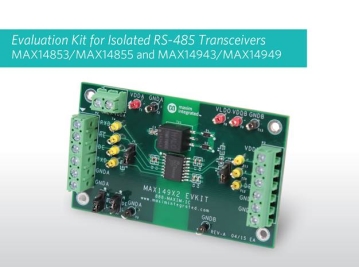
Maxim simplifies design of isolated RS-485 transceiver family
Maxim announced that it has simplified power and data isolation design by integrating a transformer driver and LDO (Low Drop Out) regulator into its isolated RS-485 transceiver product family.
2016.03.02by 명세환 기자
Intel Unveils Next-Generation 'Core Ultra Series 3' and vPro Platform for Enterprise PCs
Intel has officially unveiled the "Intel Core Ultra Series 3" for next-generation enterprise PCs and the latest vPro platform, addressing a wide range of demands from enterprise notebooks to high-performance workstations.
2026.03.26by 배종인 기자
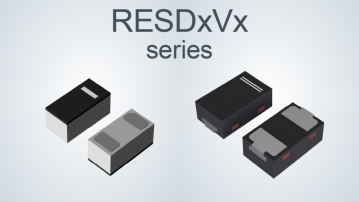
ROHM Launches ESD Protection Diode Compatible with High-Speed Interfaces of 10Gbps or Higher
반도체 전문 기업 로옴(ROHM)이 10Gbps를 넘어서는 차세대 고속 데이터 통신 환경에 대응할 수 있는 ESD(정전기 방전) 보호 다이오드 ‘RESDxVx 시리즈’를 개발하며, 고속 인터페이스에서 요구되는 신호 품질 유지와 IC 보호 성능을 동시에 끌어올렸다.
2026.03.26by 배종인 기자











