

.png)

The commercialization of autonomous driving will evolve from a product-centric to a service market.
 Published2016.04.29 17:58
The prediction that approximately 80% of all OEMs will complete their automation technology roadmaps by 2016 is expected to provide strong support to the autonomous driving market.
These trends will pave the way for new business models in the automotive ecosystem. Once OEMs have established market-ready test environments and developed improved sensing capabilities, they will shift their focus to collecting and validating the increasing volume of data.
According to the 'Strategic Outlook of Global Autonomous Driving Market in 2016' published by Frost & Sullivan Korea, it is predicted that one in seven cars will have advanced autonomous functions by 2030.
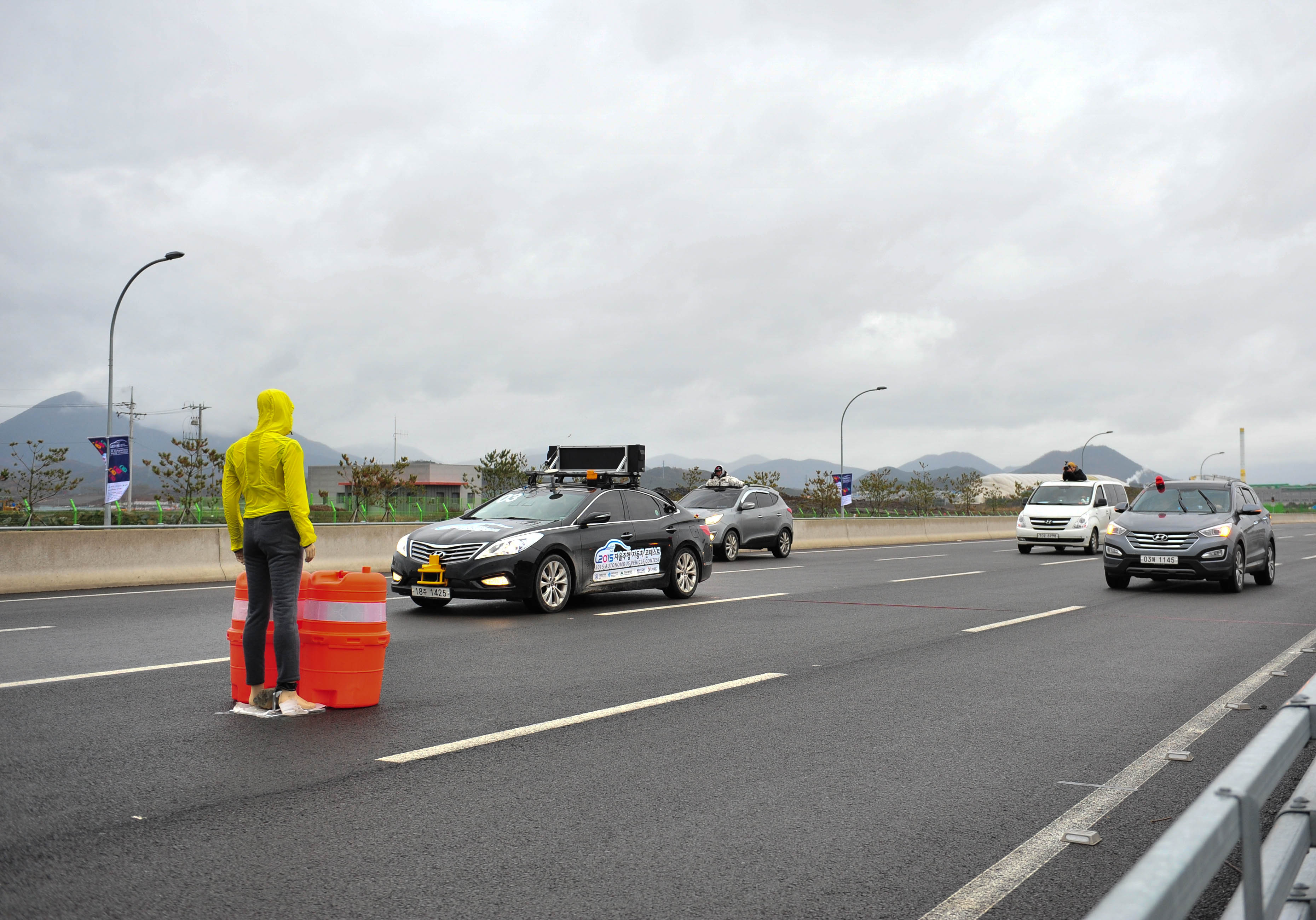
▲ A self-driving car contest held at the Intelligent Vehicle Parts Testing Center last year (Ministry of Trade, Industry and Energy)
Interestingly, the factors that could strongly push for autonomous driving do not seem to include reducing traffic fatalities and improving the commuter experience. OEMs should focus on building a trusted ecosystem by forming best-in-class partnerships with diverse organizations that can deliver value at multiple levels.
"The autonomous driving market is actively adopting and investing in innovative technologies such as artificial intelligence and deep learning," said Arunprasad Nandakumar, Research Analyst for Frost & Sullivan's Mobility Industry Research practice. "In fact, powerful AI and deep learning are seen as essential elements for designing autonomous driving as a sustainable business model in the long term."
However, there are several technical challenges in creating an ideal sensing suite. While companies are striving to provide vision capabilities across a wide range of driving conditions at an affordable price, the software and validation capabilities currently lack the capabilities to fully manage complex autonomous driving environments. This necessitates a favorable regulatory framework.
Industry stakeholders must adopt a unified approach to developing a regulatory framework. This is crucial to ensuring that new regulations support the growth of the global autonomous driving market, not just regional ones. Without global standards and regulations, interoperability will be limited, negatively impacting the market.
Researcher Nandakumar stated, "Companies that build ecosystems through strong partnerships with other organizations, rather than through a single entity, will generally succeed in the autonomous driving market. We expect these companies to introduce powerful products and services that address the needs of drivers in the future."
관련뉴스
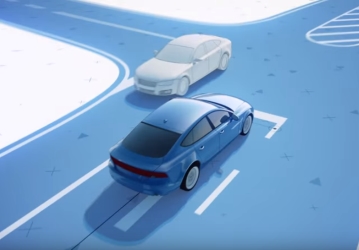
Can self-driving cars operate without precise maps, V2X, or road infrastructure?
As autonomous vehicle development accelerates both domestically and internationally, interest in vehicle-to-infrastructure wireless communication linking roads and vehicles—that is, V2X (vehicle-to-x)—and high-precision maps for autonomous driving is rising. Autonomous vehicles, as commonly understood, refer to human-friendly automobiles capable of safe autonomous operation by minimizing driver intervention through self-recognition of surrounding environments, risk assessment, and route planning. Accordingly, when autonomous vehicles are classified in stages, they are divided from Level 0 (driver perceives, controls, and is responsible) to Level 4 (vehicle perceives and controls, driver availability not required). True autonomous vehicles are those of Level 2 (driver perceives, vehicle controls) or higher.
2016.03.28by 신윤오 기자

[Reporter's Notebook] The Autonomous Vehicle Industry: How to Avoid Going Backwards
For autonomous vehicles to be realized, core enabling technologies must be supported. Advanced technologies are required, including LIDAR systems, GPS technology, IMU (inertial measurement unit technology for measuring speed and direction), HVI (optimal UI for drivers), smart actuator technology, V2X communication technology, and LDM (digital map technology). In other words, all technologies must be mobilized—from core components to road infrastructure and mapping technologies.
2016.04.04by 신윤오 기자
The autonomous vehicle industry is actively pursuing regulatory improvements and the creation of a convergence ecosystem.
What was emphasized to Minister Ju Hyung-hwan of the Ministry of Industry, Trade and Resource at an autonomous vehicle industry roundtable held on the 29th at the Intelligent Automotive Parts Promotion Institute. Participants in this meeting included complete vehicle manufacturers, parts suppliers, information technology (IT) companies, research institutes and other autonomous vehicle-related companies, experts and professionals who discussed industry challenges and requests, and deliberated on development strategies to foster autonomous vehicles as a core new industry.
2016.04.29by 신윤오 기자
A single misaligned light means 'defect'… Vehicle interior lighting now guarded by semiconductors and software
Automotive interior lighting is moving beyond its role as 'auxiliary lighting.' As it becomes a core element of user experience (UX) that expresses brand identity through color and animation while reflecting driver preferences, the LED interior ambient lighting market is growing rapidly. In connection with this, we met in advance with Choi Young-jae, Research Director at Dabo Corporation, who will present a technical webinar session on "Intelligent LED Interior Lighting Solutions Illuminating Future Vehicles," to hear about market trends and changes in design requirements.
2026.08.28by 명세환 기자
TI, HEV·EV 트랙션 인버터용 다축 코어리스 전류 센서 TMCS2100-Q1 공개
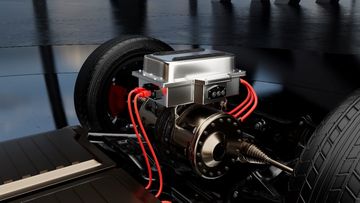
Texas Instruments가 HEV·EV 트랙션 인버터용 다축 코어리스 홀 효과 전류 센서 TMCS2100-Q1을 공개했다. 수평·수직 자기장을 동시에 측정하는 다축 센싱 기술로 기존 단일 축 센서 대비 최대 20배 높은 정확도를 달성하며, 버스바 무개조 설계로 기계 설계 유연성을 확보했다. 800V 아키텍처 확산에 따른 고정확도 요구 충족과 소형화를 동시에 구현한다.
2026.08.27by 배종인 기자











