


Atheris Announces Configurable Custom Cache Coherent Interconnect IP
 Published2016.05.17 10:05
A configurable and highly scalable distributed architecture
Arteris, a SoC interconnect IP specialist dreaming of becoming the next ARM, has thrown down the gauntlet to ARM with Cache Coherent.
Arteris announced the release of version 1.5 of its Ncore cache coherent interconnect IP. Prior to the announcement, Branch Manager Yeon Myeong-heum emphasized the importance of the product, stating that cache coherent represents "another realm" and is a "groundbreaking product" that will "serve as an opportunity for Arteris to take another leap forward."
Ncore IP is a distributed heterogeneous cache coherent interconnect product that supports efficient designs suitable for entire coherent systems by offering system designers the advantage of being able to configure multiple snoop filters and embedded caches. The company stated that Ncore IP provides significantly more flexible performance than the fixed or centralized cache coherent interconnects typically used in SoC designs.

▲ David Kruckemyer, Chief Executive of Hardware Design
The cache creates copies of the data, but it is difficult to manage these copies with software. In contrast, hardware cache coherence has the advantage of creating a virtual, flat shared memory where multiple copies are stored consistently. However, copy management in hardware requires extensive communication because it must check every possible location where a valid copy might exist.
Optimization of system performance, power consumption, and cost is possible, and timing closure is also easy.
Ncore's unique heterogeneous cache coherence supports multiple coherence models and allows the use of multiple configurable snoop filters to accommodate different cache configurations.
During his visit to Korea, David Kruckemyer, Chief Hardware Design Officer, stated, “The coherent agent interface can transform individual coherence models into general models,” adding, “Related cache agents that share common attributes with individual snoop filters occupy less die area than a single snoop filter.”
In particular, the adoption of a modular approach with configurable settings is another advantage. Executive David explained, “With transaction processing and data bandwidth control capabilities, each component can be adjusted individually, and ports per component can be controlled separately,” adding, “This allows for achieving target performance without wasting resources and enables easy adjustment of the system design even as requirements change.”
In other words, Ncore interconnect IP improves configurability in SoC designs by simultaneously realizing the implementation of different coherent protocols, cache state models, and cache configurations. Accordingly, the company stated that this product is suitable for implementing heterogeneous cache coherent SoC designs for rapidly changing market environments such as wireless mobility, HDTV, enterprise storage, automotive ADAS (advanced driver assistance systems), microservers, and networking.
Ncore Interconnect IP version 1.5 supports one to eight full coherent agent ports, multiple snoop tag filters with adjustable size and agent coupling rates, and a configurable embedded proxy cache (I/O cache). Because Ncore has ample room for significant advancement beyond the feature set of version 1.5 in terms of its architecture, it is possible to design a more robust next-generation Ncore product roadmap.
Furthermore, Executive David, who compared the Ncore interconnect to fixed or hub-based cache controller implementations, stated, “It is characterized by a distributed solution consisting of replicators and core components,” adding, “This supports scalability so that the interconnect IP meets various processing requirements.”
He added, “It requires less space for cache coherent interconnects and, as a modular Ncore component, can be placed close to critical IP, minimizing power distribution congestion.”
The full video is available for viewing on TECH PREVIEW.
관련뉴스

ARM Launches Architecture Implementing TrustZone Capabilities
ARM announced the latest ARMv8-M architecture implementing ARM TrustZone functionality at ARM TechCon 2015, held recently. The TrustZone implementation enables the identification of "Secure" and "Non-secure" states throughout the processor system, thereby helping to safely protect data, firmware, and peripherals.
2015.11.19by
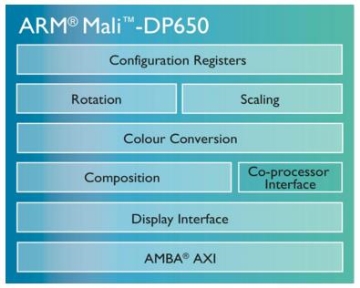
ARM Announces Mobile Display Processor Capable of 4K Resolution Processing
ARM has announced the ARM Mali-DP650, a mobile display processor that supports 4K resolution while achieving the highest performance and power efficiency. This cost-effective product is designed to maximize visual user experience and offers exceptional power efficiency.
2016.01.22by 신윤오 기자
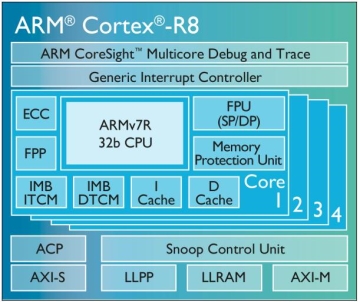
ARM Announces Cortex-R8 Processor, Real-Time CPU Supporting 5G Speeds
ARM has announced a new ARM Cortex-R8 processor that supports 5G speeds. As a result, semiconductor design companies can now double the SoC performance of ARM-based modems and high-capacity storage systems. ARM's latest real-time CPU delivers the low latency, high performance, and power efficiency required by next-generation 5G modems and high-capacity storage devices. The processor is currently available for licensing and is expected to be produced in silicon within 2016.
2016.02.19by 신윤오 기자
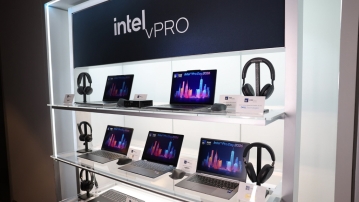
Intel Unveils Next-Generation 'Core Ultra Series 3' and vPro Platform for Enterprise PCs
Intel has officially unveiled the "Intel Core Ultra Series 3" for next-generation enterprise PCs and the latest vPro platform, addressing a wide range of demands from enterprise notebooks to high-performance workstations.
2026.03.26by 배종인 기자
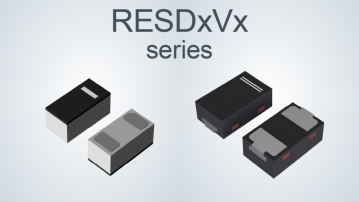
ROHM Launches ESD Protection Diode Compatible with High-Speed Interfaces of 10Gbps or Higher
반도체 전문 기업 로옴(ROHM)이 10Gbps를 넘어서는 차세대 고속 데이터 통신 환경에 대응할 수 있는 ESD(정전기 방전) 보호 다이오드 ‘RESDxVx 시리즈’를 개발하며, 고속 인터페이스에서 요구되는 신호 품질 유지와 IC 보호 성능을 동시에 끌어올렸다.
2026.03.26by 배종인 기자











