


STMicroelectronics Expands High-Efficiency Power Semiconductors, Converting Automotive Power Modules to SiC
 Published2016.05.19 17:42
Benefit from superior SiC process technology based on advanced 6-inch wafers.
STMicroelectronics (ST) has announced advanced high-efficiency power semiconductors for hybrid and electric vehicles (EVs) and has also announced the schedule for qualification to the related automotive quality standard AEC-Q101.
In electric and hybrid vehicles, high electrical efficiency is essential for long-range driving. ST's latest silicon carbide (SiC) technology enables the development of vehicles with longer driving range, faster charging, and a better fit for drivers' daily lives. A leader in silicon carbide technology, ST was among the first to introduce next-generation rectifiers and MOSFETs suitable for high-voltage power modules and discrete solutions for key automotive electronic components, including traction inverters, on-board battery chargers, and auxiliary DC-DC converters.
Current power modules typically rely on standard silicon diodes and insulated-gate bipolar transistors (IGBTs). Silicon carbide, a newer wide-bandgap technology, can drive power in the 400-volt range and beyond in modern electric and hybrid vehicles, while also enabling extremely small device sizes. SiC diodes and transistors with smaller structures have lower internal resistance and respond faster than conventional silicon devices, minimizing energy consumption. Furthermore, their smaller components allow for smaller size and weight.
“Major carmakers and Tier 1 automotive suppliers are embracing silicon-carbide technology in their next-generation products, as it offers significantly higher efficiency than standard silicon across a wide range of operating scenarios,” said Mario Aleo, Group Vice President, General Manager, Power Transistor Division, STMicroelectronics. “ST’s SiC devices have already reached advanced levels of qualification and demonstrated superior performance, supporting customers as they prepare new products for 2017.”
ST was one of the first companies to produce silicon-carbide-based high-voltage MOSFETs in 2014 when it introduced its first 1200V SiC MOSFET, which achieved an industry-leading 200°C rating, enabling more efficient and streamlined designs.
ST uses industry-leading, advanced process technology to produce SiC MOSFETs and diodes on 4-inch wafers. To reduce manufacturing costs, improve quality, and enable high-volume production to meet the demands of the automotive industry, ST is expanding its production of SiC MOSFETs and diodes to 6-inch wafers, with the transition expected to be completed by the end of 2016.
Completion of AEC-Q101 qualification program in early 2017 in line with new OEM product launches.
ST has already achieved AEC-Q101 qualification for its 650V SiC diodes, and its latest 650V SiC MOSFETs and 1200V SiC diodes are expected to be qualified in early 2017. Qualification of the next-generation 1200V SiC MOSFETs is expected to be completed by the end of 2017.
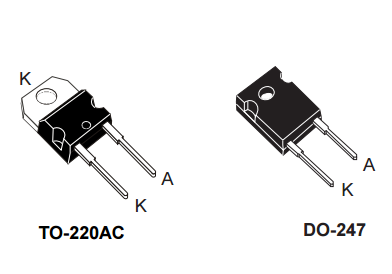
The 650V SiC diode STPSC20065WY is currently in volume production in the TO-247 package. It also includes a small form-factor TO-220 package option for lower current ratings. The 1200V SiC diode STPSC10H12DY is currently sampling to lead customers in the TO-220AC package, with volume production starting this month. Automotive-grade products are scheduled to begin volume production in Q4 2016. A range of current ratings and packaging options, from 6A to 20A, will be available.
The 650V SiC MOSFET SCTW100N65G2AG in the HiP247 package is sampling to key customers, with volume production scheduled to begin in the first half of 2017. The 650V SiC MOSFET in the surface-mount H2PAK, which enables smaller designs, will be AEC-Q101 qualified in the first half of 2017.

Comments
Related news
STMicroelectronics Unveils Automotive and Industrial OP Amplifiers with Improved Performance and Robustness
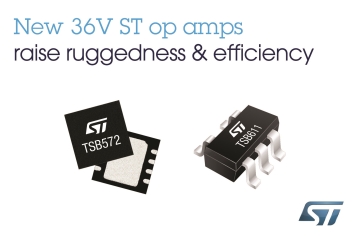
ST Microelectronics (hereinafter ST) has introduced two automotive and industrial 36V operational amplifiers with enhanced performance and robustness. These operational amplifiers are characterized by a wide supply voltage range, stability in harsh operating environments, and electrostatic discharge (ESD) tolerance reaching up to 4kV. The newly launched single operational amplifiers TSB572 and TSB611 are the first devices to employ ST's new 40V-based BiCMOS semiconductor process technology. This technology reduces quiescent current to approximately one-fifth compared to general-purpose operational amplifiers, delivering superior GBW/Icc efficiency.
2016.04.18by
STMicroelectronics Provides Free Software Support to Simplify Development of Mobile Device Detection Functions
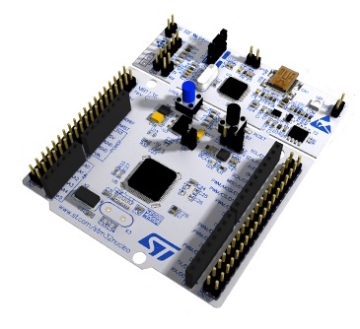
Semiconductor company STMicroelectronics (hereinafter ST) is supporting convenient motion recognition application development by adding three types to its free software library Open.MEMS. The new software library implements ST's motion-sensing technology on the ARM Cortex-M 32-bit microcontroller STM32. Through this, contextual awareness functionality can be implemented in mobile, wearable, and IoT (Internet of Things) applications. Open.MEMS collects data from inertial sensors embedded in the final product to detect human behavior. Additionally, it is optimized for power consumption minimization, making it well-suited for fitness and healthcare applications based on portable/wearable platforms that monitor human physical activity in real-time over extended periods.
2016.04.29by

STMicroelectronics Announces All-in-One Digital Compass Equipped with Geomagnetic Sensing Technology
ST Microelectronics' latest digital compass (eCompass) enables enhanced navigation guidance and motion mapping functionality for smartphones, smartwatches, fitness trackers, and other wearable devices even in situations where satellite navigation is not operational.
2016.05.12by 명세환 기자
[e4ds Tech Day 2026 ⑨] Sim Sang-gyu, Autocrypt CTO: "In the Physical AI Era, Automotive Security Must Extend Beyond the Vehicle"
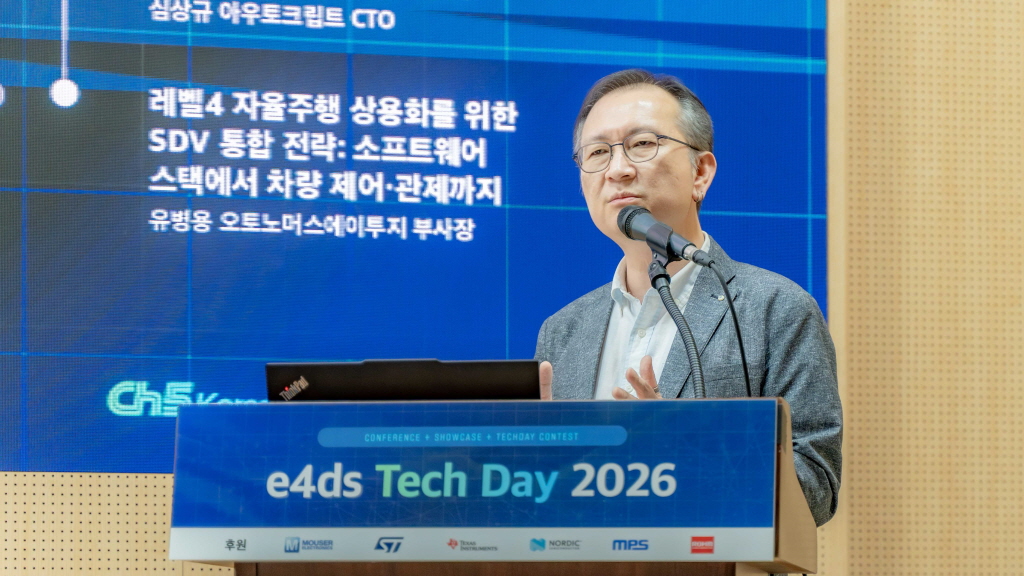
At e4ds Tech Day 2026, Sim Sang-gyu, CTO of Autocrypt, explained automotive cybersecurity strategies in the era of Physical AI and SDV (Software-Defined Vehicle). Automobiles are evolving as part of an ecosystem connected to AI, cloud, chargers, IoT, and robots, and he emphasized that the scope of security must expand beyond the vehicle interior to the entire connected environment. In particular, AI model tampering, adversarial attacks, OTA updates, and EV charger hacking were identified as major threats. He explained that response measures require zero trust, AI model integrity protection, intrusion detection, Security by Design and Default, and full lifecycle security management, and that proactive security system establishment beyond regulatory compliance is critical for securing future mobility competitiveness.
2026.10.12by 배종인 기자

Practical HIL Construction Strategy for Automotive and Off-Highway Controller Validation
As vehicle E/E architecture transitions to zonal structures and shifts to software-defined vehicles (SDV), the number of controllers (ECUs) requiring validation and software complexity are surging dramatically. Meanwhile, real vehicle testing cannot provide repeated verification under identical conditions and entails lead time and safety concerns. This white paper explains the principles of HIL (Hardware-in-the-Loop) validation and the structure of the NI platform composed of PXI, SLSC, and VeriStand, and through two actual implementation cases—Camera Record & Replay HIL for In-Cabin Monitoring Controller (ICMU) and Forklift Controller (VCU) HILS—describes how controller-level regression testing becomes possible. Additionally, it explicitly states application boundaries and limitations, such as lack of A2B support.
2026.10.12by 편집부











