

.png)

Laser products overtake inkjet products for the first time in the domestic printer and multifunction device market
 Published2016.06.02 12:42
Increased demand for products that reduce printing and maintenance costs, promotion of high-yield inkjet
According to a domestic printer and multifunction printer market forecast report published by IDC Korea (CEO Hong Yoo-sook), the domestic printer and multifunction printer market recorded a 5.3% decline last year compared to the previous year. The overall market decline was caused by a 12.8% decrease in inkjet sales compared to the previous year due to the aftermath of MERS and economic downturn.
Kim Hye-rim, Senior Research Analyst at IDC Korea, stated, “As the domestic printer and multifunction printer market enters a mature stage, the creation of new demand is limited, but there is still room for growth in the enterprise market through the strengthening of solution and specialized channel capabilities.” She added, “The copier market grew by 14.4% year-on-year, driven by the growth of color models, and color models now account for nearly half of the market.”
By product category, the inkjet market was able to maintain growth despite the overall sluggishness of the inkjet sector due to the increasing preference for high-yield inkjets, which offer reduced costs per page despite higher initial purchase prices. In the laser market, intensified competition for market share lowered the purchase price of color multifunction printers, enabling market growth. Within the laser market, the growth rate of copier-based products (14.4%) significantly outpaced that of printer-based products (1.7%). Laser products grew by 3.3% and overtook inkjet for the first time, despite difficult conditions including the absence of large bids.
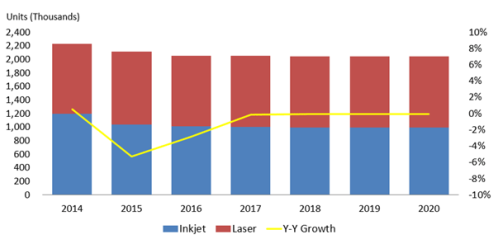
Printer and Multifunction Printer Market Forecast, 2016–2020 (Unit: Thousand Units) Source: IDC.2016>
By channel, the share of open markets expanded year-on-year to 45.6% through integrated online and mobile sales, but its contribution to revenue remained low due to cutthroat competition. The share of offline channels, including discount stores and mass merchandisers, fell to 17.8% from 19.4% the previous year due to a decrease in visitors following the MERS outbreak. While enterprise-specific channels accounted for 20.6% of shipments, they contributed 51.2% of revenue, demonstrating the growing importance of close collaboration with channel partners.
Printers and multifunction devices are expected to decline by an average of 0.7% annually until 2020 due to the transition to cloud environments.
As the domestic printer and multifunction device market enters a mature stage dependent on replacement demand, a gradual decline in demand is expected. In 2016, a shift in strategy by manufacturers is anticipated, moving away from price competition aimed at increasing market share and toward securing profits. With the printing market expected to shift in the long term toward storing and viewing documents in a cloud environment, IDC forecasted that the domestic printer and multifunction printer market would decline slightly from 2.11 million units in 2015 to 2.04 million units in 2020, with an annual average growth rate of 0.7%.
Regarding this, Senior Researcher Kim Hye-rim predicted, “While a gradual decline in growth rates during the forecast period is unavoidable, the vitality of market growth will be maintained through product mix adjustments,” adding, “For example, it will be important to provide users with an advanced printing environment by offering high-yield inkjet to the consumer and SOHO markets, and MPDS (Managed Print & Document Solutions) that combine hardware and solutions to the enterprise market.”

관련뉴스
Domestic PC shipments in the first quarter remain at last year's levels; recovery expected in public and education markets
한국IDC(대 홍유숙)의 최근 국내 PC 시장 연구 분석에 따르면, 2016년 1분기 국내 PC 출하량은 153만대로 전년 수준을 유지한 것으로 나타났다. 1분기 전세계 PC 시장이 12.5% 감소한 것과 비교하면, 국내 시장은 두께 21mm 이하 울트라슬림 노트북의 보급 확대와 교육 부문 수요 증가로 비교적 견조한 것으로 분석된다. 반면, 수출 경기 약화에 따른 IT 투자 축소로 기업 부문 PC 출하량은 전년 대비 9.0% 감소했으며, 비용과 보안 측면에서 데스크톱의 비중이 여전히 70%를 넘어서고 있다.
2016.05.18by 신윤오 기자
PCs Stuck in the Bottom: Will They Find a Breakthrough in the High-Margin, High-End Market?
가트너(Gartner Inc.)가 전세계 PC 시장이 2016년 1분기 역대 최저 수준의 분기 성장률을 기록했음에도 불구하고, PC 벤더들에게 여러 수익 기회가 존재한다고 밝혔다. 가트너 책임 연구원인 마이케 에셔리히(Meike Escherich)는 "PC는 이제 더 이상 사용자가 인터넷 접속을 위해 가장 먼저 혹은 유일하게 선택하는 디바이스가 아니다. 지난 5년 간 데스크톱 및 노트북과 같은 전통적인 PC의 글로벌 출하량은 2012년 3억4천3백만 대에서 2016년 2억3천2백만 대(추정치)로 하락했다. 또한, 매출 기준으로는 2012년 2천1백9십억 달러에서 2016년 1천2백2십억 달러 규모로 축소됐다"고 설명했다.
2016.05.19by 신윤오 기자
Mid-range smartphones driving growth are seeing a trend of upgrading core component specifications.
The core component specifications of mid-range smartphones, which are driving the global smartphone market, are being upgraded. There is an increasing trend of mounting application processors (AP), which are core components, with proprietary products, and memory capacity such as NAND and DRAM is also expanding. Additionally, Chinese handset manufacturers are increasingly adopting larger display sizes of 5 inches or more, and in particular, components such as fingerprint sensors and NFC are serving as growth drivers for mid-range smartphones. The Korea Semiconductor Industry Association and GfK, a global market research specialist, disclosed these findings in their recently conducted 2016 Market Briefing report and forecasted specific handset component trends.
2016.05.23by 신윤오 기자
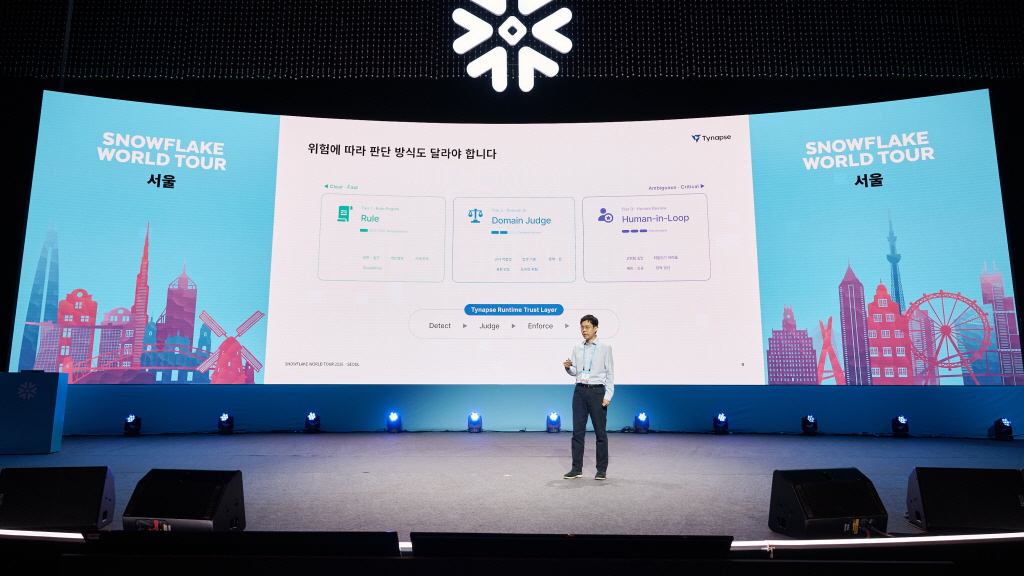
The Problem with AI is Not Performance, but Trust
CEO Kang Min-seung emphasized at Snowflake's World Tour Seoul that generative AI has entered a phase where "trust" rather than accuracy becomes the key competitive advantage. As AI is applied to various tasks including consultation, risk management, and operational automation, incorrect data, erroneous responses, and bias are creating actual business risks. He pointed out that enterprises must build a trust layer above AI. To achieve this, accurate data management, semantic structuring, governance, and prompt security are essential. He explained that AI is not merely an automation tool but a technology that reorganizes the entire organization's workflows and decision-making systems. Snowflake provides a platform that supports this trust-based AI operation, emphasizing that enterprises should build "trustworthy AI" rather than "intelligent AI."
2026.08.28by 배종인 기자

The Decisive Factor for AI Agents in Finance: "Trustworthy Data Infrastructure"
The key to spreading AI agents in the financial sector is establishing a trustworthy data system. KB Kookmin Bank is operating over 100 AI agents by 2025 and is promoting expansion to 300. AI is automating repetitive tasks across various areas such as consultation, risk management, wealth management, and relationship management. However, if data quality, governance, and semantic structuring are insufficient, errors and risks increase. KB is building an AI-Ready organization through a multi-model strategy of GPT, Gemini, and Claude, as well as a Snowflake-based data system. The bank emphasized that AI has entered a phase where it restructures not just simple automation but the entire work process and decision-making system.
2026.08.28by 배종인 기자











