


STMicroelectronics Announces Roadmap for ARM® Cortex™-M4 and M0 Core-Based MCUs
 Published2010.10.31 09:13
STMicroelectronics ( www.st.com ), the world leader in microcontrollers, has announced its roadmap for expanding its STM32 family of innovative 32-bit MCUs based on the ARM® Cortex-M™ processor core with new MCUs based on ARM's Cortex-M4 and Cortex-M0 processor cores. ST also announced the introduction of the new STM32 F-2 series, which significantly boosts the performance of the Cortex-M3 core.
New Cortex-M core-based MCU
ARM's Cortex-M4 core is an upgraded, compatible version of the Cortex-M3 core, providing DSP instructions and a floating point unit (FPU). The Cortex-M4 core will be used in new high-performance STM32 devices, which are scheduled to sample in 2011. The STM32 portfolio will be enriched with this new series of devices to support cost-sensitive applications, and an STM32 based on the Cortex-M0 core is also in development, sampling in 2011.
“ST aims to be the MCU supplier offering the industry’s most comprehensive portfolio of ARM Cortex-M-based MCUs,” said Michel Buffa, General Manager, MCU Division, STMicroelectronics. “The Cortex-M4 and Cortex-M0, combined with our advanced embedded Flash and ultra-low-power technologies, will significantly expand our STM32 family to meet the performance, functionality, and price needs of every application.”
All future Cortex-M4 and -M0 based STM32 MCUs will be fully pin- and software-compatible with each other, as well as with the existing Cortex-M3 STM32. Moreover, the ability to use the same tools and software development system allows for seamless replacement across the entire STM32 family.

New STM32 F-2 series
ST's new advanced STM32 F-2 MCU series unleashes the maximum processing power of the Cortex-M3 core by integrating ST's advanced 90nm process technology and its adaptive real-time memory accelerator (ART Accelerator™). When executing code at 120MHz, the STM32 F-2 MCUs achieve cutting-edge performance of 150DMIPS, the maximum performance the Cortex-M3 processor can deliver at that frequency. The STM32 F-2 series also offers CoreMark-certified 188µA/MHz dynamic power, consuming 22.5mA at 120MHz when executing from Flash. In addition to providing the highest on-chip memory density of any Cortex-M3-based MCU available today, the STM32 F-2 series provides enhanced support for applications such as imaging, connectivity, security, audio, and control.
The STM32 F-2 MCUs offer the perfect balance of performance, dynamic power consumption, and cost for most applications. This is evidenced by the news that over 20 ST customers are currently ramping up production of new products enabled by this new STM32 family.
“The new STM32 F-2 series additions to the STM32 platform further strengthen ST’s leadership in the Cortex-M3 MCU market,” said Michel Buffa. “ST’s proprietary 90nm process technology and the development of the ART Accelerator enable fully optimized processor-memory interaction without wait states, enabling the full performance of the Cortex-M3 core,” he added.
The launch of the STM32 F-2 series, comprising over 30 new devices, brings the total number of STM32 microcontrollers to 180, delivering the advanced performance, high efficiency, and convenience of the industry-standard Cortex-M3 processor while being pin- and software-compatible and sharing common IOs.
The STM32 F-2 is sampling now to OEM customers, with production availability scheduled for Q1 2011. The STM32-F2 is priced at $3.18 for the STM32F205RBT6, which provides 128 Kbytes of Flash and 64 Kbytes of RAM in the LQFP64 package, in quantities of 10,000 pieces.
STM32 F-2 Series – Technical Details
The STM32 F-2 MCU series complements the existing STM32 F-1 and L-1 series, maintaining pin and software compatibility, and is available in four members, each offering designers a choice of memory densities, packages, and peripheral IO options, along with the performance and power savings afforded by 90nm process technology and the ART memory accelerator. The STM32 F-2 series also leverages the STM32 family's comprehensive development tools and software development system, comprising a wide range of compilers and IDEs.
Target application
• Consumer and mobile applications; 1.65V support, audio-class architecture, small WLCSP64 package
• Industrial and medical applications; Rich peripheral connectivity, encryption, processing power, advanced timers, and increased flash and SRAM memory.
Industry-leading performance
• Achieves 150 DMIPS (Dhrystone MIPS) at 120MHz
• CoreMark™-certified fastest Cortex-M3 microcontroller at 120MHz: Delivers 1.905 CoreMark/MHz (228.60 CoreMark at 120MHz)
• 7-layer multi-AHB bus matrix that provides perfect and efficient operation even when multiple high-speed IOs are operating simultaneously;
• Two independent SRAM blocks located on the bus matrix supporting simultaneous memory access from different bus masters;
• 16 DMA channels
Power efficiency
• CoreMark-certified 188μA/MHz dynamic power consumption characteristic, consuming 22.5mA at 120MHz when running from flash;
• Voltage range further reduces power consumption characteristics - 1.65 V to 3.6 V for the WLCSP64 package and 1.8 V to 3.6 V for the other four packages.
• Supports VBAT mode with advanced low-power modes and functions, and supports power consumption characteristics of less than 1μA with RTC (Real-Time Clock) on and 4Kbyte battery-backed SRAM memory function.
Advanced peripheral IO
• Audio-class architecture providing advanced PLL and data-synchronization schemes; I2S and USB IO
• 52 bytes of One-Time-Programmable (OTP) memory that can store important data such as Ethernet MAC address, encryption key, etc.
• Parallel CMOS-camera sensor interface;
• Connectivity – Up to two USB full-speed OTG interfaces (one supporting USB high-speed via dedicated DMA), one Ethernet MAC 10/100 with IEEE1588 PTP hardware support, two CAN 2.0B active, operating at up to 60MHz and supporting Compact Flash, SRAM, PSRAM, NOR

관련뉴스

Intel Unveils Next-Generation 'Core Ultra Series 3' and vPro Platform for Enterprise PCs
인텔이 차세대 기업용 PC를 위한 ‘인텔 코어 Ultra 시리즈 3’와 최신 vPro 플랫폼을 공식 발표하며, 기업용 노트북부터 고성능 워크스테이션까지 폭넓은 수요 충족에 나섰다.
2026.03.26by 배종인 기자

ROHM Launches ESD Protection Diode Compatible with High-Speed Interfaces of 10Gbps or Higher
반도체 전문 기업 로옴(ROHM)이 10Gbps를 넘어서는 차세대 고속 데이터 통신 환경에 대응할 수 있는 ESD(정전기 방전) 보호 다이오드 ‘RESDxVx 시리즈’를 개발하며, 고속 인터페이스에서 요구되는 신호 품질 유지와 IC 보호 성능을 동시에 끌어올렸다.
2026.03.26by 배종인 기자
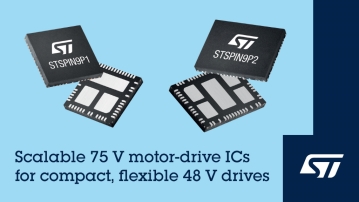
ST Launches 75V Drive IC Targeting 48V Industrial Motor Driving
ST마이크로일렉트로닉스가 48V급 산업용 구동 시스템 설계에 맞춘 75V 모터 드라이브 IC ‘STSPIN9P’ 시리즈를 공개했다. 새 제품군은 하프 브리지와 풀 브리지 구조로 구성돼 모터 종류와 출력 조건에 따라 설계를 확장할 수 있도록 한 것이 특징이다. 전원 회로와 보호 기능, 전류 감지 회로를 칩에 통합해 시스템 구성을 단순화했으며, 최대 500W급 애플리케이션까지 대응하도록 설계됐다. 회사는 레퍼런스 디자인과 데모 보드도 함께 제공해 산업 자동화, 로보틱스, 펌프, 팬, 조명, 섬유 기계 등에서 개발과 평가를 지원할 계획이다.
2026.03.26by 배종인 기자

Nordic supports security updates for the entire lifecycle of IoT devices at a single fixed cost
Nordic Semiconductor, a global leader in low-power wireless connectivity solutions, has unveiled a single fixed-cost licensing model that delivers FOTA (Firmware Over-the-Air) and device management capabilities throughout the device lifecycle via nRF Cloud, and introduced a new firmware update solution to prepare for the enforcement of the European Union's Cyber Resilience Act (CRA).
2026.03.26by 배종인 기자

Practical Training in Low-Noise, Low-Power Circuit Design All in One Place… Training Fee Support
고감도 아날로그 회로와 센서 기반 시스템 설계 역량을 강화할 수 있는 ‘2026 고급 엔지니어 실무 마스터 클래스’가 오는 4월16일 서울 가산동 e4ds 컨퍼런스 센터에서 열린다. 이번 과정은 온라인이 아닌 오프라인 유료 실습 교육으로 진행되며, 현장 중심의 심화 학습을 원하는 엔지니어를 대상으로 한다. 이번 교육은 텍사스 인스트루먼트(Texas Instruments)가 교육비를 지원해 정가 25만원에서 10만원 할인 된 15만원에 참가할 수 있다.
2026.03.26by 배종인 기자











