



What technologies are at the peak of Gartner's Emerging Technology Hype Cycle?
 Published2016.08.18 15:39
Key trends such as pure immersive experiences, smart machines, and platform technology are presented.
Gartner Inc. recently released its 2016 Hype Cycle for Emerging Technologies report, which identified three key technology trends that businesses should prioritize.
Gartner identified three key technology trends: pure immersive experiences, the era of smart machines with perceptual capabilities, and the platform revolution. Gartner stated that these trends will create new experiences with unparalleled intelligence and provide platforms that enable enterprises to connect with new business ecosystems.
The Hype Cycle for Emerging Technologies report is the longest-running annual Gartner Hype Cycle report and provides a cross-industry perspective on the technologies and trends that business strategists, chief innovation officers, R&D professionals, entrepreneurs, global market developers, and emerging technology teams should consider when building emerging technology portfolios.
Mike J. “The Hype Cycle for Emerging Technologies report is unique among Hype Cycles because it distills insights from more than 2,000 technologies into a concise list of must-know emerging technologies and trends, which significantly influences enterprise strategy,” said Walker, research director at Gartner. “In particular, this Hype Cycle focuses on a select few technologies that are expected to deliver a high level of competitive advantage over the next five to 10 years.”
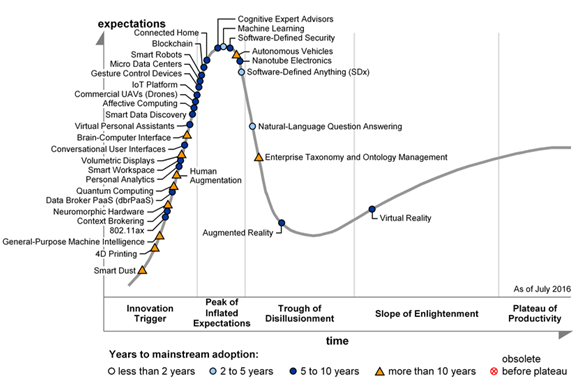
2016 Emerging Technology Hype Cycle
"To succeed in the digital economy, enterprise architects must proactively identify emerging technologies and collaborate continuously with CIOs and business leaders," Walker said. "This will enable them to develop innovative business models that secure competitive advantage, maximize value through operational cost reduction, and overcome regulatory hurdles." He added, "This Hype Cycle report offers expert insights on key emerging trends and specific technologies that enterprises should pay attention to and monitor."
Pure immersive experience technology is expected to become increasingly human-centric, reaching a level where transparency is introduced between people, businesses, and objects. As technology evolves and interactions within the workplace, at home, and between businesses and people become more adaptive, contextual, and fluid, these relationships are likely to become more complex.
Pure immersive experiences, 4D printing, brain-computer interfaces, and more.
Smart machines, machine learning, virtual personal assistants, etc.
Platform technologies, neuromorphic hardware, quantum computing, etc.
Key technologies to watch in this space include 4D printing, brain-computer interfaces, human augmentation, volumetric displays, affective computing, connected homes, nanotube electronics, augmented reality (AR), virtual reality (VR), and gesture-controlled devices.
Smart machine technology with perceptual capabilities offers radical computational power, almost infinite.Deep neural networks (DNNs) are poised to be the most disruptive technology field of the next decade, driven by massive amounts of data and unprecedented advancements in deep neural networks (DNNs).
This means that enterprises adopting smart machine technologies will be able to leverage data to adapt to new situations and solve problems they never experienced before. Gartner recommends that enterprises seeking to exert influence in this area consider technologies such as smart dust, machine learning, virtual personal assistants (VPAs), cognitive expert advisors, smart data mining, smart workspaces, conversational user interfaces, smart robots, commercial unmanned aerial vehicles (drones), autonomous vehicles, natural language question answering, personal analytics, enterprise taxonomy and ontology management, data broker platform as a service (dbrPaaS), and contextual brokering.
Emerging technologies are revolutionizing the definition and use of platforms. The shift from technological infrastructure to ecosystem-centric platforms is laying the foundation for entirely new business models, which are poised to serve as a bridge between humans and technology.
In such a dynamic ecosystem, companies need to understand and redefine their strategies in advance to build platform-based business models. Neuromorphic hardware, quantum computing, blockchain, Internet of Things platforms, software-defined security, and software-defined anything (SDx) are key technologies that facilitate platform construction.
“These trends demonstrate that as companies embrace technology as an integral part of their employee, partner, and customer experiences, they will be able to connect their ecosystems to platforms in new and dynamic ways,” Walker said. “Similarly, as smart machine technologies evolve, they will become a vital part of the human experience and digital business ecosystem.”
관련뉴스

Public cloud services projected to grow at an annual average rate of 19.4% until 2019
According to the latest research report from IDC (www.idc.com), an IT market analysis and consulting firm, the global public cloud services market is projected to grow at a compound annual growth rate (CAGR) of 19.4% through 2019. This figure represents six times the growth rate of the overall IT market. The report (Worldwide Semiannual Public Cloud Services Spending Guide) indicates that the global public cloud services market size is expected to expand to more than double, from $70 billion in 2015 to over $141 billion in 2019.
2016.02.02by 신윤오 기자

China's VR Market Is Growing Fast, VR Devices Expected to Grow 476% This Year
According to IDC (www.idc.com), a market analysis and consulting firm specializing in the IT sector, China's VR (Virtual Reality) device market is projected to reach 480,000 units in 2016, representing a 476% increase year-over-year, driven by the growth of Chinese VR companies such as DeePoon, ANTVR, and 3Glasses. Currently, these VR companies are announcing long-term plans encompassing both hardware and equipment as well as software ecosystems. Furthermore, major global VR companies such as Oculus, HTC, and Sony have announced that they will begin launching products starting in 2016.
2016.02.25by 신윤오 기자
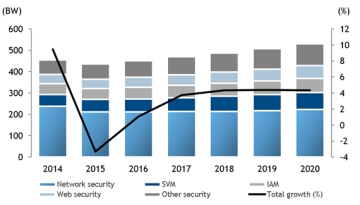
The domestic IT security market contracted by 4.1% last year compared to the previous year, but the future outlook is bright.
한국IDC(대표 홍유숙)가 최근 발간한 국내 IT 보안 제품 시장 전망 보고서에 따르면, 지난해 국내 IT 보안 제품 시장은 전년대비 4.1% 감소한 4,370억원으로 집계되었다. 방화벽, UTM 장비 등이 포함된 네트워크 보안 부문이 시장 포화에 따라 전년대비 약 10% 감소하며 전체 IT 보안 제품 시장의 하락을 주도한 것으로 분석된다. 국내 IT 보안 제품 시장은 향후 5년간 연평균(CAGR) 3.2% 성장해 오는 2019년 5천억원을 넘어서고, 2020년 5,300억원 규모에 이를 것으로 전망된다.
2016.04.07by 신윤오 기자
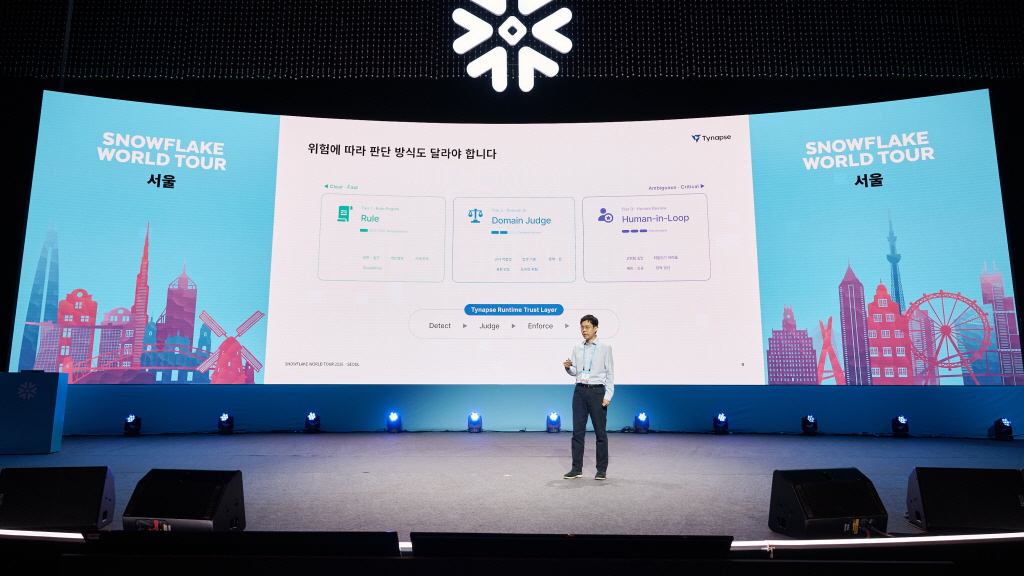
The Problem with AI is Not Performance, but Trust
CEO Kang Min-seung emphasized at Snowflake's World Tour Seoul that generative AI has entered a phase where "trust" rather than accuracy becomes the key competitive advantage. As AI is applied to various tasks including consultation, risk management, and operational automation, incorrect data, erroneous responses, and bias are creating actual business risks. He pointed out that enterprises must build a trust layer above AI. To achieve this, accurate data management, semantic structuring, governance, and prompt security are essential. He explained that AI is not merely an automation tool but a technology that reorganizes the entire organization's workflows and decision-making systems. Snowflake provides a platform that supports this trust-based AI operation, emphasizing that enterprises should build "trustworthy AI" rather than "intelligent AI."
2026.08.28by 배종인 기자
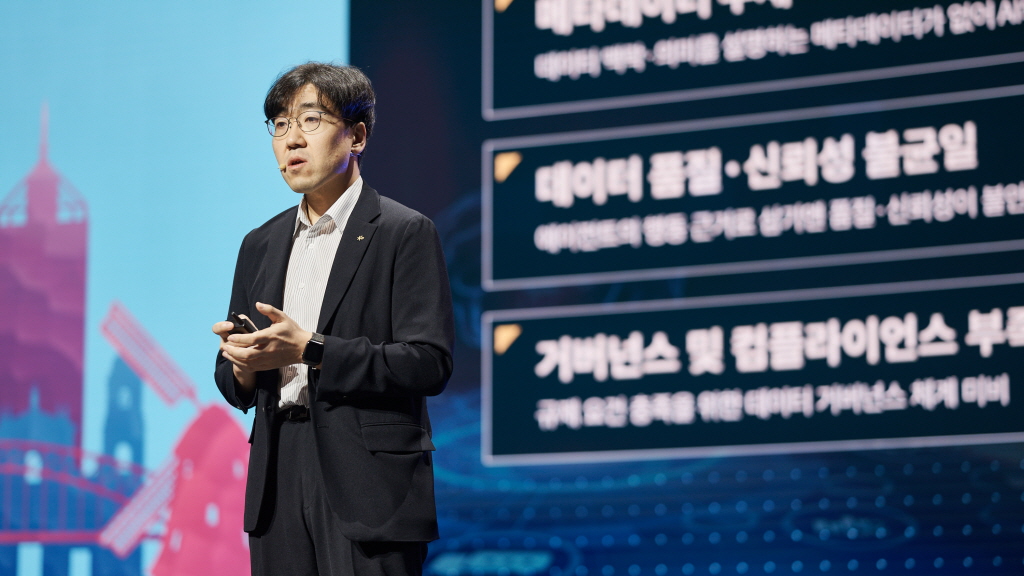
The Decisive Factor for AI Agents in Finance: "Trustworthy Data Infrastructure"
The key to spreading AI agents in the financial sector is establishing a trustworthy data system. KB Kookmin Bank is operating over 100 AI agents by 2025 and is promoting expansion to 300. AI is automating repetitive tasks across various areas such as consultation, risk management, wealth management, and relationship management. However, if data quality, governance, and semantic structuring are insufficient, errors and risks increase. KB is building an AI-Ready organization through a multi-model strategy of GPT, Gemini, and Claude, as well as a Snowflake-based data system. The bank emphasized that AI has entered a phase where it restructures not just simple automation but the entire work process and decision-making system.
2026.08.28by 배종인 기자











