


[ICT R&D Review] ⑤Mobile Communications: Losing Leadership in Core Technologies and Mobile Ecosystem
 Published2016.08.30 08:39
Strengths in world-class wired and wireless communication infrastructure and terminal device companies
The Ministry of Science and ICT released Technology Roadmap 2022 (draft) adding 10 major ICT R&D technology fields and artificial intelligence field. The 10 major ICT R&D technologies selected by the Ministry for strengthening mutual linkage of science and technology ICT and discovering new industries are: ▲digital content ▲convergence services ▲ICT devices ▲information security ▲mobile communications ▲networks ▲broadcasting/smart media ▲radio waves and satellites ▲foundational SW computing ▲software. Accordingly, e4ds news plans to introduce R&D strategies in these fields sequentially and present future technology development roadmaps. [Reporter Shin Yun-oh]
Domestic mobile communications industry is a national strategic core industry with significant forward and backward linkage effects driving economic growth, accounting for 21.7% of total ICT production value (2014).
In the terminal device sector, Samsung Electronics leads while Apple's pursuit and China's rapid growth stand out. In Q1 2016, global smartphone market share was Samsung Electronics (23.6%), Apple (15.3%), Huawei (8.5%), Xiaomi (4.7%), and Lenovo (4.4%). In 2015, domestic smartphone market share was Samsung Electronics (46%), Apple (33%), LG Electronics (14%), and others (7%)
In the systems sector, three companies—Ericsson, Nokia, and Huawei—dominate the global market. Aside from Samsung, the industry consists of small and medium-sized enterprises with a domestic-focused structure, with domestic manufacturers holding 43.6% (2014) of the domestic mobile communications equipment market share. In the services sector, most global operators provide 4G services, with 360 operators supporting LTE services. As of 2015, service penetration rate stands at 11.5%.
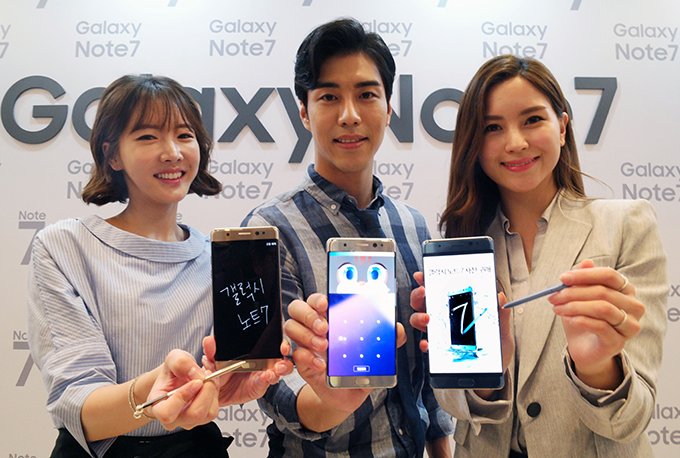
▲The global mobile communications market that will realize ultra-immersive services with Gbps-class and above in future 5G/B5G is projected to record an average annual growth rate of 4.6% until 2022.
(Photo shows the recent launch of Galaxy Note7 which has been attracting sensational popularity)
Mobile communications is a high value-added technology that provides customized immersive services and new convergence services to all users through high-speed, high-quality mobile communications systems, service platforms, and portable multi-functional devices, where people, objects, and information are organically connected anytime, anywhere.
Mobile services that understand me without being asked what I want, mobile networks that follow me everywhere, and devices that are always with me—these fall within the scope of mobile communications.
Domestic mobile communications market expected to reach 34-35 trillion won total in 2016-2022
Mobile communications technology is currently a sector with significant growth potential due to explosive wireless traffic growth, IoT expansion, and new technology and service demands. Domestic mobile phone traffic reached 200,000TB per month (March 2016), an 8.3-fold increase compared to four years prior, with video comprising 57.6% of total traffic. Gartner reports that global mobile traffic will increase by 55% annually over the next five years.
IoT expansion is also broadening the mobile communications industry. As connectivity expands from people to objects, the number of connected objects is expected to reach 50 billion by 2020. IoT-dedicated operators have emerged and 3GPP standards are being established. New technologies including immersive services such as AR and VR, cloud networks, autonomous vehicles, and disaster safety networks have appeared, with SDN/NFV gaining attention through optimized network configuration via flexible resource management.
From voice (2G), data (3G), and video (4G) to future 5G/B5G realizing Gbps-class and above ultra-immersive services, the global mobile communications market is projected to grow at an average annual rate of 4.6% from 1.4 trillion dollars in 2016 to 1.8565 trillion dollars in 2022. The domestic market is expected to form a total market size of 34-35 trillion won during 2016-2022.
Emerging nations including China improving product competitiveness and expanding market influence
Domestic mobile communications industry possesses world-class wired and wireless communication infrastructure and has global leading mobile communications terminal device companies. Additionally, forward and backward linked industries such as semiconductors and displays are strengths.
However, high overseas dependency on core terminal components such as modems and RF chips has been identified as a problem, and the industry is failing to lead the mobile ecosystem including open platforms and mobile software. Weak global competitiveness of small and medium-sized enterprises is also an issue. Moreover, emerging nations including China are improving product competitiveness and expanding market influence, and overseas global companies are leading core technologies—these are also threat factors. Burden from increased royalty payments and patent issues is increasing.
The domestic industry is noted as needing to continuously expand demand through emerging nations' telecommunications industry development, increase consumer demand for high value-added terminal products, and expand demand through convergence of wired and wireless markets and linkage with other industries.
The government has set a vision of "achieving world-leading global competitiveness in mobile communications industry." Park Hyun-chul, CP of the mobile communications sector, stated "We have set goals to provide world-first 5G trial service in 2018 and world-first commercial service in 2020," adding "We will also secure core fundamental technologies for B5G mobile communications systems and future mobile devices by 2022."
Looking at priority R&D areas by terminal components, systems, and services for this purpose, first, terminal components will receive concentrated investment in △convergence-integrated multi-functional RF and antenna technologies △convergence-integrated multi-functional modem and AP component development. The systems sector will focus on △B5G mobile communications △convergence intelligent mobile communications systems △5G mobile communications technology development. The services sector will prioritize △ultra-connected mobile convergence intelligent services △mobile hyper-reality services △ultra-natural wireless communications services for ultra-high-speed moving objects △user proximity service platform technology.
Park Hyun-chul, CP, stated "For terminal components, the R&D promotion strategy is to nurture 5G-based future terminal core component industries and maintain government investment; for systems, to secure 5G/B5G core fundamental technologies, foster equipment industries, and strengthen government investment," and explained "Finally, for the services sector, the promotion direction is to secure user-centered convergence intelligent mobile services core technologies."
Related news
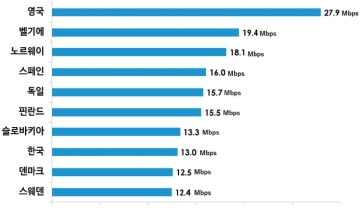
South Korea Ranks 8th Globally for Average Mobile Speed at 13Mbps
Our country ranked first globally in average internet speed for nine consecutive quarters and maintained the top position in broadband penetration across all sectors. Mobile average speed reached 13 Mbps, recording first place in the Asia-Pacific region and eighth place worldwide. According to the "Internet Status Report for Q1 2016" released by Akamai Korea (CEO Son Bu-han), a global leader in the content delivery network (CDN) sector, Korea recorded 29 Mbps in average internet speed during Q1 2016, ranking first worldwide. This represents an 8.6% increase compared to the previous quarter and is approximately five times faster than the global average.
2016.07.01by 홍보라 기자

Samsung Electronics reports strong second-quarter performance across various sectors, including mobile displays
Samsung Electronics announced its Q2 2016 results on the 28th, reporting consolidated revenues of 50.94 trillion won and operating profit of 8.14 trillion won. Revenues increased 5% compared to 48.54 trillion won in the same period last year, and operating profit rose 18% from 6.9 trillion won year-over-year. Compared to the previous quarter, revenues increased 2% and operating profit grew 22%. Samsung Electronics' Q2 performance improvement resulted from strong performance across all divisions based on differentiated core competitiveness in both set business segments including IM and CE, as well as component businesses such as semiconductors and displays. The set business recorded a clear recovery trend with substantially improved results compared to both the same period last year and the previous quarter. In IM, improved sales of Galaxy S7 and S7 Edge drove the performance improvement.
2016.07.28by 신윤오 기자
Waiting for Premium Phones in Second Half, Q2 Smartphone Sales Increase
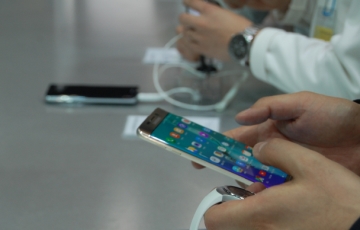
Gartner Inc. announced that global end-user smartphone sales in Q2 2016 reached 344 million units, representing a 4.3% increase compared to the same period last year. While overall mobile phone sales declined by 0.5%, among the top 10 global smartphone vendors, only five companies including China's Huawei, Oppo, Xiaomi, BBK, and Samsung achieved sales growth. Anshul Gupta, Principal Research Analyst at Gartner, explained, "Demand for premium smartphones declined in Q2 2016. This is analyzed to be because consumers are waiting for new hardware products to be launched in the second half. Additionally, the 14% decline in feature phone sales appears to have impacted overall mobile phone sales."
2016.08.19by 김수지 기자
The Problem with AI is Not Performance, but Trust
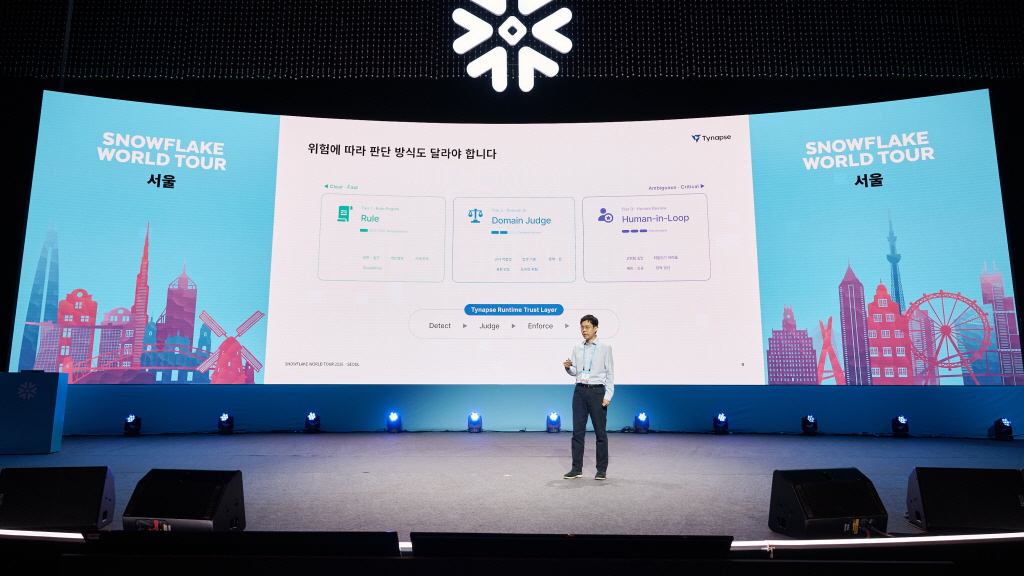
CEO Kang Min-seung emphasized at Snowflake's World Tour Seoul that generative AI has entered a phase where "trust" rather than accuracy becomes the key competitive advantage. As AI is applied to various tasks including consultation, risk management, and operational automation, incorrect data, erroneous responses, and bias are creating actual business risks. He pointed out that enterprises must build a trust layer above AI. To achieve this, accurate data management, semantic structuring, governance, and prompt security are essential. He explained that AI is not merely an automation tool but a technology that reorganizes the entire organization's workflows and decision-making systems. Snowflake provides a platform that supports this trust-based AI operation, emphasizing that enterprises should build "trustworthy AI" rather than "intelligent AI."
2026.08.28by 배종인 기자
The Decisive Factor for AI Agents in Finance: "Trustworthy Data Infrastructure"
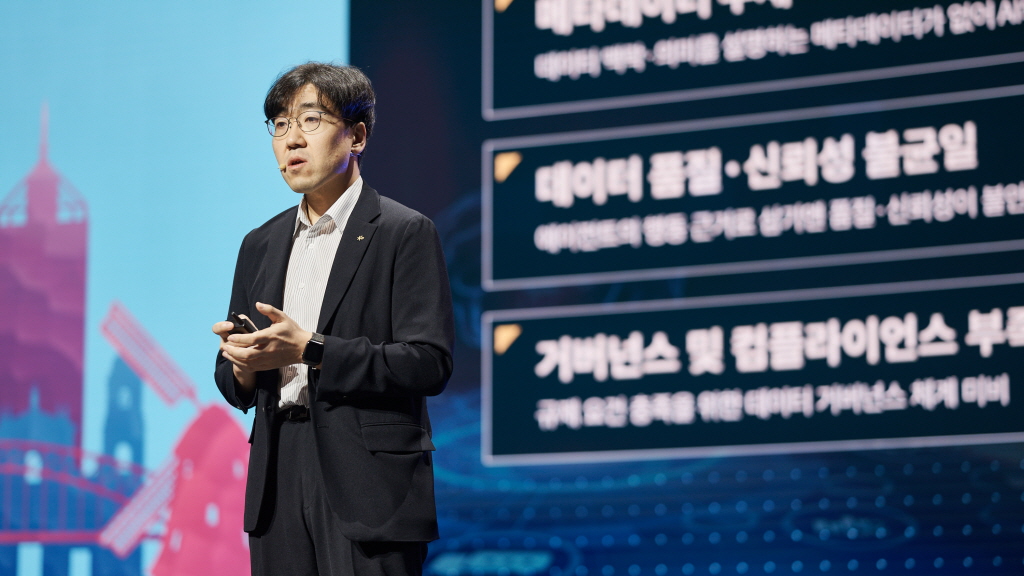
The key to spreading AI agents in the financial sector is establishing a trustworthy data system. KB Kookmin Bank is operating over 100 AI agents by 2025 and is promoting expansion to 300. AI is automating repetitive tasks across various areas such as consultation, risk management, wealth management, and relationship management. However, if data quality, governance, and semantic structuring are insufficient, errors and risks increase. KB is building an AI-Ready organization through a multi-model strategy of GPT, Gemini, and Claude, as well as a Snowflake-based data system. The bank emphasized that AI has entered a phase where it restructures not just simple automation but the entire work process and decision-making system.
2026.08.28by 배종인 기자











