


KT Establishes Smart Farm for the Disabled Using 'Hanging Beds'
 Published2016.09.27 15:43
Expectations for job creation for local people with disabilities through herb cultivation and utilization of disability experience facilities
KT and the Community Chest of Korea announced on the 27th that they have established the nation's first customized smart farm for the disabled at the Seoul Municipal Agricultural Vocational Rehabilitation Facility for the Disabled in Namyangju, Gyeonggi Province.
The smart farm tailored for the disabled incorporates temperature and humidity detection via internal and external sensors—which are typically found in existing smart farms—and real-time greenhouse monitoring and control functions, thereby introducing customized greenhouse equipment for individuals with limited mobility.
While conventional farms cultivate crops on land within greenhouses, smart farms tailored for the disabled are designed to allow individuals with developmental and physical disabilities to work easily by installing waist-height 'elevated beds' to accommodate those with limited mobility.
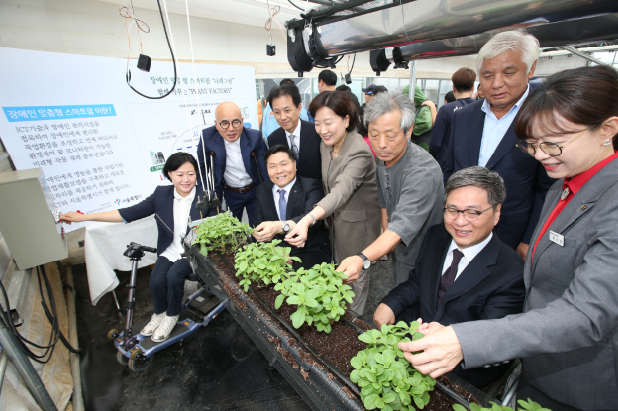
In addition, hard flooring was laid throughout the smart farm to make it easy for people with disabilities using wheelchairs or crutches to access it, and 'hanging beds' were installed on the ceiling that can be adjusted in height using a switch or smartphone, allowing for more efficient movement and work for people with disabilities. .
Previously, only intellectually disabled individuals with a certain level of intellectual ability and the ability to use their limbs could work, but through the 'hanging bed,' even severely disabled people in wheelchairs can participate in agricultural activities.
This smart farm, the first of its kind in Korea tailored for people with disabilities, is set to create jobs for local residents through herb cultivation and serve as an agricultural experience learning center where those who find it difficult to participate in outdoor activities can engage in farm activities. Additionally, the herbs produced at this smart farm will be purchased by culinary expert Edward Kwon in the future.
In particular, it enables the employment of people with disabilities who, even after graduating from school, must rely on their families for not only jobs but also their entire lives, thereby supporting their independence and social activities. In addition, it is expected to have a positive effect on the emotional well-being of people with disabilities through a nature-friendly environment, rather than the existing isolated rehabilitation facilities.
Kim Song-seok, director of '3 Pro Farm,' where a smart farm for the disabled is installed, stated, "People with developmental disabilities experienced positive emotional changes as they touched the soil, sweated, and farmed," adding, "This customized smart farm will enable people with disabilities to engage in activities more efficiently, which I believe will be of great help to their rehabilitation."
Lee Seon-ju, Senior Vice President of KT’s Sustainable Management Center, stated, “We strove to reflect the practical needs of people with disabilities in this customized smart farm, the first of its kind in the nation,” adding, “We hope this facility will contribute to the economic independence and rehabilitation of people with disabilities.”
Meanwhile, KT plans to create a new paradigm for social contribution activities targeting the disabled by securing a new vocational rehabilitation model and a foundation for independence through the nationwide expansion of smart farms tailored for the disabled.
관련뉴스
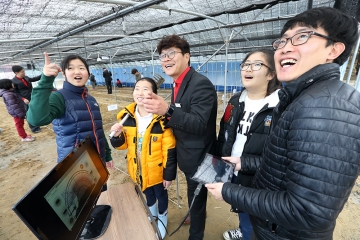
KT Opens Korea's Only Experiential Smart Farm for Children's Education
KT(회장 황창규, www.kt.com)는 임자도 기가아일랜드에 국내 유일의 어린이 체험형 스마트팜을 개소했다고 20일 밝혔다. 임자초등학교 스마트팜에서는 실시간으로 농작물을 모니터링하고, 스마트기기에서 하우스 시설 자동 개폐는 물론, 온도 및 습도를 언제 어디서나 자동으로 제어할 수 있다.
2016.03.23by
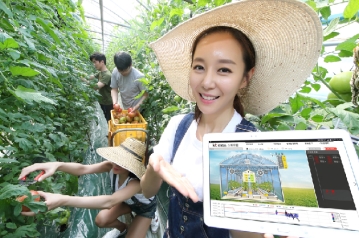
Reduce construction costs with 24-hour monitoring 'Smart Farm' greenhouse control
KT는 스마트팜 설비 구축 비용을 최대 40%까지 줄여주고 온실시설 제어 성능을 대폭 향상시킨 ‘KT GiGA 스마트팜’ 서비스를 출시했다고 밝혔다. ‘KT GiGA 스마트팜’은 센서가 달린 사물인터넷(IoT) 기기를 통해 재배시설의 온도/습도/일사/CO2/토양 등을 분석하고, 분석 결과에 따라 제어장치를 구동해 최적의 작물 재배환경을 구현하는 솔루션이다. 농림축산식품부에서 ‘16년 1월 실시한 여론조사에 따르면 스마트팜 도입 걸림돌로 ‘초기 투자 및 관리비용 부담’이 53.8%, ‘ICT 기술 사용의 어려움’이 16.7%로 각각 1,2위를 차지했다.
2016.05.26by 명세환 기자
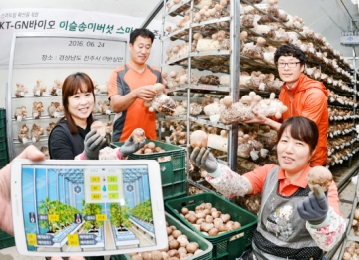
We utilized a smart farm to grow mushrooms using four-season automatic control of temperature and humidity.
KT announced on the 24th that it has established the nation's largest "Eurasian truffle mushroom smart farm" in collaboration with agricultural company G&Bio (represented by Kim Young-chan). The Eurasian truffle mushroom smart farm built by the two companies is located in Iban-seong-myeon, Jinju-si, Gyeongnam, with a scale of 11 dome houses (1,800m2). The KT GiGA smart farm solution is applied to enable automatic control of cultivation environment conditions such as temperature, humidity, and CO2 throughout all four seasons. Additionally, the Eurasian truffle mushroom smart farm is being utilized in the development of a "Eurasian truffle mushroom smart farm solution" that enables automated cultivation under optimal growth environment conditions.
2016.06.24by 장은성 기자
Ecolab and K-water Discuss Innovation Collaboration in Advanced Industry Water Management
Ecolab and the Korea Water Resources Corporation jointly discussed cooperation directions for maximizing water use efficiency in advanced industries such as semiconductors and data centers and establishing sustainable water circulation. The two companies agreed to gradually develop a long-term cooperation model that combines water resource infrastructure and water management technology to promote water efficiency optimization, water reuse, and carbon reduction.
2026.08.28by 명세환 기자
에이치에너지, 녹색기술인증 획득…솔라온케어 가동률 99.82%
에이지에너지가 태양광 발전예측 및 I-V커브 이상진단 기술로 중소벤처기업부 녹색기술인증을 획득했다. AI 기반 자산관리 플랫폼 솔라온케어는 전국 3,000개 이상 발전소에 적용되어 99.82%의 시스템 가동률과 3.7% 발전성능 개선을 달성했다. 실시간 데이터 분석을 통해 모듈 노화와 부분 음영 등 미세한 손실을 조기에 감지하고 관리함으로써 발전 수익을 보호한다.
2026.08.25by 명세환 기자











