


Connected Cars to Increase Fivefold Over Next Five Years, Ushering in Smart Mobility Era
 Published2016.10.04 09:41
According to a recent forecast released by Gartner Inc., production volumes of connected cars in the automotive market are increasing sharply.
New vehicle production equipped with data connectivity capabilities through embedded communication modules or portable device connectivity is projected to increase from 12.24 million units in 2016 to 61 million units in 2020.
Gartner defines connected cars as automobiles capable of bidirectional wireless communication with external networks for the purpose of providing digital content and services, remote data transmission from vehicles, remote monitoring and control, and in-vehicle system management.
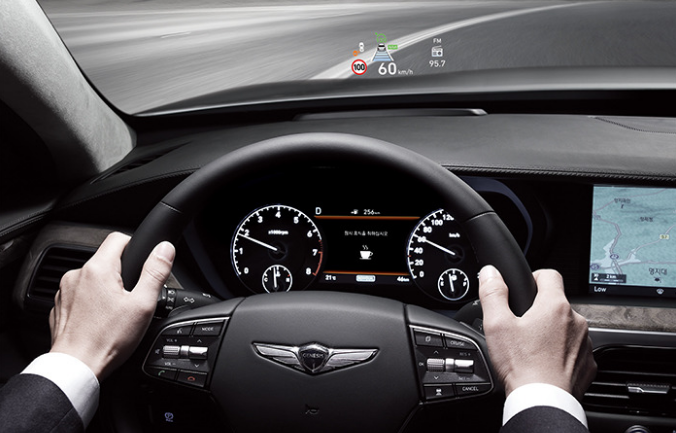
▲Hyundai Motor Connected Car
James Hines, principal research analyst at Gartner, stated, "Connected cars will provide a fundamental foundation of opportunity and innovation for the automotive industry and other related industries. Connected cars will produce new and innovative products and services, spawn new companies, drive the adoption of new value propositions and novel business models, and usher in a new era of smart mobility. The automotive industry's perspective will shift from individual vehicle sales to a service-centric approach for personal mobility."
Automakers will be able to generate additional revenue through service sales and upgrades even after selling connected cars, and will gain opportunities to enhance brand loyalty through customer-tailored services. Furthermore, they will contribute to innovation in adjacent business sectors such as insurance, vehicle rental, car sharing and ride-sharing services, and electric vehicle charging.
Gartner forecasts that demand for contextual information such as video sensing and geographic location information in connected car applications from 2016 to 2020 will grow by 150%.

▲ Global Connected Car Production Forecast by Connection Type (Unit: Thousand Units) Source: Gartner (September 2016)
*Embedded type: SIM chip-based embedded modem
**Tethered type: A method that allows mobile IP data connectivity to be shared with the vehicle using wired and wireless connections
Research analyst James Hines stated, "As vehicles become increasingly automated, numerous sensor technologies such as cameras and radar systems are being installed. Many vehicles will be able to distinguish and identify surrounding objects using video sensing technology, demonstrate more sophisticated responses, and enable automatic control as well."
To achieve environmentally friendly and increasingly automated vehicles, embedded processing capabilities must be enhanced by 5% annually from 2016 to 2020. Autonomous driving functions such as adaptive cruise control (ACC), collision avoidance, and lane departure warning systems require real-time camera and sensor data processing and pattern recognition. Sophisticated engine and transmission control systems are necessary for improved fuel efficiency and reduced exhaust emissions.
Related news

Hyundai Motor Vice Chairman Chung: “Creating amazing life value based on connected cars through collaboration with Cisco”
Hyundai Motor will establish an ultra-high-speed in-vehicle communication network for controlling data transmission and reception within vehicles through collaboration with Cisco. The two companies will also conduct testing through various virtual connected car simulation projects. Hyundai Motor's collaboration with Cisco is part of its strategy to secure a connected car platform through open innovation collaboration with global companies that possess leading technological capabilities in their respective fields. On the 19th (Tuesday), at Hyundai Motor Group's Yangjae headquarters, Hyundai Motor and Cisco decided to develop "vehicle network technology," one of the core technologies for connected cars, through mutual cooperation, with attendees including Hyundai Motor Executive Vice Chairman Euisun Chung and Cisco CEO Chuck Robbins.
2016.04.20by 명세환 기자
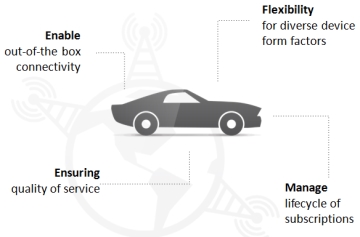
Gemalto Supplies Connected Car and IoT Solutions to Japanese Mobile Operator KDDI
Gemalto is supplying LinqUs On-Demand Connectivity (ODC) enrollment management solutions and embedded SIM (eSIM) to KDDI, a Japanese mobile carrier. With over 40 million subscribers, KDDI can now leverage Gemalto's solutions to ensure secure connectivity for connected cars and IoT applications worldwide. As a result, KDDI is now able to provision all pre-requested operator profiles for connected cars equipped with eSIMs in their pre-embedded state.
2016.07.01by 명세환 기자
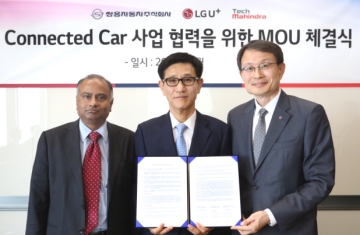
LG Uplus Collaborates with SsangYong Motor Tech Mahindra on Connected Car Business
LG U+ announced that it has signed a business agreement with SsangYong Motor and Tech Mahindra, an IT specialist subsidiary of India's Mahindra Group, to cooperate in LTE-based connected car business. The three companies will jointly promote SsangYong Motor's connected car business, which embeds LTE communication modems in vehicles to provide drivers with safety, security, and infotainment content services. LG U+ will provide the communication services that form the foundation of connected car services and plans to build a content service platform that delivers various infotainment content including real-time navigation, location-based recommendation services, streaming music services, voice recognition, smart home IoT linkage services, smartphone mirroring, and concierge services.
2016.09.27by 신윤오 기자

A single misaligned light means 'defect'… Vehicle interior lighting now guarded by semiconductors and software
Automotive interior lighting is moving beyond its role as 'auxiliary lighting.' As it becomes a core element of user experience (UX) that expresses brand identity through color and animation while reflecting driver preferences, the LED interior ambient lighting market is growing rapidly. In connection with this, we met in advance with Choi Young-jae, Research Director at Dabo Corporation, who will present a technical webinar session on "Intelligent LED Interior Lighting Solutions Illuminating Future Vehicles," to hear about market trends and changes in design requirements.
2026.08.28by 명세환 기자
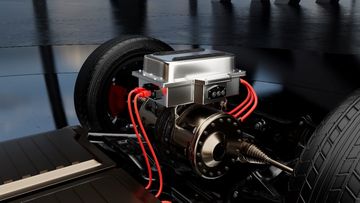
TI Unveils Multi-Axis Coreless Current Sensor TMCS2100-Q1 for HEV/EV Traction Inverters
Texas Instruments has unveiled the TMCS2100-Q1, a multi-axis coreless Hall-effect current sensor for HEV and EV traction inverters. By simultaneously measuring horizontal and vertical magnetic fields through multi-axis sensing technology, it achieves up to 20 times higher accuracy compared to conventional single-axis sensors, while the busbar-unmodified design provides mechanical design flexibility. It simultaneously meets the high-accuracy requirements and miniaturization driven by the expansion of 800V architectures.
2026.08.27by 배종인 기자











