



Is the Era of Virtual Reality (VR) Live Streaming Beginning? Localization of 360-Degree Video Real-Time Streaming Technology
 Published2016.10.18 18:26
Development of differential compression and eye-tracking transmission technology with wide future applications in defense, medical, and education
The 'era of real-time VR (virtual reality) viewing,' which has previously been difficult to livestream due to high data consumption, is expected to begin.
SK Telecom announced that it has developed technology capable of high-quality 4K VR (Virtual Reality) live streaming and demonstrated it at its R&D center in Bundang.
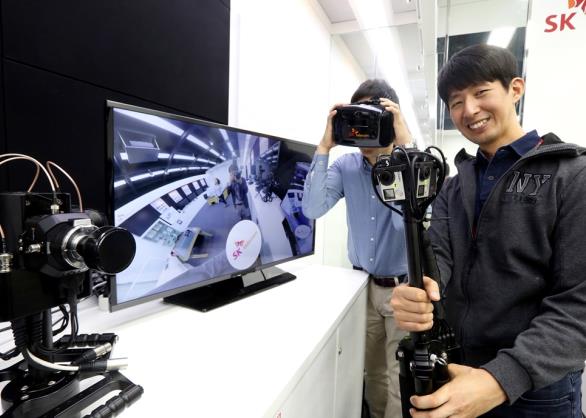
'High-definition VR live streaming' technology is a solution that synthesizes and compresses videos captured through a 360-degree camera into a single VR video and sends it to the user's TV or smartphone, enabling the viewing of VR live streaming.
In particular, VR live streaming technology offers superior immersion compared to conventional broadcasting by allowing viewers to freely watch desired matches in real time. It is currently being utilized not only for live sports broadcasts but also for e-sports and K-pop concerts, and there is high potential for its future application in fields such as national defense, medicine, and education.
In this demonstration, SK Telecom showcased high-definition VR live streaming technology that uses a 'ultra-low latency high-definition VR streaming solution' to synthesize and compress video input from six cameras into 4K UHD video in real time, transmits it seamlessly, and allows it to be downloaded to a smartphone.
SK Telecom plans to commercialize this technology by applying it to various VR fields, while simultaneously pushing for its technology to be included in standardization at the MPEG (Moving Picture Experts Group) meeting, a multimedia standards organization, to be held in Chengdu, China, on the 17th.am.
VR video requires a large amount of data because it must transmit all 360-degree video around the camera. Therefore, unless the video resolution is reduced or the overall quality of the video is lowered, the amount of data cannot keep up with the transmission speed, resulting in stuttering during playback.
To solve this problem, SK Telecom has developed and applied its own 'differential tiling' technology, which allows users to view the main viewing area where their gaze falls in 4K high definition, and the surrounding area where their gaze falls less in Full HD standard definition.
In addition, it is characterized by the development of a technology that tracks the user's gaze and rapidly changes the position of the 4K high-definition area according to the gaze, so that the user can always see only the high-definition area.
With this technology, wireless data consumption is reduced by 65% compared to existing methods even when watching in 4K high definition, which not only significantly lowers the burden of data usage for customers but also reduces interruptions and freezing.
SK Telecom explained that while real-time streaming technology for VR services has previously relied on foreign equipment, it succeeded in localizing the solution by enhancing its completeness through the Korea Internet & Security Agency (NIA)'s 'Giga Internet Leading Pilot Project' and incorporating technologies*.
Park Jin-hyo, Head of SK Telecom’s Network Technology Institute, stated, “This VR live streaming technology will take the customer experience with VR, which is garnering attention as killer content, to the next level,” adding, “SK Telecom will lead the development of innovative technologies that enhance both customer experience and viewing convenience.”
관련뉴스
[A Close Look at ICT R&D] ⑦ Foster New Media Industries such as VR/AR
Broadcasting and smart media services refer to a series of processes and forms in which content is produced targeting multiple users, delivered through wired and wireless networks, and consumed by users through various reception devices. This includes broadcasting and smart media-related services, content, media infrastructure, consumer terminals, mobile broadcasting, broadcasting-telecommunications convergence, immersive broadcasting, signage and other platforms, as well as public welfare and disaster safety technologies. Accordingly, the market size is substantial. The broadcasting and smart media industry is projected to grow at a compound annual growth rate of 11.5%, from 23.86 billion dollars in 2016 to 43.92 billion dollars in 2022. Specifically, services and content are expected to grow at an annual average rate of 2.2%, from 3.22 billion dollars to 3.67 billion dollars, the infrastructure and consumer (terminal) sector is projected to expand at a compound annual rate of 20.1%, from 7.53 billion dollars to 22.63 billion dollars, and the platform sector is anticipated to grow at an annual average rate of 6.4%, from 12.04 billion dollars to 17.51 billion dollars.
2016.09.09by 김수지 기자

What is needed to enter the Chinese VR market is 'this'
중국 가상현실(VR) 산업이 빠르게 성장하는 이유는 무엇일까. 전문가들은 중국 정부의 육성 정책과 중국 기업들의 발 빠른 대처, 중국의 사회 문화 환경 등에서 그 이유를 찾는다. 중국 가상현실 산업의 현재와 미래를 들여다 볼 수 있는 자리가 마련됐다. 10월 첫째 주에 정부가 개최한 ‘Korea VR Festival’ 행사의 일환으로 열린 한-중 가상현실 산업 워크숍에서 그 실마리를 찾을 수 있었다. 행사 주간에 열린 이 워크숍에서는 현재 중국 가상현실 산업에서 두각을 나타내고 있고 기업의 전문가들이 참여하여 중국 시장의 생생한 정보를 전달하였다. 이에 본지에서는 토론 지상 중계를 통해 중국 가상현실 산업의 현실과 국내 산업이 나아갈 길을 모색하고자 한다. 다음은 토론을 요약 정리한 내용이다.
2016.10.17by 신윤오 기자
[Reporter's Notebook] South Korea and China's Perspectives on the Virtual Reality (VR) Industry
In 2014, when Facebook acquired Oculus for $2 billion, virtual reality, or VR, rapidly emerged as a leading player in future industries. Major global IT companies are now stepping forward to actively foster VR businesses. It appears that companies searching for business opportunities in the post-smartphone era are bustling as if virtual reality has materialized as "genuine reality" before their eyes.
2016.10.17by 신윤오 기자
The Problem with AI is Not Performance, but Trust
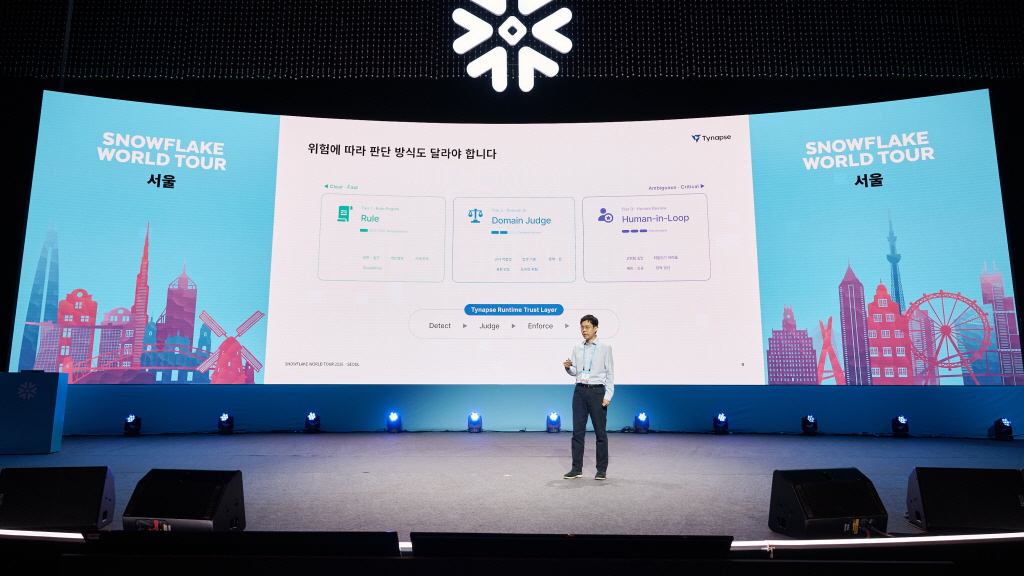
CEO Kang Min-seung emphasized at Snowflake's World Tour Seoul that generative AI has entered a phase where "trust" rather than accuracy becomes the key competitive advantage. As AI is applied to various tasks including consultation, risk management, and operational automation, incorrect data, erroneous responses, and bias are creating actual business risks. He pointed out that enterprises must build a trust layer above AI. To achieve this, accurate data management, semantic structuring, governance, and prompt security are essential. He explained that AI is not merely an automation tool but a technology that reorganizes the entire organization's workflows and decision-making systems. Snowflake provides a platform that supports this trust-based AI operation, emphasizing that enterprises should build "trustworthy AI" rather than "intelligent AI."
2026.08.28by 배종인 기자
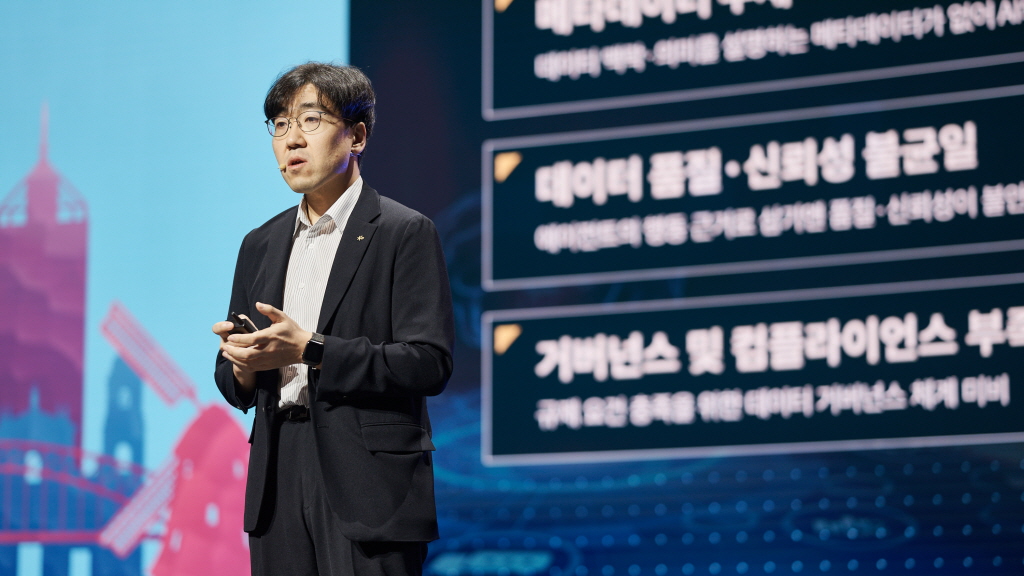
The Decisive Factor for AI Agents in Finance: "Trustworthy Data Infrastructure"
The key to spreading AI agents in the financial sector is establishing a trustworthy data system. KB Kookmin Bank is operating over 100 AI agents by 2025 and is promoting expansion to 300. AI is automating repetitive tasks across various areas such as consultation, risk management, wealth management, and relationship management. However, if data quality, governance, and semantic structuring are insufficient, errors and risks increase. KB is building an AI-Ready organization through a multi-model strategy of GPT, Gemini, and Claude, as well as a Snowflake-based data system. The bank emphasized that AI has entered a phase where it restructures not just simple automation but the entire work process and decision-making system.
2026.08.28by 배종인 기자











