


"Wearable design requires easy and fast development boards – that's the competitive edge"
 Published2016.11.25 16:27
Helps Design Healthcare and Fitness Applications Quickly and Easily
First, a question: When wearable device developers choose a reference board, what feature do they consider most important?
1. Low power consumption
2. Fast prototyping
3. Small size
4. Fast development verification
What is the answer to this question?
The answer is all of 1 through 4.
Developers' choice is singular: achieving maximum results using optimal materials. Particularly in the Internet of Things era, wearable devices must deliver maximum performance in minimum size, and they must complete development verification quickly to avoid falling behind in time-to-market.
Maxim Integrated Korea's (CEO Choi Heon-jung) ultra-compact 'hSensor Platform' for wearables is expected to lead in solving such developer challenges. Healthcare, wellness, and fitness application designers will be able to quickly and easily validate next-generation solutions using the ultra-compact hSensor Platform, the company explained.
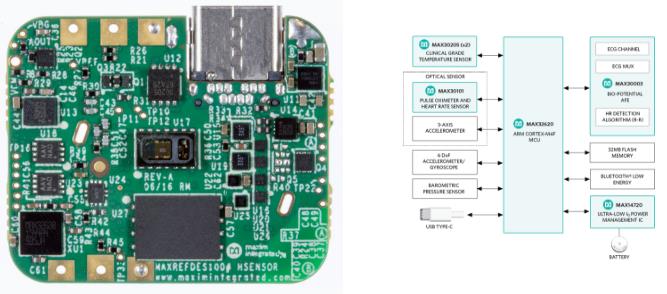
▲ Ultra-Compact hSensor Board and Block Diagram
The reason the hSensor Platform emphasizes fast verification and development becomes clear when examining the complex sensor board development process. Designers who develop custom hardware and firmware must create a prototype, and creating a prototype requires considerable time for sensor evaluation and assessment of existing solutions. However, Maxim's hSensor Platform integrates all hardware components onto a printed circuit board (PCB) and confirms hardware performance immediately using 'ARM mbed' Hardware Development Kit (HDK), accelerating prototype development by 3 to 6 months.
The hSensor Platform, provided as a reference design (MAXREFDES100#), comprises a complete firmware debugger board with hSensor board drivers, a graphical user interface (GUI), and more, with firmware source code available from Maxim's website. By downloading firmware, designers can optimize their designs, evaluate more rapidly, and significantly reduce time-to-market.
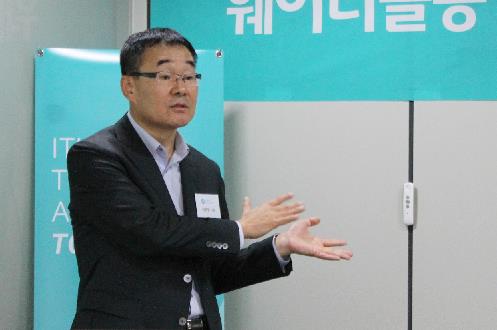
▲Maxim Integrated Korea CEO Choi Heon-jung
The Maxim hSensor Platform features the ultra-low-power single-channel integrated biopotential AFE 'MAX30003', the high-sensitivity oxygen saturation and heart rate measurement sensor 'MAX30101', the clinical-grade temperature sensor 'MAX30205', the lowest quiescent current power management semiconductor (PMIC) 'MAX14720', along with inertial sensors (3-axis accelerometer, 6-axis accelerometer/gyroscope), atmospheric pressure sensor, flash memory, and low-power Bluetooth (BLE) in an ultra-compact form factor (25.4mm x 30.5mm).
The hSensor Platform is suitable for healthcare, wellness, and advanced fitness products such as chest straps, electrocardiogram (ECG) patches, wrist-worn devices, thermometers, disposable temperature measurement patches, blood oxygen measurement, smart scales, and biometric authentication.
Korea Country Manager Choi Heon-jung stated, "Although Maxim entered the sensor market only a few years ago, the sensor business has been growing since domestic major smartphone manufacturers began implementing HRM sensors. As the wearable market is expected to grow significantly in the future, we will continue expanding in this market."
Andrew Baker, Senior Director of Industry and Healthcare Products at Maxim Integrated, also said, "This new product represents a meaningful leap for Maxim. Currently, with wearable device development cycles shortening, the key is how quickly you can establish the concept and reduce development time. In particular, in the IoT era, protecting data securely is important, so Maxim's wearable solution, which incorporates security features, will aim to improve quality of life."
Interview
The following is an exclusive interview with Senior Director Andrew Baker.
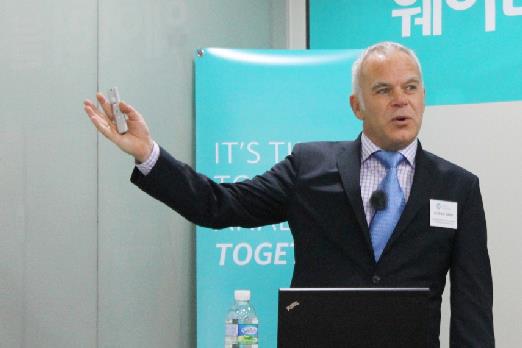
▲Senior Director Andrew Baker
-First, please briefly introduce Maxim's sensor business.
Maxim's sensor business is considered important enough to be selected as a priority project for the 2017 fiscal year. We are expanding investment in this area and plan to continue growing it going forward.
-What differentiates the hSensor Platform from other reference boards?
Currently available reference boards on the market are quite large in size. However, the hSensor Platform was manufactured in an ultra-compact form factor. The reason is to enable developers to reuse it quickly. We made it ultra-compact to shorten the time required for rapid prototyping and concept validation.
-What enables rapid prototyping?
The concept of this newly launched hSensor Platform is that it has already (implemented) tasks that developers would otherwise need to repeat. By creating this board, we resolved various issues related to component interoperability and optimization. The hSensor Platform has been in development for approximately one year, and during that time, through numerous improvements, it has been optimized. Component interoperability is therefore guaranteed and verified. Because the board was designed with optimized performance, developers can create the products they want.
-The ability to minimize the solution likely benefited significantly from Maxim's integration technology.
Most components used on the board were designed from the beginning to be applicable to wearable devices. To that extent, creating such devices requires very high-level integration technology. Unlike existing products, we had to apply extremely high levels of integration technology for the wearable environment. For example, in the power management solution, we integrated multiple converters, and in the ECG AFE, we integrated diverse functions into one unit.
-Security is also an important factor in the healthcare field.
Maxim's MCU incorporates unique security solutions. Unlike typical cases where data encryption is handled through software, Maxim's encryption occurs at the hardware level. This demonstrates robustness against hacking and thorough security.
-What are your goals for the sensor business going forward?
Maxim is approaching diverse markets through sensors. Wearables represent one of these diverse markets, and we plan to target various other fields in the future.
-Is there anything you would like to say to Korean developers?
Ultimately, we launched the hSensor Platform to enable many people to evaluate and develop products themselves as we approach the mass market. We hope many developers will try using it once, shorten their development time, accelerate their time-to-market, and develop many excellent products.
Related news
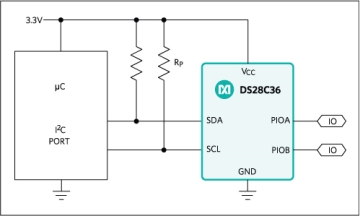
Maxim Announces Secure DeepCover Authentication Device to Protect IP and Guarantee Device Integrity
Maxim Integrated Products Korea (CEO Kim Hyun-sik, www.maximintegrated.co.kr) has announced the DS28C36, a secure DeepCover authenticator device that protects and safely controls industrial, medical, and Internet of Things (IoT) systems. Using the DS28C36, enterprises can protect their intellectual property and ensure device integrity. Faced with frequent product counterfeiting, dangerous reuse of medical auxiliary devices, and vulnerabilities in networks connected to sensor nodes, enterprises have recognized the need for robust security features in their products and systems. The DS28C36 is a compact, cost-effective solution that provides both asymmetric and symmetric key cryptography tools. It supports asymmetric public key functionality based on P256-based ECC (Elliptic Curve Cryptography) algorithms and symmetric secret key functionality based on the SHA-256 algorithm.
2016.10.13by 김수지 기자
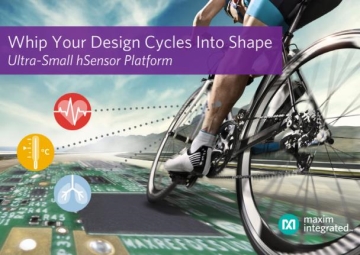
Maxim Announces Ultra-Small Reference Design for Wearables
Maxim Integrated Korea (CEO Choi Hun-jung) has unveiled an ultra-compact 'hSensor Platform' for wearable applications. Designers of healthcare, wellness, and fitness applications can quickly and easily validate next-generation solutions using Maxim Integrated's ultra-compact hSensor Platform. Developing a board with sensors is complex. Designers must first develop custom hardware and firmware for concept verification, then produce prototypes before starting field testing. During prototype development, significant time is spent evaluating sensors and existing solutions. The Maxim hSensor Platform integrates all hardware components onto a PCB (printed circuit board) and allows immediate verification of hardware performance with the 'ARM mbed' Hardware Development Kit (HDK), accelerating prototype development by 3 to 6 months.
2016.11.07by 명세환 기자
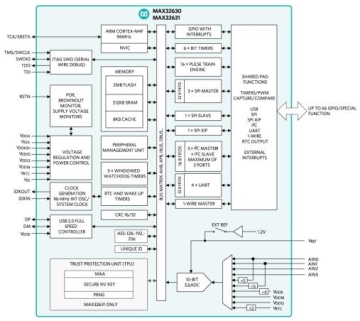
Maxim Simplifies Medical Wearable Design with Ultra-Low Power, High Performance MCUs
Maxim Integrated Korea (CEO Choi Heon-jeong) has announced the ARM Cortex-M4F microcontrollers (MCU) 'MAX32630' and 'MAX32631', which simplify the design of high-performance medical and fitness wearable devices. As the wellness and medical wearable application market grows rapidly, the requirements for electronic components inside wearable devices have become increasingly complex and diverse. Internal electronic components must provide high-level functionality, processing power, and optimal integration with peripherals in a small form factor. In addition to high precision and low noise, power consumption must be extremely low across various operating modes to ensure long battery life with a single charge. The Maxim MAX32630 and MAX32631 MCUs address these challenges.
2016.11.16by 김수지 기자
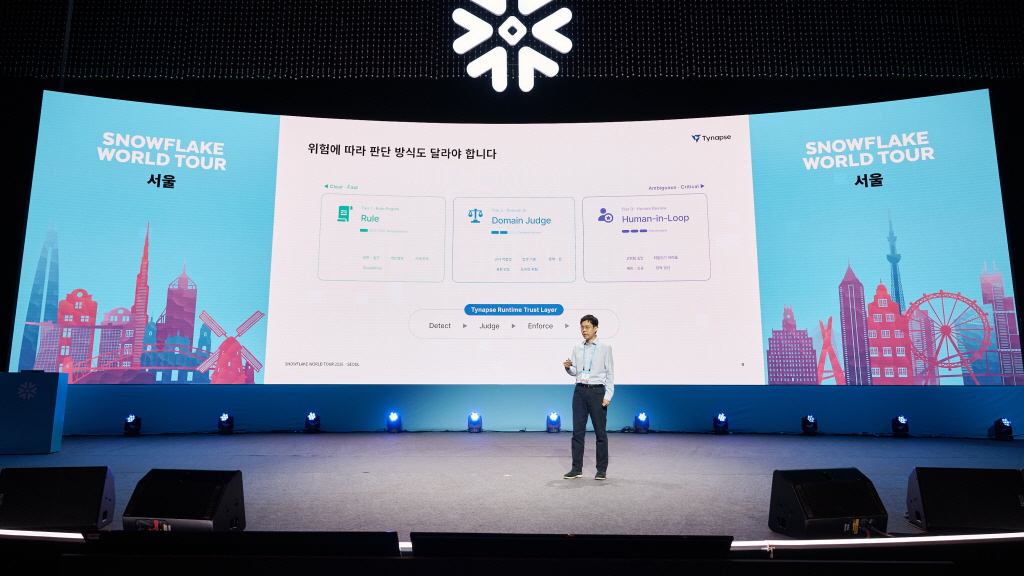
The Problem with AI is Not Performance, but Trust
CEO Kang Min-seung emphasized at Snowflake's World Tour Seoul that generative AI has entered a phase where "trust" rather than accuracy becomes the key competitive advantage. As AI is applied to various tasks including consultation, risk management, and operational automation, incorrect data, erroneous responses, and bias are creating actual business risks. He pointed out that enterprises must build a trust layer above AI. To achieve this, accurate data management, semantic structuring, governance, and prompt security are essential. He explained that AI is not merely an automation tool but a technology that reorganizes the entire organization's workflows and decision-making systems. Snowflake provides a platform that supports this trust-based AI operation, emphasizing that enterprises should build "trustworthy AI" rather than "intelligent AI."
2026.08.28by 배종인 기자
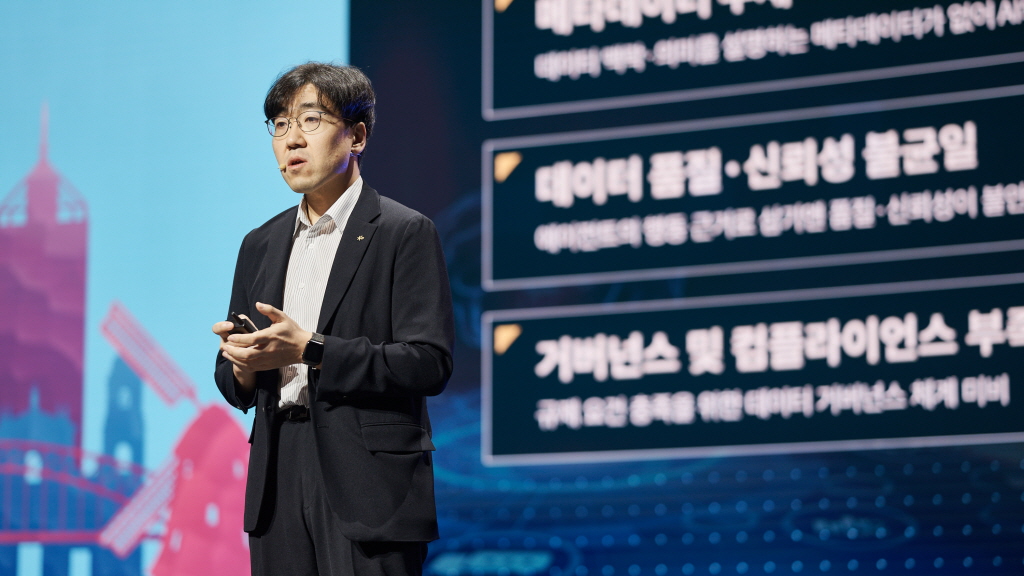
The Decisive Factor for AI Agents in Finance: "Trustworthy Data Infrastructure"
The key to spreading AI agents in the financial sector is establishing a trustworthy data system. KB Kookmin Bank is operating over 100 AI agents by 2025 and is promoting expansion to 300. AI is automating repetitive tasks across various areas such as consultation, risk management, wealth management, and relationship management. However, if data quality, governance, and semantic structuring are insufficient, errors and risks increase. KB is building an AI-Ready organization through a multi-model strategy of GPT, Gemini, and Claude, as well as a Snowflake-based data system. The bank emphasized that AI has entered a phase where it restructures not just simple automation but the entire work process and decision-making system.
2026.08.28by 배종인 기자











