



SK Telecom Presents Technical Standards for Four Core 5G Areas, Successfully Adopted in Succession
 Published2016.11.28 06:32
Only Domestic Telecom Operator Participating in '5G Global Collaboration Group' Active Global Cooperation
The core 5G technical standards proposed by the '5G Global Collaboration Group'* comprising SK Telecom, AT&T, Deutsche Telekom, Ericsson, and 15 other global telecommunications and equipment companies have been adopted by 3GPP (3rd Generation Partnership Project), the world's mobile communications standardization body.
With this, 5G standardization work is assessed to have surpassed the 70 percent mark. At a time when international concerns are heightened regarding fragmentation of the 5G ecosystem due to recent diverse 5G standard announcements, SK Telecom's leadership in standardization based on the Global Collaboration Group is drawing attention.
The 5G Global Collaboration Group formed the '5G Global Joint Collaboration Group' last August with 15 companies including global mobile communications and equipment providers such as AT&T, Deutsche Telekom, Ericsson, Nokia, and Samsung for 5G standardization, and SK Telecom is the only domestic telecommunications provider participating in it.
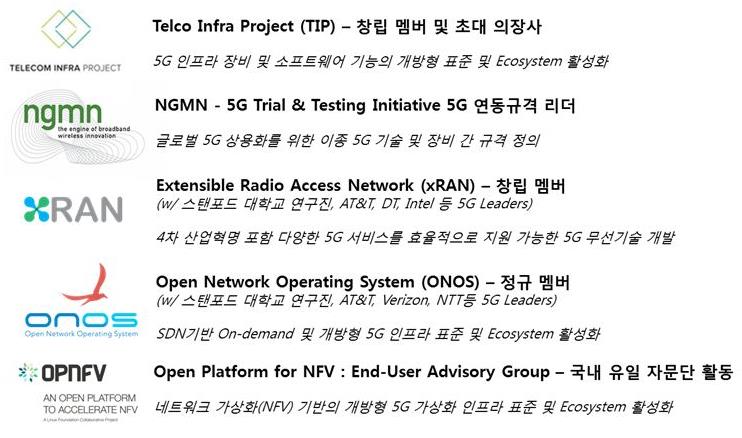
▲5G Global Collaboration Group in which SK Telecom is participating
SK Telecom announced on the 27th that through cooperation among the '5G Global Collaboration Group' formed in August, it has successively proposed and achieved adoption of unified technical standards in four areas: data transmission, virtual networks, and data response latency.
The technical standards proposed by the '5G Global Collaboration Group' include ▲technology to minimize errors in the process of high-capacity data transmission ▲technology to partition a single physical network into multiple virtual networks according to service characteristics ▲technology to enhance perceived service quality by improving data request response speed ▲technology to enhance efficiency by configuring networks with only essential functions tailored to services, etc., and are evaluated as the most important framework to bring out the characteristics of 5G.
The '5G Global Collaboration Group' plans to move away from fragmented 5G development and discuss and agree on 5G technology from the perspectives of future commercialization and subsequent evolution, reflecting these in 3GPP, the international official mobile communications standardization body.
Meanwhile, SK Telecom is also leading 5G technology innovation at NGMN (Next Generation Mobile Networks), an international standardization body that discusses the blueprint for next-generation networks and defines new service requirements. NGMN is an organization that leads standardization discussions and cooperation for next-generation network infrastructure, service platforms, and terminals from the perspective of mobile communications operators and users.
SK Telecom was elected as the chairperson of NGMN in 2012 and led LTE-A standardization. To promote early commercialization of 5G, it was elected as the leader of the 5G Trial and Testing Initiative* established this year, and is taking the lead in creating a 5G equipment development ecosystem by standardizing interoperability verification between equipment such as terminals-base stations, core-base stations, and 4G-5G connections, which are the most critical aspects of 5G commercialization.
Park Jin-hyo, Head of Network Technology at SK Telecom, emphasized, "While leading 5G standard specification through the Global Collaboration Group, we plan to promote commercialization of 5G innovative technology together with major global equipment and chipset manufacturers."
Comments
Related news

SK Telecom to Develop 5G AI-Based Autonomous Vehicles with Intel
SK Telecom has partnered with Intel, a global semiconductor chip manufacturer, to jointly develop autonomous driving technology based on 5G and deep learning. SK Telecom (CEO Park Jae-young, www.sktelecom.com) announced that it has signed a memorandum of understanding (MOU) with Intel (CEO Brian Krzanich), a global semiconductor chip manufacturer, for joint research and development of autonomous driving technology and services.
2016.10.31by 신윤오 기자

SK Telecom Joins 5G Automotive Association Established by BMW and Mercedes-Benz
SK Telecom announced that it has become the first domestic company to join the '5G Automotive Association (5GAA)', which was established by global telecommunications and automotive companies to research 5G technologies and services to be applied to future vehicles. The '5GAA', established in September of this year, started with three German automakers—BMW, Mercedes-Benz, and Audi—and eight global companies in the telecommunications, network equipment, and chipset sectors. With this announcement, SK Telecom, Deutsche Telekom, and Valeo (automotive parts supplier) have joined as additional participants.
2016.11.07by 홍보라 기자
SK Telecom launches new network brand 'Quantum' marking leap into 5G
SK Telecom is launching a new network brand called 'Quantum'. 'Quantum' refers to the 'quantum', the minimum unit of all physical entities, and is used as a concept in quantum mechanics to explain transcendence of space and time. This signifies SK Telecom's will for transcendental and dramatic change toward 5G that surpasses its existing network experience.
2016.11.23by 신윤오 기자
European Patent Applications Surpass 200,000 for the First Time… South Korea Maintains 5th Place, Led by Batteries and Telecommunications
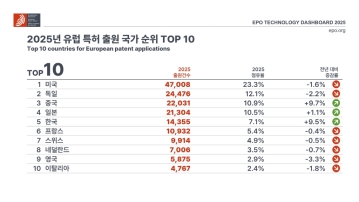
According to the European Patent Office (EPO)'s 'Technology Dashboard 2025', European patent applications last year reached 201,974, surpassing 200,000 for the first time. Korean companies and inventors filed 14,355 applications, representing a 9.5% increase from the previous year and maintaining 5th place by country. Battery, digital communication, and semiconductor technologies led the growth, with Samsung ranking as the top EPO applicant for the second consecutive year and LG reaching 3rd place. The presence of major domestic cities such as Seoul, Suwon, and Yongin was also confirmed. It was also revealed that Korea's European patent strategy is expanding beyond individual technologies to span the entire industry.
2026.03.24by 명세환 기자

SK Telecom First Applies AI-Based Network Operations at Gwanghwamun K-Pop Concert
SK Telecom announced that it applied an AI-based network operation system for the first time at a large-scale K-pop concert held in the Gwanghwamun area of Seoul on March 21st, managing communication quality throughout the event. Mobile data usage during the three hours before and after the concert reached 12.15TB, approximately doubling compared to the same time slot the previous weekend. SK Telecom monitored traffic using the AI system 'A-One' in five-minute and 50-meter units to respond to potential overload situations, while also operating temporary communication facilities and on-site personnel in parallel. This case is interpreted as confirmation of the practical applicability of AI-based autonomous network operation in an environment where demand from dense events and foreign users increases simultaneously.
2026.03.23by 명세환 기자











