



Launch of USRP Solution for University Communications Lab Experiments
 Published2011.10.26 13:39
National Instruments has announced the launch of new educational platforms, the NI USRP-2920 and NI USRP-2921. Until now, universities have relied on computer-based simulations to practice theoretical concepts, but these products, as USRP (Universal Software Radio Peripheral) instruments, provide hands-on learning using actual signals in RF and communications laboratories. This new platform, consisting of NI USRP hardware, NI LabVIEW software, and learning course materials, offers an affordable commercial solution that enables students to directly practice the mathematical theories learned in existing lectures through real-world applications.
Thad Welch, professor and Ph.D. at Boise State University, stated, "In recent years, USRP has been gaining prominence in universities as a research tool in areas such as software-defined and cognitive radio. When educators use LabVIEW support and experimental materials for curricula alongside NI USRP, students can better understand RF and communications through hands-on experiments."
Using this platform, students can implement abstract mathematical theories in experiments utilizing real communication systems. The NI USRP device is characterized by having a software-tunable front end covering frequency ranges from 50 MHz to 2.2 GHz or 5 GHz ISM bands. Additionally, because this hardware integrates a software-reconfigurable RF transceiver and high-speed A/D and D/A converters, it is possible to stream baseband I and Q signals through gigabit Ethernet to the host PC at 20 MS/s speed for real-time spectrum access.
The effectiveness of NI USRP technology has been verified through use by undergraduate electrical engineering students at Stanford University in laboratory settings. These undergraduates were able to gain deeper understanding of engineering concepts through communication systems developed via hands-on projects during the spring 2011 semester.
Sachin Katti, associate professor in the Department of Electrical Engineering and Computer Science at Stanford University, stated, "I wanted students planning careers in engineering to experience real signals as early as possible. Through NI USRP and LabVIEW, students were able to experience actual RF and communications for the first time, which has been greatly beneficial for educators in teaching theoretical concepts and for students in learning them."
Educators can use the NI USRP platform to teach curricula and topics such as digital communications, communication systems design, antenna theory, digital modulation, wireless communications, software-defined radio, digital signal processing, and information theory. Additionally, the new USRP educational platform can be extended for communications practice, research, and rapid prototyping applications.

Related news
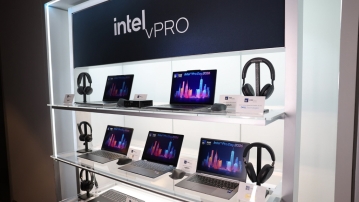
Intel Unveils Next-Generation 'Core Ultra Series 3' and vPro Platform for Enterprise PCs
Intel has officially unveiled the "Intel Core Ultra Series 3" for next-generation enterprise PCs and the latest vPro platform, addressing a wide range of demands from enterprise notebooks to high-performance workstations.
2026.03.26by 배종인 기자
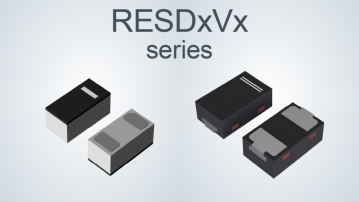
ROHM Launches ESD Protection Diode Compatible with High-Speed Interfaces of 10Gbps or Higher
Semiconductor specialist ROHM has developed the 'RESDxVx series' of ESD (electrostatic discharge) protection diodes capable of responding to next-generation high-speed data communication environments exceeding 10Gbps, simultaneously enhancing both signal quality maintenance required in high-speed interfaces and IC protection performance.
2026.03.26by 배종인 기자
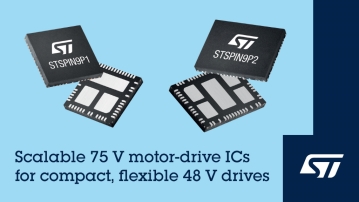
ST Launches 75V Drive IC Targeting 48V Industrial Motor Driving
ST Microelectronics has unveiled the 'STSPIN9P' series of 75V motor drive ICs tailored for 48V-class industrial drive system design. The new product family is characterized by half-bridge and full-bridge configurations that enable design scalability according to motor type and output conditions. Power supply circuits, protection functions, and current sensing circuits are integrated on-chip to simplify system configuration, and the devices are designed to support applications up to 500W maximum. The company plans to provide reference designs and demo boards to support development and evaluation in industrial automation, robotics, pumps, fans, lighting, and textile machinery.
2026.03.26by 배종인 기자
Nordic supports security updates for the entire lifecycle of IoT devices at a single fixed cost
Nordic Semiconductor, a global leader in low-power wireless connectivity solutions, has unveiled a single fixed-cost licensing model that delivers FOTA (Firmware Over-the-Air) and device management capabilities throughout the device lifecycle via nRF Cloud, and introduced a new firmware update solution to prepare for the enforcement of the European Union's Cyber Resilience Act (CRA).
2026.03.26by 배종인 기자
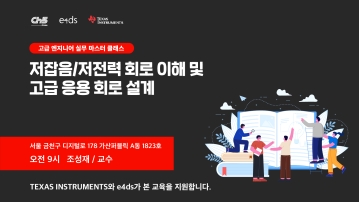
Practical Training in Low-Noise, Low-Power Circuit Design All in One Place… Training Fee Support
The "2026 Advanced Engineer Practical Masterclass" to strengthen competencies in high-sensitivity analog circuit and sensor-based system design will be held on April 16 at the e4ds Conference Center in Gasan-dong, Seoul. This program will be conducted as an offline paid hands-on training session, not online, and is targeted at engineers seeking on-site intensive learning. Texas Instruments will provide educational support for this training, allowing participation at 150,000 won, a 100,000 won discount from the original price of 250,000 won.
2026.03.26by 배종인 기자











