



Materials and components exports declined last year, showing recovery trend from the second half
 Published2017.01.18 09:38
Exports of $25.19 Billion, Trade Surplus of $9.94 Billion Representing 111% of All Industries
Materials and components exports in Q4 2016 increased 2.0% for the first time in seven quarters since Q1 2015.
Exports (2.0%), imports (1.7%), and trade balance (6.3%) all turned positive, and export unit prices showed a recovery trend. In 2016, our materials and components exports totaled $25.19 billion (up 4.8%), imports totaled $15.25 billion (up 4.5%), and the trade surplus reached $9.94 billion.
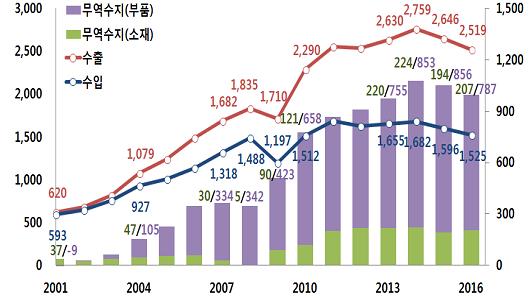
▲Materials and Components Industry Trade Performance
Materials and components exports last year declined 4.8% ($1.27 billion) compared to the previous year. However, export and import growth rates showed recovery from November 2016 onward, marking two consecutive months of growth for the first time in 20 months. The Ministry of Industry announced plans to implement the Fourth Basic Plan for Materials and Components Development (December 27, 2016) without delay, converting materials and components policy to support the fourth industrial revolution, thereby backing the cultivation of related new industries and the advancement of leading industries.
Materials showed positive growth in both exports (up 2.7%) and imports (up 0.9%) in the second half compared to the first half. Components showed a slight decline in year-on-year trade results, but certain items such as electrical machinery components and computers and office equipment led export recovery in the second half of 2016.
By region, exports to China decreased (down 11.5%), while exports to ASEAN (up 8.9%) and Japan (up 3.2%) increased. China saw decreased exports of electronic components (semiconductors, displays, wireless communications equipment) and transportation machinery due to improved self-sufficiency in materials and components. The ASEAN region saw increased trade volume following the implementation of the Korea-Vietnam Free Trade Agreement (FTA), and exports grew due to expansion of Korean companies entering Vietnam. In particular, export performance expanded centered on electronic components and electrical machinery components. Japan experienced significant increases in transportation machinery components and electrical machinery components including generator parts, as complete vehicle manufacturers diversified supply chains following the Kumamoto earthquake in the second half of the year.
By region, imports declined in most areas including Europe (down 14.6%) and China (down 8.2%), while Vietnam (up 37.9%) and Japan (up 3.1%) within ASEAN showed increases.
Do Gyeong-hwan, Director of Industrial Base at the Ministry of Industry, stated, "We will actively support advanced new materials and components technology development, future-type materials and components infrastructure construction, and global partnering (GP) business expansion to promote high value-added growth of our materials and components industry, and concentrate all policy capabilities to achieve positive export growth and a trade surplus of $100 billion in 2017."
Related news
Trade Surplus in Materials and Components for Two Consecutive Years; Competitiveness of the Materials Industry Remains a Challenge
Last year, materials and components exports surpassed 50% of total exports for the first time in history, and achieved trade surpluses exceeding $100 billion for two consecutive years, demonstrating that they have served as a solid foundation for our economy despite challenging conditions such as low oil prices, weak yen, and sluggish emerging market economies.
2016.01.11by 신윤오 기자

[2017 Outlook] Focus on Multi-Cloud Adoption and Expanding Business Mobility
VMware (CEO Pat Gelsinger) has announced the "Top 10 IT Predictions for 2017." The report, authored by Bask Iyer, Chief Information Officer at VMware headquarters, contains IT market outlook and trends to watch for 2017. According to the report, in 2017, enterprise digitalization will intensify, and business mobility will evolve beyond simple mobile management to a level that enhances sales and operational efficiency. Additionally, as the types of cloud utilized by enterprises become more diverse, effective operational methods will be recognized as a core competency. The expansion of IT influence will accelerate innovation and enhance customer experience.
2016.12.23by 신윤오 기자

Total global device shipments this year are expected to reach 2.3 billion units, similar to last year.
IT consulting firm Gartner Inc. forecasted that the total global shipments of all devices (PCs, tablets, ultramobiles, and mobile phones) in 2017 would reach 2.3 billion units, remaining at a similar level to the previous year. In 2016, mobile phones, tablets, and PCs were estimated to have approximately 7 billion units in use worldwide. Gartner projected that shipments of existing devices would not increase through 2018, while ultramobile and mobile phone shipments are expected to see marginal growth.
2017.01.16by 홍보라 기자

Intel Unveils Next-Generation 'Core Ultra Series 3' and vPro Platform for Enterprise PCs
Intel has officially unveiled the "Intel Core Ultra Series 3" for next-generation enterprise PCs and the latest vPro platform, addressing a wide range of demands from enterprise notebooks to high-performance workstations.
2026.03.26by 배종인 기자

ROHM Launches ESD Protection Diode Compatible with High-Speed Interfaces of 10Gbps or Higher
Semiconductor specialist ROHM has developed the 'RESDxVx series' of ESD (electrostatic discharge) protection diodes capable of responding to next-generation high-speed data communication environments exceeding 10Gbps, simultaneously enhancing both signal quality maintenance required in high-speed interfaces and IC protection performance.
2026.03.26by 배종인 기자











