



[Discussion] Telecom companies: "Give us more 5G frequency bands" vs. government: "3GPP standards must be met before allocating more frequencies."
 Published2017.02.14 13:56
The three major telecom companies say they need at least 800GHz of bandwidth .
With the PyeongChang Winter Olympics just one year away , interest in 5G trial services is growing .
Among these , a place was created to look back on the 5G standardization trends and technology development status . On the 10th, the Korea Institute of Communications and Information Sciences held a workshop titled "5G Standard Technology and Frequency / Industry Trends " for academic and industrial professionals in the medium-sized conference room of the Construction Center . The workshop explored 5G core technologies , frequency demand , allocation trends , and standardization trends, and included presentations and discussions on the current status of 5G technologies by SK Telecom , KT, and LG U+ . E4ds News reports on the main issues raised at the workshop and the contents of the discussions . < Editor's Note >
The three telecommunications companies, which are currently aiming for early commercialization of 5G, are accelerating efforts to establish 5G areas in which they can each specialize.
First, KT, a pilot service partner, is preparing for the PyeongChang Olympics to the extent that Chairman Hwang Chang-gyu came forward and said, “5G is not simply a network evolution, but an important strategic asset that will lead the Fourth Industrial Revolution.”
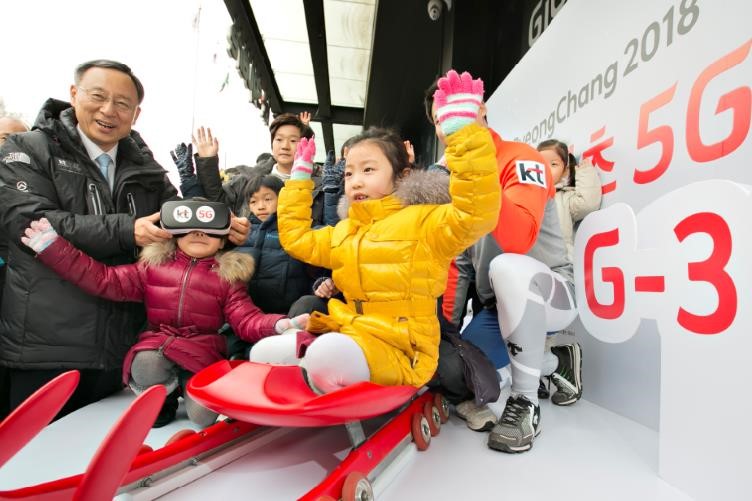
▲ Chairman Hwang Chang-gyu visits the ' Pyeongchang Winter Olympics G-365 Experience Zone ' that opened at KT Square .
The pilot service that KT will present at the Pyeongchang Olympics will be in the 28GHz band. KT's Team Leader Kwak Do-young said, "Since the standard for 5G technology has not been established yet, we have established the world's first 5G standard that satisfies Verizon and the ITU-R (International Telecommunication Union) requirements," and added that the 28GHz field test of the 5G bus to be shown in PyeongChang was conducted in Gwanghwamun and the result was that it is possible even in a large city with tall buildings. He also explained that they plan to show Omni View, which provides 360-degree omnidirectional video, Time Slice, which expresses movement in three dimensions, Sync View, which is seen from the athlete's perspective, Hologram Live, which will be broadcast as real-time streaming, and security services using 5G (5G IoT-5G Safety).
Among the services that can be implemented with 5G, SK Telecom announced that it is focusing on connected cars. SKT's Lab Director Cho Seong-ho said, "There is talk of services such as VR and AR being implemented with 5G, but in order to differentiate ourselves from existing LTE services, we need to provide services that are one step ahead." He added, "We will provide a connected car service that enables safe driving using V2X, image recognition, drones, and multi-beams."
LG Uplus' team leader Kim Jung-seop said, "5G will enable services across a wide range of environments, including VR/AR, self-driving cars, remote surgery, smart cities, smart factories, and smart buildings," and added that they are focusing on issues that may arise when 5G is commercialized.
What needs to be prepared for successful 5G deployment and frequency allocation ?
Following the technological status of the three major telecommunications companies, a panel discussion was held. They discussed what preparations are needed for the successful introduction of 5G and frequency allocation. The discussion was based on the Ministry of Science, ICT and Future Planning's (MSIP) K-ICT Spectrum Plan presentation. Moderated by Professor Hong In-ki of the Department of Electronic and Radio Engineering at Kyung Hee University (moderator), the panel included Kim Gyeong-woo, Director of the MSIP's Frequency Policy Division; Choi Young-seok, Executive Director of KT; Lim Hyeong-do, Executive Director of SKT; Park Hyeong-il, Executive Director of LGU+; and Noh Won-il, Executive Director of Samsung Electronics.
The Ministry of Science, ICT and Future Planning announced the K-ICT Spectrum Plan on January 18th. This plan is a comprehensive mid- to long-term spectrum plan covering the period up to 2026. It is divided into four areas: mobile communications, industrial frequency, public frequency, and satellite frequency. The central plan is to provide a total of 4.3 GHz of 5G frequency by 2026. It was reported that the plan is to divide it into three stages: 2018 (Stage 1), 2021 (Stage 2), and 2026 (Stage 3), and supply 1.3GHz bandwidth in Stage 1, 2GHz bandwidth in Stage 2, and 1GHz bandwidth in Stage 3.
In the first phase (2018-2019), the 27.5-28.5 GHz band will be supplied, and the 3.5-3.7 GHz band will be supplied with a width of 300 MHz to secure coverage. In the second phase, the left and right adjacent bands of 28GHz, 26.5-27.5GHz and 28.5-29.5GHz bands are provided in 2GHz width, but if the ecosystem environment is created, the total 3GHz width can be supplied earlier in the first phase.
Since the announcement of the plan, the company has been discussing with relevant experts and business operators various matters related to allocation, including the size of the allocation blog, auction method, allocation period, allocation price, additional conditions for allocation, and measures to ensure fair and effective competition.
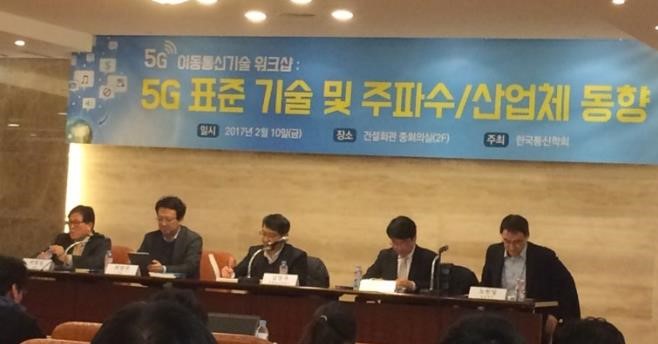
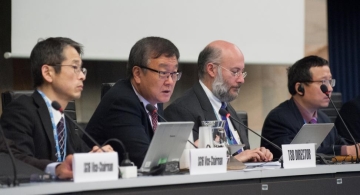
▲ A discussion session at the '5G Standard Technology and Frequency / Industry Trends ' workshop hosted by the Korea Institute of Information and Communications Sciences .
All three major telecommunications companies expect 5G to be commercialized in 2019 or early 2020 at the latest.
In response to additional questions about the discussion, including how the service will be implemented at the PyeongChang Olympics and whether terminals with LTE and mmWave will be supplied, Executive Director Choi Young-seok said, “We plan to distribute terminals and allow people to experience the service. He replied, "The terminal hasn't been set up yet." Managing Director Noh Won-il added, "Technically, it's impossible to build a network solely using mmWave, so I expect both will be deployed together to ensure a quick transition to LTE when haulback occurs."
관련뉴스
LG Uplus successfully demonstrates 31 Gbps speeds at a 5G base station for the first time.
LG유플러스는 서울 금천구 독산동 사옥 기술 실험실에서 시험용 5G 기지국을 이용해 현재 이용중인 3밴드 LTE_A 기술보다 100배 이상 빠른 최대 31Gbps의 다운로드 전송 속도를 국내 최초로 시연하는데 성공했다고 밝혔다. LG유플러스의 5G 기지국이 상용화되면 2GB 고화질 영화 1편을 0.5초만에 휴대폰에 내려 받을 수 있게 된다.
2016.11.14by 홍보라 기자
SK Telecom Begins Development of 5G Equipment and Terminals Based on 3GPP Standards
SK Telecom (www.sktelecom.com) announced on the 21st that it has begun designing base station equipment and terminal prototypes based on the 5G specifications established by 3GPP*, a global standardization body, together with Qualcomm and Ericsson. SK Telecom, Ericsson, and Qualcomm, as the leading companies in the mobile communications, base station equipment, and chipset sectors respectively, plan to conduct interoperability testing in the second half of 2017, when the initial development of 5G base station equipment and terminal prototypes is completed.
2016.12.22by 신윤오 기자
KT Leads International Standards in 5G Pilot Services
KT는 1월 16일에서 27일까지 스위스 제네바에서 개최된 국제전기통신연합(ITU) 회의에서, KT 5G 시범 서비스 5개가 국제표준 초안으로 채택되었다고 30일 밝혔다. KT는 평창 올림픽을 위해 개발해 온 5G 서비스들의 시나리오 및 기술요구사항을 국제표준 기고서로 제안, 표준 문서 초안으로 선정되었다.
2017.01.31by 김지혜 기자
The Problem with AI is Not Performance, but Trust
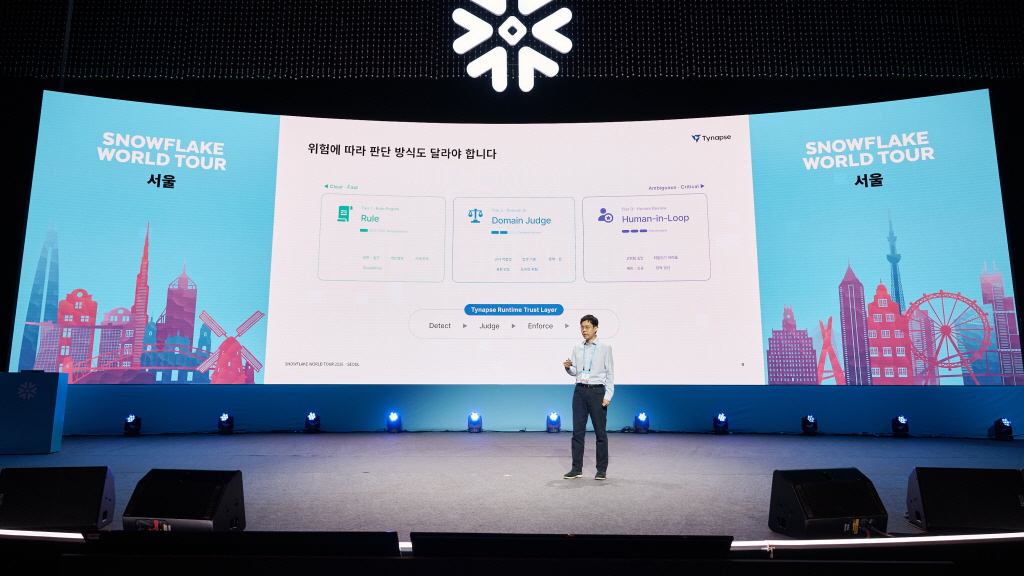
CEO Kang Min-seung emphasized at Snowflake's World Tour Seoul that generative AI has entered a phase where "trust" rather than accuracy becomes the key competitive advantage. As AI is applied to various tasks including consultation, risk management, and operational automation, incorrect data, erroneous responses, and bias are creating actual business risks. He pointed out that enterprises must build a trust layer above AI. To achieve this, accurate data management, semantic structuring, governance, and prompt security are essential. He explained that AI is not merely an automation tool but a technology that reorganizes the entire organization's workflows and decision-making systems. Snowflake provides a platform that supports this trust-based AI operation, emphasizing that enterprises should build "trustworthy AI" rather than "intelligent AI."
2026.08.28by 배종인 기자
The Decisive Factor for AI Agents in Finance: "Trustworthy Data Infrastructure"
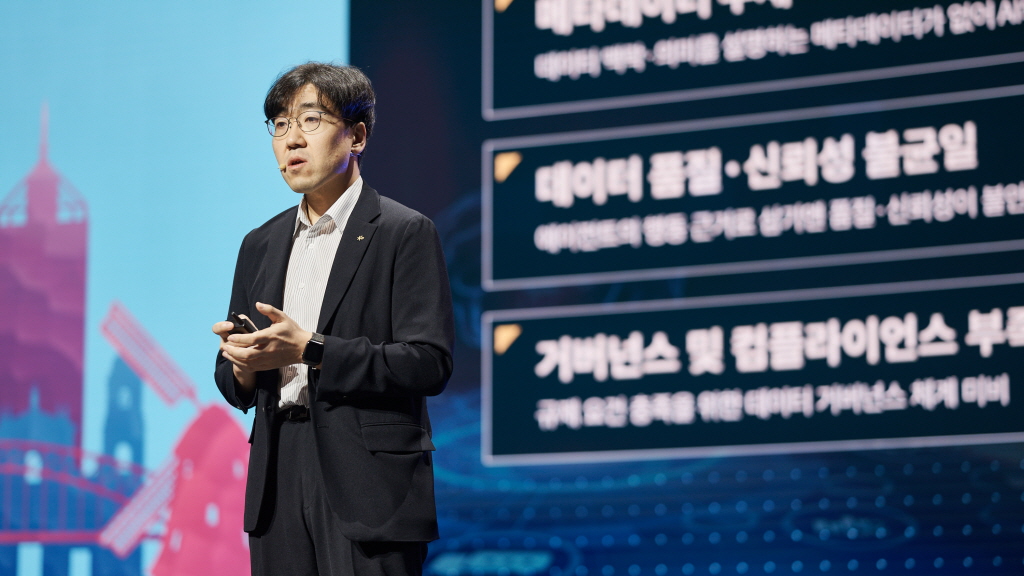
The key to spreading AI agents in the financial sector is establishing a trustworthy data system. KB Kookmin Bank is operating over 100 AI agents by 2025 and is promoting expansion to 300. AI is automating repetitive tasks across various areas such as consultation, risk management, wealth management, and relationship management. However, if data quality, governance, and semantic structuring are insufficient, errors and risks increase. KB is building an AI-Ready organization through a multi-model strategy of GPT, Gemini, and Claude, as well as a Snowflake-based data system. The bank emphasized that AI has entered a phase where it restructures not just simple automation but the entire work process and decision-making system.
2026.08.28by 배종인 기자











