

.png)

Industry's First Cortex-M0 MCU with Integrated Segment LCD Driver Launched
 Published2011.10.04 09:55
NXP Launches Industry's First Cortex-M0 MCU with Integrated Segment LCD Driver
- Providing high-contrast LCD displays at reasonable prices ∙∙∙ Integrated applications in industrial automation, lighting, home electronics, etc.
September 28, 2011, Seoul — NXP Semiconductors (NASDAQ: NXPI) today launched the LPC11D00 and LPC12D00 series microcontrollers, which feature the industry's first integrated segment LCD driver on ARM® Cortex™-M0 microcontrollers. This enables high contrast and high brightness on a single chip. Equipped with NXP's PCF8576D LCD driver, the LPC11D00 and LPC12D00 can drive any static or multiplexed LCD with up to four backplanes and 40 segments, and can easily be connected to a multi-segment LCD driver capable of holding up to 2,560 segments for larger display applications.

With the launch of the LPC11D00 and LPC12D00, NXP can integrate LCDs into a wide range of applications such as industrial automation, home appliances, lighting, home electronics, and portable medical devices, and reduce overall system costs by up to 15%. NXP is showcasing its new display microcontrollers at the ESC (Embedded Systems Conference, Booth 800) currently being held in Boston, USA.
Jean-Jap Besmer, Marketing Director for NXP’s Microcontroller Product Line, said, “Our Cortex-M0 microcontrollers have enjoyed significant popularity as replacements for 8-bit and 16-bit MCUs in home appliance and industrial applications. “System designers have hoped to be able to drive high-quality, high-definition segment LCD displays without the need for two chips or being trapped in legacy MCU architectures, and we are now providing a convenient Cortex-M0 solution for them,” the company stated. “The LPC11D and LPC12D series provide cost-effective basic options for the Cortex-M LCD portfolio, which includes Cortex-M3-based graphic LCD controllers capable of driving TFT and STN displays. NXP’s LCD portfolio includes Cortex-M3-based graphic LCD controllers capable of driving TFT and STN displays. These newly released products reinforce the rich range of options made possible through the collaboration between NXP and ARM.”
In contrast to current general-purpose segment LCD drivers, the NXP PCF8576D LCD driver exhibits high stability and supports a wide LCD supply range between 2.5 V and 6.5 V, making it an ideal choice for interfacing the LPC11D00 and LPC12D00 with both high-threshold and low-threshold LCDs. The integrated PCF8576D enhances system reliability and quality while reducing electrical interconnect and compatibility issues, and includes key features such as on-chip display RAM and versatile blinking modes.
In addition to making the entire display blink, the LPC11D00 and LPC12D00 also support AC messages appearing on arbitrarily selected LCD elements at a settable (changeable) blink frequency. Display data sent from the microcontroller is stored in 40 x 4-bit on-chip display RAM that supports direct mapping to the LCD elements displayed on the display. In addition, since these characteristics are maintained even in low-power mode, the LPC11D00 and LPC12D00 are considered competitive solutions for low-power 8/16-bit applications requiring low-cost segment LCD integration.
The LPC11D00 supports up to 32KB Flash and 8KB SRAM, and includes a rich set of peripherals such as two SSPs, I2C (FM+), UART, four system timers, and an 8-channel high-precision 10-bit ADC. As an extension of the energy-efficient LPC 1100L family, the LPC11D00 also implements differentiated API-driven power profiles, providing users with ready-to-use power management templates and enabling designers to achieve runtime optimization, efficiency, and dynamic power consumption through simple API calls.
The LPC12D00 expands on the feature set of the LPC11D00 and features up to 128KB of flash and innovative analog peripherals such as 32 levels of voltage reference and dual analog voltage comparators with edge and level detection and output feedback loops. As a newly upgraded version of the LPC1200 industrial control series, the LPC12D00 is a highly stable solution for industrial automation and white goods applications where safety is paramount. The LPC1200 product family received a high immunity rating in the electrical fast transient (EFT) test conducted by Langer EMV-Technik GmbH in accordance with the IEC 61697-1 recommendations and received IEC 60730 Class B certification.
LPC11D00 Key Features
NXP’s LPC11D00 display microcontroller is the latest version of the ultra-low power Cortex-M0 microcontroller LPC1100L and offers the following features.
• Up to 50 MHz speed on LPC1100L
• 32 vector interrupts; 4 priority levels; dedicated interrupts for up to 13 GPIOs
• Serial Peripherals: UART, 1-2 SSP, I2C (FM+)
• Two 16-bit and two 32-bit timers with PWM/Match/Capture functions
• 12 MHz internal RC oscillator with 1% accuracy for heat and voltage
• Power-On-Reset (POR); Multi-level BOD (Brown-Out-Detect); Phase-Locked Loop (PLL)
• 8-channel high-precision 10-bit ADC including ±1LSB DNL
The LPC11D00 series combines these various functions with the ARM Cortex-M0 v6-M 16-bit Thumb instruction set, enabling code density to be increased by up to 50% compared to 8/16-bit microcontrollers used for general tasks.
LPC12D00 Key Features
NXP's LPC12D00 display microcontroller is an extension of the very powerful LPC1200 industrial control series. It also includes up to 55 GPIOs and multiple timer/serial channels to provide the accuracy required for baud rate generation, as well as onboard peripherals including an RTC, DMA, CRC, and an internal oscillator with 1% accuracy. Other features are as follows.
• Windowed watchdog timer with an independent internal oscillator source designed to comply with IEC 60370 Class B safety requirements for white goods
• Use programmable digital filters on all GPIO pins to improve signal integrity management for industrial applications
• An optimized ROM-based divide library for Cortex-M0 that not only provides the computational performance of a software-based library but also combines a reduced flash code size with highly deterministic cycle times
• Dual analog comparator with 32-step voltage reference, edge and level detection, and output feedback loop
Pricing and Availability
NXP's LPC11D14 and LPC12D27 microcontrollers are currently in the sampling phase, and 2011

관련뉴스

Intel Unveils Next-Generation 'Core Ultra Series 3' and vPro Platform for Enterprise PCs
인텔이 차세대 기업용 PC를 위한 ‘인텔 코어 Ultra 시리즈 3’와 최신 vPro 플랫폼을 공식 발표하며, 기업용 노트북부터 고성능 워크스테이션까지 폭넓은 수요 충족에 나섰다.
2026.03.26by 배종인 기자

ROHM Launches ESD Protection Diode Compatible with High-Speed Interfaces of 10Gbps or Higher
반도체 전문 기업 로옴(ROHM)이 10Gbps를 넘어서는 차세대 고속 데이터 통신 환경에 대응할 수 있는 ESD(정전기 방전) 보호 다이오드 ‘RESDxVx 시리즈’를 개발하며, 고속 인터페이스에서 요구되는 신호 품질 유지와 IC 보호 성능을 동시에 끌어올렸다.
2026.03.26by 배종인 기자
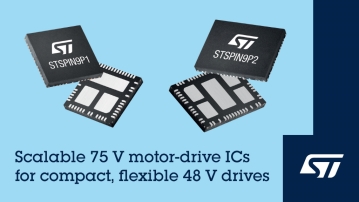
ST Launches 75V Drive IC Targeting 48V Industrial Motor Driving
ST마이크로일렉트로닉스가 48V급 산업용 구동 시스템 설계에 맞춘 75V 모터 드라이브 IC ‘STSPIN9P’ 시리즈를 공개했다. 새 제품군은 하프 브리지와 풀 브리지 구조로 구성돼 모터 종류와 출력 조건에 따라 설계를 확장할 수 있도록 한 것이 특징이다. 전원 회로와 보호 기능, 전류 감지 회로를 칩에 통합해 시스템 구성을 단순화했으며, 최대 500W급 애플리케이션까지 대응하도록 설계됐다. 회사는 레퍼런스 디자인과 데모 보드도 함께 제공해 산업 자동화, 로보틱스, 펌프, 팬, 조명, 섬유 기계 등에서 개발과 평가를 지원할 계획이다.
2026.03.26by 배종인 기자

Nordic supports security updates for the entire lifecycle of IoT devices at a single fixed cost
Nordic Semiconductor, a global leader in low-power wireless connectivity solutions, has unveiled a single fixed-cost licensing model that delivers FOTA (Firmware Over-the-Air) and device management capabilities throughout the device lifecycle via nRF Cloud, and introduced a new firmware update solution to prepare for the enforcement of the European Union's Cyber Resilience Act (CRA).
2026.03.26by 배종인 기자

Practical Training in Low-Noise, Low-Power Circuit Design All in One Place… Training Fee Support
고감도 아날로그 회로와 센서 기반 시스템 설계 역량을 강화할 수 있는 ‘2026 고급 엔지니어 실무 마스터 클래스’가 오는 4월16일 서울 가산동 e4ds 컨퍼런스 센터에서 열린다. 이번 과정은 온라인이 아닌 오프라인 유료 실습 교육으로 진행되며, 현장 중심의 심화 학습을 원하는 엔지니어를 대상으로 한다. 이번 교육은 텍사스 인스트루먼트(Texas Instruments)가 교육비를 지원해 정가 25만원에서 10만원 할인 된 15만원에 참가할 수 있다.
2026.03.26by 배종인 기자











