



TI Launches TMS320C66x Multicore DSPs
 Published2011.11.16 08:53
TI Launches TMS320C66x Multicore DSPs
Meet the power, accuracy, and resolution demands of mission-critical markets.
Setting a new standard for performance and floating-point capabilities, exceeding industry standards.
TI Korea ( www.ti.com/ww/kr ) November 11, 2011 – Raising the bar for performance and precision in mission-critical applications, TI (TI) offers developers the industry’s highest-performance multicore digital signal processors (DSPs) based on the TMS320C66x generation of DSPs. Ideal for applications such as software-defined radios (SDRs), radar, surveillance and video cameras, TI’s C66x DSPs provide developers with a range of multicore solutions and performance capabilities, along with comprehensive intellectual property (IP) cores, development software and tools to create sophisticated, power-efficient and cost-effective system architectures. TI’s C66x multicore DSPs enable developers to more effectively meet the growing demands for processing performance, accuracy and high resolution in mission-critical applications.
“The direction sensor processing market is constantly demanding higher compute performance as well as lower power devices,” said Bill Lundgren, CEO of Gedae. “TI’s multicore DSP family is ideal for mission-critical applications due to its high on-chip data bandwidth, available on-chip memory, flexibility of MIMD multicore, and high compute bandwidth.”
Meeting the needs of mission-critical developers
Functionality, reliability, and ease of use are key factors that mission-critical developers consider when developing high-quality system applications. TI's C66x multicore DSPs are the industry's first 10 GHz DSPs with fixed-point and floating-point performance in a single device, enhancing precision, a critical requirement for mission-critical systems. Additionally, the C66x multicore DSPs deliver high system performance by integrating multiple DSP functions into a single device, which saves board space and cost, alleviates SwaP (size, weight, power) concerns, and reduces overall clock rates and power consumption. TI's multicore DSPs can also meet the bandwidth requirements of interfaces such as SRIO, PCIe, and Hyperlink. Furthermore, for applications that must operate under extreme physical conditions, such as very high temperatures or long-term system shelf life, TI's multicore solutions are available in industrial temperature range leaded solder ball packages, making the C66x products highly reliable and available for mission-critical applications.
Meeting the requirements of SDR
TI's C66x DSP generation includes the TMS320C6670 wireless SoC, a 1.2GHz quad-core device with enhanced accelerators ideal for SDR, public safety, and advanced broadband wireless systems. The C6670 includes a multistandard Bit Rate Coprocessor (BCP) and other coprocessors that accelerate physical layer processing for LTE, WCDMA, TD-SCDMA, and WiMAX, significantly improving system capacity and performance with low latency. Additionally, the balanced mix of programmable CPU cores and configurable accelerators enables SDR implementations using a simplified programming model. Furthermore, the addition of enhanced accelerators enables the development of multistandard, communications-oriented solutions for mission-critical industries. Additionally, TI's KeyStone multicore architecture enables developers to support complex, multi-waveform SDRs across multiple TI C66x multicore DSPs using the same platform.
Meeting the requirements of intelligent radar systems
Today's radar systems require fast processing times for Fast-Fourier Transform (FFT). TI's C66x multicore DSPs support parallel processing to meet FFT processing time requirements. Radar developers can choose to utilize all or a subset of cores to meet FFT time response requirements. Once a radar system has achieved FFT performance, developers can utilize other C66x DSP cores for signal post-processing, pre-processing, or other system tasks. TI's software tools can also determine the optimal core configuration for multicores, giving developers greater flexibility to meet the diverse needs of radar systems.
Meeting the requirements of surveillance and video systems
With the rise of cloud computing, surveillance applications are shifting to more centralized networks, driving the need for advanced video analytics algorithms to support the growing number of camera inputs. All of these requirements demand high processing performance. TI's C66x multicore DSPs not only provide mission-critical developers with a comprehensive selection of algorithms developed by leading third-party and partner companies, but also facilitate the development of these algorithms using TI's Vision Library, which includes more than 40 kernels that serve as the fundamental building blocks of most video analytics algorithms. Additionally, TI provides developers with codecs including JPEG2000 for the best image quality and low latency, eliminating the interframe dependency required by many government-regulated applications.
TI's C66x multicore DSPs are ideal for applications such as flight control, routing, servers, video processing networks, and security, in addition to SDR, radar, surveillance and imaging systems.
Convenient development with multicore software, tools, and low-cost EVMs.
TI offers a robust multicore software suite, tools, and low-cost EVMs to simplify development and enable customers to realize the full potential of multicore processors. TI's recently significantly updated multicore software kit and toolset includes Linux software, optimized libraries, support for the OpenMP programming model, and a free Multicore Software Development Kit (MCSDK). TI's low-cost EVMs also simplify development and evaluation of C66x multicore devices. Developers can begin developing with the C6678 multicore DSP using the $399 TMDSEVM6678L. This EVM includes the MCSDK, Code Composer Studio™ integrated development environment (IDE), and application/demo code suite, enabling programmers to quickly implement new platforms.
TI's KeyStone multicore architecture
TI's KeyStone multicore architecture is a platform for true multicore innovation, providing developers with a robust portfolio of high-performance, low-power multicore devices. TI has built its new TMS320C66x DSP product generation on the groundbreaking performance of KeyStone architecture. KeyStone differs from other multicore architectures by delivering full processing power across all cores of a multicore device. KeyStone-based devices are optimized for high-performance markets such as wireless base stations, mission-critical, test and automation, medical imaging, and high-performance computing. (For more information, visit www.ti.com/c66multicore .)
TI's HiRel analog and embedded processing portfolio
Beyond commercial and industrial temperature products, TI's HiRel group develops technologies that enhance the quality and accessibility of defense, avionics, and aerospace applications, offering an enhanced product portfolio that meets the demands of high reliability and long operating life. All TI analog and embedded processing products are available in industry-standard packages, providing controllable reference levels, extended product change notification times, improved temperature performance, and proven track records. TI guarantees that all products are manufactured to datasheet specifications. (For more information, visit www.ti.com/ep .)

관련뉴스

Intel Unveils Next-Generation 'Core Ultra Series 3' and vPro Platform for Enterprise PCs
Intel has officially unveiled the "Intel Core Ultra Series 3" for next-generation enterprise PCs and the latest vPro platform, addressing a wide range of demands from enterprise notebooks to high-performance workstations.
2026.03.26by 배종인 기자

ROHM Launches ESD Protection Diode Compatible with High-Speed Interfaces of 10Gbps or Higher
Semiconductor specialist ROHM has developed the 'RESDxVx series' of ESD (electrostatic discharge) protection diodes capable of responding to next-generation high-speed data communication environments exceeding 10Gbps, simultaneously enhancing both signal quality maintenance required in high-speed interfaces and IC protection performance.
2026.03.26by 배종인 기자
ST Launches 75V Drive IC Targeting 48V Industrial Motor Driving
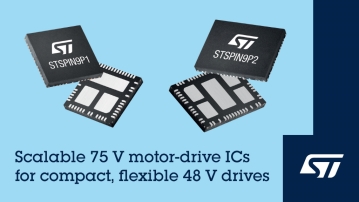
ST Microelectronics has unveiled the 'STSPIN9P' series of 75V motor drive ICs tailored for 48V-class industrial drive system design. The new product family is characterized by half-bridge and full-bridge configurations that enable design scalability according to motor type and output conditions. Power supply circuits, protection functions, and current sensing circuits are integrated on-chip to simplify system configuration, and the devices are designed to support applications up to 500W maximum. The company plans to provide reference designs and demo boards to support development and evaluation in industrial automation, robotics, pumps, fans, lighting, and textile machinery.
2026.03.26by 배종인 기자

Nordic supports security updates for the entire lifecycle of IoT devices at a single fixed cost
Nordic Semiconductor, a global leader in low-power wireless connectivity solutions, has unveiled a single fixed-cost licensing model that delivers FOTA (Firmware Over-the-Air) and device management capabilities throughout the device lifecycle via nRF Cloud, and introduced a new firmware update solution to prepare for the enforcement of the European Union's Cyber Resilience Act (CRA).
2026.03.26by 배종인 기자

Practical Training in Low-Noise, Low-Power Circuit Design All in One Place… Training Fee Support
The "2026 Advanced Engineer Practical Masterclass" to strengthen competencies in high-sensitivity analog circuit and sensor-based system design will be held on April 16 at the e4ds Conference Center in Gasan-dong, Seoul. This program will be conducted as an offline paid hands-on training session, not online, and is targeted at engineers seeking on-site intensive learning. Texas Instruments will provide educational support for this training, allowing participation at 150,000 won, a 100,000 won discount from the original price of 250,000 won.
2026.03.26by 배종인 기자











