



"We will realize fully autonomous vehicles with a design platform that comprehensively manages sensor data"
 Published2017.04.13 16:23
Integrated Management of Raw Data and Real-time Sensing Capabilities
Mentor (Siemens Business), which has demonstrated outstanding software technological capabilities in the automotive field through Linux, AUTOSAR and other solutions, has unveiled a hardware platform with self-developed architecture, expressing confidence in the autonomous vehicle market.
By utilizing innovative technologies applied to 'DRS360', an autonomous vehicle design platform, raw data can be captured and integrated in real time from a wide range of sensing methods including radar, LIDAR, vision and other sensors. The DRS360 platform significantly reduces the latency required for SAE Level 5 autonomous vehicle design verification and dramatically improves sensing accuracy and overall system efficiency.
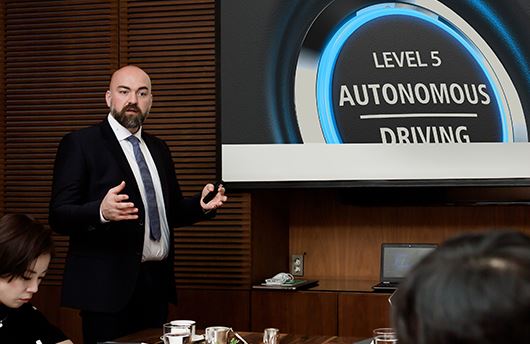
DRS360 is the first autonomous driving platform to directly transmit unfiltered information from all system sensors to the central processing unit for real-time fusion at all levels. Through partnerships with major sensor suppliers, the innovative "raw data sensors" adopted in this platform are equipped with microcontrollers, eliminating power, cost, and size concerns required for the associated processing.
Removing preprocessing microcontrollers from all system sensor nodes provides extensive advantages. Real-time performance is achieved, system cost and complexity are significantly reduced, and by accessing all captured sensor data, the highest resolution model of vehicle environment and driving conditions can be obtained.
Amin Kashi, Director of ADAS and Autonomous Driving Division, stated "Traditional data processing in ADAS has been a distributed processing approach, but Mentor has achieved a paradigm shift to a centralized data processing method," adding "This approach lowers costs, simplifies the system, and increases efficiency accordingly."
In other words, due to continuously added sensors, current ADAS systems inevitably encounter delays by obtaining only partial data, but this can now be intelligently processed through a centralized processing platform.
Enables Use in Systems Complying with ISO 26262 ASIL D Standards
This platform's simplified data transmission architecture further reduces system latency by minimizing physical bus structures, hardware interfaces, and complex time-triggered Ethernet backbones. This architecture also improves accuracy and reliability by using centralized and unfiltered sensor data to reduce redundant operations and realize dynamic resolution according to context. The optimized signal processing software of this solution and advanced algorithms, along with neural networks optimized for machine learning computation, are seamlessly integrated and executed on an automotive-grade platform.
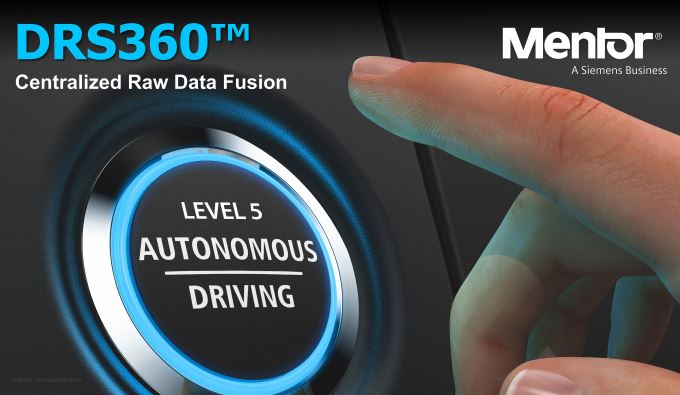
The DRS360 platform is designed as a product meeting safety, cost, power, thermal, and emissions requirements for use in systems complying with ISO 26262 ASIL D standards.
DRS360 uses Xilinx Zynq UltraScale+ MPSoC devices providing FPGA flexibility and superior signal processing efficiency in the first generation product, and adopts SoC and safety controllers based on X86 or ARM-based architecture. Accordingly, a comprehensive solution supporting full autonomous driving within a 100W power range has been realized, according to Director Amin Kashi.
Related news

[Planning IIoT Interview] Mentor Graphics' IoT Multi-Platform Concerns: Embedded Software
Mentor Graphics, a leader in the semiconductor design automation (EDA) market, is preparing for Industry 4.0 in the industrial IoT market. How are they approaching this? As smart IoT devices with various functional applications are increasing and the need to interact with cloud-based services is growing, Mentor Graphics is continuously investing in embedded software and implementing integrated heterogeneous multi-core solutions, focusing on helping embedded developers maximize the utilization of heterogeneous SoCs.
2017.03.15by 김지혜 기자
Mentor Graphics' Design Verification Solutions Receive Automotive Functional Safety Certification
Mentor Graphics announced that three Questa products—its design verification solutions (Questa® Simulation, Questa® Verification Management, and Questa® Clock-Domain Crossing (CDC))—have obtained ISO 26262 certification, the international standard for automotive functional safety, from SGS-TÜV Saar, a standardization certification body. ISO 26262 is an international standard for automotive functional safety established in 2011 to prevent accidents caused by electrical/electronic failures. The Questa products that received this certification have been added as the latest offerings to the Mentor Safe functional safety verification program.
2017.03.16by 김지혜 기자

Siemens Completes Acquisition of Mentor Graphics, Strengthening Its Position as an Industrial Software Provider
Siemens has announced the completion of its acquisition of Mentor Graphics, a leading company in the electronic design automation (EDA) software market. Siemens believes that electronic systems and integrated circuit (IC) design tools will deliver significant customer value, and this acquisition enables the company to further strengthen its ability to deliver customer value. Mentor Graphics will become part of Siemens' product lifecycle management (PLM) software business division. With this move, Siemens has reinforced its position as a leading industrial software company with the capability to provide integrated solutions across product design, simulation, verification, testing, and manufacturing.
2017.04.05by 신윤오 기자

A single misaligned light means 'defect'… Vehicle interior lighting now guarded by semiconductors and software
Automotive interior lighting is moving beyond its role as 'auxiliary lighting.' As it becomes a core element of user experience (UX) that expresses brand identity through color and animation while reflecting driver preferences, the LED interior ambient lighting market is growing rapidly. In connection with this, we met in advance with Choi Young-jae, Research Director at Dabo Corporation, who will present a technical webinar session on "Intelligent LED Interior Lighting Solutions Illuminating Future Vehicles," to hear about market trends and changes in design requirements.
2026.08.28by 명세환 기자
TI Unveils Multi-Axis Coreless Current Sensor TMCS2100-Q1 for HEV/EV Traction Inverters
Texas Instruments has unveiled the TMCS2100-Q1, a multi-axis coreless Hall-effect current sensor for HEV and EV traction inverters. By simultaneously measuring horizontal and vertical magnetic fields through multi-axis sensing technology, it achieves up to 20 times higher accuracy compared to conventional single-axis sensors, while the busbar-unmodified design provides mechanical design flexibility. It simultaneously meets the high-accuracy requirements and miniaturization driven by the expansion of 800V architectures.
2026.08.27by 배종인 기자











