



ST Strengthens Rad-Hard Analog Product Family for Aerospace
 Published2011.09.27 10:03
STMicroelectronics Strengthens Rad-Hard Analog Family for Aerospace
Achieving full QML V certification for innovative analog amplifier family
Korea, September 23, 2011 – STMicroelectronics ( www.st.com ), the world’s leading integrated semiconductor company and aerospace leader, has announced the expansion of its European Rad-Hard space portfolio with four new amplifiers that have been officially certified as QML V. Achieving QML V certification strengthens ST’s family of analog radiation-hardened devices that are extremely robust and can operate under the extreme environmental conditions encountered in space, ensuring longer device endurance.

“According to the Satellite Industry Association, the global satellite industry is stable and growing steadily,” said Alberto De Marco, General Manager, ST’s High Reliability and Standard Products Division. “It achieved an average annual industry growth rate of 11.2% over the past five years, and the global market size in 2010 was 168.1 billion dollars,” he said. “As satellites are increasingly used in daily life, such as in entertainment, navigation, and communications, the function and reliability of electronic components that can withstand high levels of radiation generated in space, such as the new product launched this time, are becoming very important.”
ST is setting a benchmark for the aerospace industry by establishing its own standard hardness (TID, Total Ionization Dose hardness) for ionizing radiation at low dose rate (radiation dose per unit time) conditions of 300 krad (Si), making it the first to offer RNA (Hardness Assurance) certified products incorporating ELDRS-free (Enhanced Low Dose Rate Sensitivity free) ICs.
ST also offers the highest hardness against damage caused by heavy ions by implementing Single Event Latch-up (SEL)-free and Single Event False Interrupt (SEFI)-free components. With these new products, ST continues its market leadership by providing protection against transient glitches caused by heavy ions, called Single Event Transients (SETs), which are particularly problematic for analog components used in space.
- The new products include: The RHF484, a quad version of the RHF43B and a replacement for the industry standard. It is available in a flat-14W package and was QML V certified in August 2011.
- The RHF310 and RHF330 are ultra-low-power 5V operational amplifiers optimized for a variety of single-condition applications. The 120MHz and 1.0GHz versions have already obtained QML V certification. The 550MHz RHF350 is expected to be certified in Q4 2011.
ST's space-grade analog components are designed to provide special attenuation of Single Event Transients (SETs) and are fully characterized for low amplitude and small duration glitches.
All of ST's Rad-Hard analog ICs offer very low power consumption and are designed using BICMOS technology. Once space-qualified, these devices will be added to the EPPL (European Product Part List) and will receive active support from the CNES (Centre National d'Etudes Spatiales).
Key features of ST QML V analog products
• QML V certified 300krad (Si) TID (Total Ionizing Dose)
• ELDRS (Enhanced Low Dose Rate Sensitivity) free
• Supports Single Event Latch up (SEL) tolerance at 110 MeV/mg/cm² @ 125 °C
• Complete characterization of SET
• Sealed package
• Obtained certification for export to Europe
About semiconductors for aerospace
A key requirement for space components is the ability to withstand radiation encountered in space due to a variety of sources, including the Van Allen radiation belts, solar wind and solar flares, and galactic cosmic rays.
Radiation hardened or Rad-Hard devices can operate in these environments with nominal performance and long lifetimes even when exposed to various particles, common protons, electrons, heavy ions, etc. Transient operation of semiconductor devices, especially analog products, is important when exposed to heavy ions.
The Total Ionization Dose (TID) test measures the intensity in krad (Si) of ionization normally caused by protons and electrons of a product under given dose rate conditions (which may be high, low, or enhanced low).
The hardness to heavy ions is measured by testing on a certified device that verifies the effect on each component by increasing the energy until failure occurs. Various BICMOS analog product tests include:
- SEL (Single Event Latch Up)
- SET (Single Event Transient)
- SEFI (Single Event False Interrupt)
The aerospace industry’s need for high reliability goes beyond radiation requirements. Accredited organizations such as the European Space Components Committee (ESCC) or the Defense Logistics Agency (DLA), formerly known as the Defense Supply Columbus Center (DSCC), maintain specifications that outline how suppliers can become certified and how certified suppliers can manufacture and certify devices.
ST is an active member of these organizations (ST was the first to receive ESCC certification in 1977) and provides aerospace products based on all of these globally recognized quality systems.
QML V components are certified and manufactured to specifications such as Military Standard MIL-STD-38535 and Military Standard MIL-STD-883 issued by the Defense Logistics Agency (DLA). QML V certification includes reliability and radiation testing formally defined by the QML V specification.

관련뉴스

Intel Unveils Next-Generation 'Core Ultra Series 3' and vPro Platform for Enterprise PCs
인텔이 차세대 기업용 PC를 위한 ‘인텔 코어 Ultra 시리즈 3’와 최신 vPro 플랫폼을 공식 발표하며, 기업용 노트북부터 고성능 워크스테이션까지 폭넓은 수요 충족에 나섰다.
2026.03.26by 배종인 기자
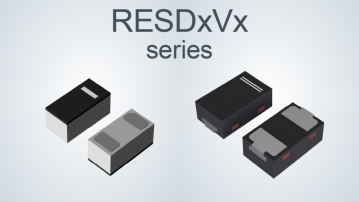
ROHM Launches ESD Protection Diode Compatible with High-Speed Interfaces of 10Gbps or Higher
반도체 전문 기업 로옴(ROHM)이 10Gbps를 넘어서는 차세대 고속 데이터 통신 환경에 대응할 수 있는 ESD(정전기 방전) 보호 다이오드 ‘RESDxVx 시리즈’를 개발하며, 고속 인터페이스에서 요구되는 신호 품질 유지와 IC 보호 성능을 동시에 끌어올렸다.
2026.03.26by 배종인 기자
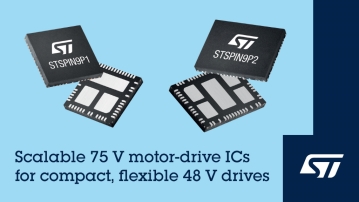
ST Launches 75V Drive IC Targeting 48V Industrial Motor Driving
ST마이크로일렉트로닉스가 48V급 산업용 구동 시스템 설계에 맞춘 75V 모터 드라이브 IC ‘STSPIN9P’ 시리즈를 공개했다. 새 제품군은 하프 브리지와 풀 브리지 구조로 구성돼 모터 종류와 출력 조건에 따라 설계를 확장할 수 있도록 한 것이 특징이다. 전원 회로와 보호 기능, 전류 감지 회로를 칩에 통합해 시스템 구성을 단순화했으며, 최대 500W급 애플리케이션까지 대응하도록 설계됐다. 회사는 레퍼런스 디자인과 데모 보드도 함께 제공해 산업 자동화, 로보틱스, 펌프, 팬, 조명, 섬유 기계 등에서 개발과 평가를 지원할 계획이다.
2026.03.26by 배종인 기자
Nordic supports security updates for the entire lifecycle of IoT devices at a single fixed cost
Nordic Semiconductor, a global leader in low-power wireless connectivity solutions, has unveiled a single fixed-cost licensing model that delivers FOTA (Firmware Over-the-Air) and device management capabilities throughout the device lifecycle via nRF Cloud, and introduced a new firmware update solution to prepare for the enforcement of the European Union's Cyber Resilience Act (CRA).
2026.03.26by 배종인 기자
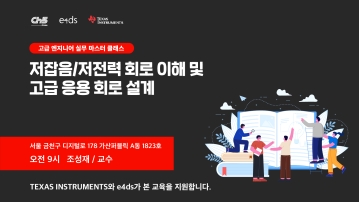
Practical Training in Low-Noise, Low-Power Circuit Design All in One Place… Training Fee Support
고감도 아날로그 회로와 센서 기반 시스템 설계 역량을 강화할 수 있는 ‘2026 고급 엔지니어 실무 마스터 클래스’가 오는 4월16일 서울 가산동 e4ds 컨퍼런스 센터에서 열린다. 이번 과정은 온라인이 아닌 오프라인 유료 실습 교육으로 진행되며, 현장 중심의 심화 학습을 원하는 엔지니어를 대상으로 한다. 이번 교육은 텍사스 인스트루먼트(Texas Instruments)가 교육비를 지원해 정가 25만원에서 10만원 할인 된 15만원에 참가할 수 있다.
2026.03.26by 배종인 기자











