



Stanford University Solar Car Adopts STMicroelectronics Semiconductors
 Published2011.12.07 00:39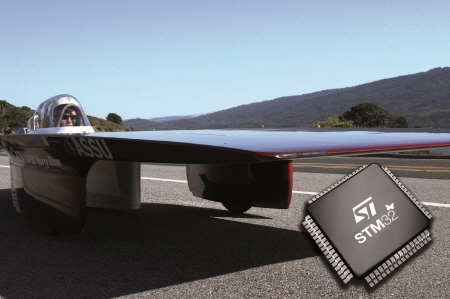
- Controlling the entire system with STM32 microcontrollers ∙∙∙ Technology unveiled at Australian auto racing competition
December 7, 2011, Seoul – STMicroelectronics, a global semiconductor company in various electronic device applications, announced that its advanced 32-bit microcontroller products were used to control the electrical and electronic systems of Stanford University's latest solar car. This high-tech vehicle made a successful debut at the World Solar Challenge, a global solar car race held across Australia from October 16 to 21.
This solar car, named Xenith, was designed and built by Stanford University students and participated in a 3,000 km race from Darwin to Adelaide alongside about 40 other cars. The car's electrical system uses STMicroelectronics' STM32 32-bit microcontroller technology to control all subsystems, ranging from solar conversion and driving control operations to helmet-mounted display control and vehicle acceleration.
The success of solar cars depends on the ability to maximize the amount of electricity that can be collected during daylight hours and to use power resources and consumption efficiently in a balanced manner. Four STM32 microcontrollers track the maximum power point to optimize the output of the Zenith car's solar array, and another STM32 device performs key tasks such as monitoring voltage, measuring temperature and current, and controlling power flow throughout the car.
Another STM32 microcontroller manages communication between the driver, car, motor controller, and rear-wheel steering system, and controls auxiliary systems such as lighting, telemetry, and tire pressure monitoring.
Gregory Hall, who leads Stanford University’s solar car project, said, “Many complex systems within a solar car must be able to operate and interact normally without failure, and energy consumption must also be minimized. ST’s powerful, flexible, and reliable control devices provide excellent peripherals and high-quality libraries, making them suitable for our project, which requires high performance and has a tight development schedule.”
Michel Buffa, General Manager of ST’s Microcontroller Business Unit, said, “The application of STM32-based subsystems to Stanford University’s solar car reaffirms ST’s firm position in the field of embedded applications. We are pleased to participate in the Stanford solar car project as a notable program that combines innovative research with cutting-edge alternative transportation technology.”
ST’s STM32 is the industry’s most extensive family of ARM Cortex M-based microcontrollers, offering over 250 devices with a comprehensive range of peripherals and various memory configurations. These devices feature excellent power consumption and functionality. In addition, ST provides the industry’s best development ecosystem alongside these products. With a 45% market share, STM32 microcontrollers are suitable for any application requiring real-time control or connectivity, ranging from consumer electronics, instrumentation, home audio, medical, and industrial networking.
Stanford University’s Solar Car Project is a student-organized, non-profit initiative designed to provide students with practical experience in engineering, project management, and business, while raising awareness of clean energy vehicles. The project team works on design and implementation over a two-year period and is funded by donations. More information can be found at http://solarcar.stanford.edu .

관련뉴스

Intel Unveils Next-Generation 'Core Ultra Series 3' and vPro Platform for Enterprise PCs
인텔이 차세대 기업용 PC를 위한 ‘인텔 코어 Ultra 시리즈 3’와 최신 vPro 플랫폼을 공식 발표하며, 기업용 노트북부터 고성능 워크스테이션까지 폭넓은 수요 충족에 나섰다.
2026.03.26by 배종인 기자

ROHM Launches ESD Protection Diode Compatible with High-Speed Interfaces of 10Gbps or Higher
반도체 전문 기업 로옴(ROHM)이 10Gbps를 넘어서는 차세대 고속 데이터 통신 환경에 대응할 수 있는 ESD(정전기 방전) 보호 다이오드 ‘RESDxVx 시리즈’를 개발하며, 고속 인터페이스에서 요구되는 신호 품질 유지와 IC 보호 성능을 동시에 끌어올렸다.
2026.03.26by 배종인 기자
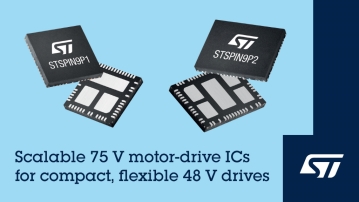
ST Launches 75V Drive IC Targeting 48V Industrial Motor Driving
ST마이크로일렉트로닉스가 48V급 산업용 구동 시스템 설계에 맞춘 75V 모터 드라이브 IC ‘STSPIN9P’ 시리즈를 공개했다. 새 제품군은 하프 브리지와 풀 브리지 구조로 구성돼 모터 종류와 출력 조건에 따라 설계를 확장할 수 있도록 한 것이 특징이다. 전원 회로와 보호 기능, 전류 감지 회로를 칩에 통합해 시스템 구성을 단순화했으며, 최대 500W급 애플리케이션까지 대응하도록 설계됐다. 회사는 레퍼런스 디자인과 데모 보드도 함께 제공해 산업 자동화, 로보틱스, 펌프, 팬, 조명, 섬유 기계 등에서 개발과 평가를 지원할 계획이다.
2026.03.26by 배종인 기자
Nordic supports security updates for the entire lifecycle of IoT devices at a single fixed cost
Nordic Semiconductor, a global leader in low-power wireless connectivity solutions, has unveiled a single fixed-cost licensing model that delivers FOTA (Firmware Over-the-Air) and device management capabilities throughout the device lifecycle via nRF Cloud, and introduced a new firmware update solution to prepare for the enforcement of the European Union's Cyber Resilience Act (CRA).
2026.03.26by 배종인 기자
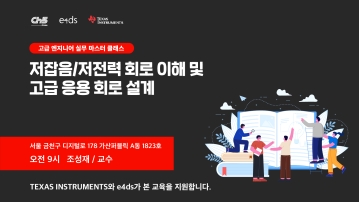
Practical Training in Low-Noise, Low-Power Circuit Design All in One Place… Training Fee Support
고감도 아날로그 회로와 센서 기반 시스템 설계 역량을 강화할 수 있는 ‘2026 고급 엔지니어 실무 마스터 클래스’가 오는 4월16일 서울 가산동 e4ds 컨퍼런스 센터에서 열린다. 이번 과정은 온라인이 아닌 오프라인 유료 실습 교육으로 진행되며, 현장 중심의 심화 학습을 원하는 엔지니어를 대상으로 한다. 이번 교육은 텍사스 인스트루먼트(Texas Instruments)가 교육비를 지원해 정가 25만원에서 10만원 할인 된 15만원에 참가할 수 있다.
2026.03.26by 배종인 기자











