



China's Shift from DRAM to NAND: Can Korea's 3D NAND Compete?
 Published2017.05.01 06:36
From 2019 Onwards, China's Semiconductor Industry Policy Becomes a Variable
As the semiconductor market boom continues, Gartner, an IT market research firm, stated in a report on the 14th that "market growth is expected to continue through next year due to price increases and production volume growth in DRAM and NAND flash memory."
IHS Markit senior research analyst Len Jelinek forecasted that "due to the large-capacity trend in IT devices, the amount of memory semiconductors installed in devices is increasing, and the memory semiconductor market growth rate will reach 30.3% this year." The system semiconductor market is expected to grow 10.5% year-over-year, and microcontroller units (MCU) are anticipated to show 6.7% growth driven by autonomous vehicle development.
The overall memory market is projected to show growth through 2018, but from 2019 onwards, it is expected to slow due to variables such as China's government semiconductor industry policies.
Mirae Asset Daewoo analyst Do Hyun-woo anticipated that the 2017 semiconductor equipment market will continue following last year's growth, with DRAM, foundry, and backend processes leading to overall 6% growth. The DRAM equipment market saw investment decrease at 23% last year, but this year investment is expected to increase by 15%, and due to memory market influence, investment will concentrate particularly in the second half. As Samsung Electronics and SK Hynix increase production volume of 18nm DRAM and invest in 17nm DRAM, equipment demand is predicted to increase.
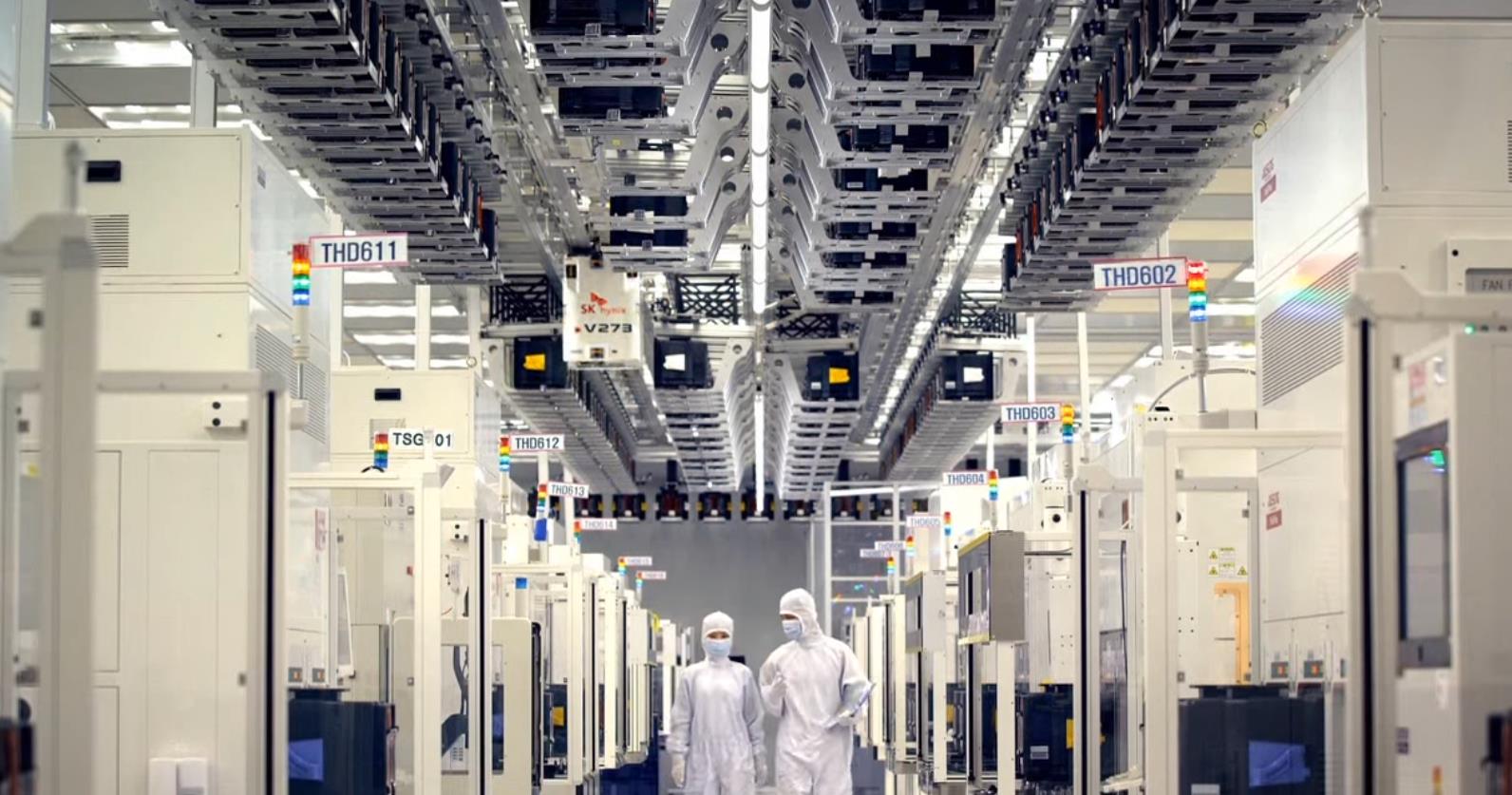
SK Hynix is preparing M14 3D NAND flash
The NAND equipment market is expected to decline 4-5% compared to last year, as concentrated new capacity investments from Samsung Electronics, Toshiba, and Micron occurred in 2016. Samsung Electronics in particular invested heavily in 3D NAND flash at its Pyeongtaek plant last year, with plans to mass-produce 64-layer 3D NAND in the first half of this year. SK Hynix is preparing M14 3D NAND flash on the second floor of its Icheon plant this year, with plans to mass-produce 72-layer 3D NAND in the second half.
China Taking Aggressive Stance Through Semiconductor Industry Development Push
NH Investment & Securities analyst Lee Se-cheol stated, "The Chinese government is aggressively pursuing the goal of achieving 20% compound annual sales growth through the 'Semiconductor Industry Development Push.' Although China's semiconductor market is still in its nascent stage, it has significant potential given the market size."
In the upstream industries of China's semiconductor market, telecommunications networks, electronic products, and computers account for high proportions. As China becomes a production base, semiconductor consumption is high, accounting for 29% of global semiconductor consumption. However, the supply share is only 4%, resulting in continuously increasing imports and limited exports.
Until 2014, investments continued through company initiatives, but when the "Semiconductor Industry Development Push" was announced in June, the semiconductor industry situation changed completely. In September last year, the "National Semiconductor Industry Investment Fund" was established, and local governments are following suit by establishing semiconductor funds. For 2015-2018, the four-year period is the critical investment window, with a total of 35 companies participating in 43 project investments, and public funds are planned to be injected.
From 2014 onwards, many M&As occurred globally, and China is also investing heavily in acquiring semiconductor companies. Unlike the smooth initial phase, China faced difficulties when Tsinghua Unigroup's acquisition of Micron fell through in 2016. Additionally, the acquisition of SanDisk through Western Digital equity acquisition also failed, and governments worldwide intensified their screening of Chinese capital's overseas M&A. Consequently, M&A among domestic companies in China is occurring, moving in the direction of acquiring Tier 2 and Tier 3 companies.
Besides M&A, China is investing in fab construction to enter the semiconductor industry. Yangtze Memory is a 3D NAND company facing difficulties in technology introduction and is developing its own technology through the Chinese Academy of Sciences. Jinhua Semiconductor is jointly producing DRAM with local governments, and SMIC, a foundry company, has risen to the global top 5. Currently, 16 12-inch semiconductor fabs are planned, with 8 foundry fabs and 7 memory production lines among them. Once all production lines are completed, 12-inch semiconductor production capacity will increase to 1,265k wafers/month, and supply volume is expected to expand significantly.
DRAM Entry to be Prolonged; Focusing on NAND Business
NH Investment & Securities analyst Lee Se-cheol explained, "China's memory business is expected to be delayed beyond market expectations. While Micron and SK Hynix acquisitions were pursued for DRAM industry entry, DRAM market entry will be prolonged. Therefore, the government is focusing on NAND business rather than DRAM, where technology transfer is difficult."
Additionally, backend process company Jingfang Technology recently surged to 3rd place in OSAT by acquiring STATSChipPAC, a global OSAT company. This is expected to create difficulties for domestic backend process companies. SMIC's 8-inch capacity is estimated at approximately 130-190k wafers/month, 12-inch capacity at 80-90k, with 28nm already productized and 14nm under development.
Chinese semiconductor material companies are known to be mainly focusing on wafers, primarily beginning to produce 6-inch and 8-inch single-crystal silicon. However, for 12-inch wafers, technological capabilities are insufficient, and supply shortage is likely without additional increases from global top wafer companies.
Analyst Lee Se-cheol stated, "Domestic companies should not become complacent thinking they have 3D NAND technological capabilities. The equipment market side appears to have good global prospects," adding "companies supplying display equipment to China that also engage in semiconductors appear poised to benefit. The same applies to front-end/backend process equipment and material companies." He further noted, "Japan, the United States, China, and our country all face significant semiconductor talent shortages. China is expected to face a shortage of 400,000 personnel by 2020. We also need to prepare for this."
Comments
Related news
Taiwan has become a 'big player' in the semiconductor material consumption market, while Korea ranks second.
The Semiconductor Equipment and Materials International (SEMI) announced that the global semiconductor materials market increased by 2.4% compared to 2015. Previously, SEMI disclosed that global semiconductor sales increased by 1.1% in 2016.
2017.04.04by 신윤오 기자
Why the Semiconductor Market, Benefiting from DRAM and NAND Memory, Is a Worry in 2019
Gartner Inc. forecasted that global semiconductor revenue in 2017 would reach $38.6 billion, representing a 12.3% increase compared to the previous year. In the second half of 2016, the market showed strong performance as it secured growth momentum centered on commodity memory, which led to upward revisions of forecasts for 2017 and 2018. However, due to volatility in the memory market and increased production of DRAM and NAND flash memory, these forecasts are expected to be revised in 2019.
2017.04.17by 신윤오 기자

The semiconductor equipment industry is sailing smoothly, driven by the semiconductor investment boom.
The Semiconductor Equipment and Materials International (SEMI) announced that North American semiconductor equipment shipments in March totaled $2.03 billion. SEMI reports semiconductor equipment shipments from North American equipment manufacturers in its reports as a three-month average. March shipments increased 2.6% compared to February equipment shipments of $1.97 billion, and showed a 69.2% increase compared to March of the previous year's shipments of $1.2 billion.
2017.04.24by 신윤오 기자

Intel Unveils Next-Generation 'Core Ultra Series 3' and vPro Platform for Enterprise PCs
Intel has officially unveiled the "Intel Core Ultra Series 3" for next-generation enterprise PCs and the latest vPro platform, addressing a wide range of demands from enterprise notebooks to high-performance workstations.
2026.03.26by 배종인 기자

ROHM Launches ESD Protection Diode Compatible with High-Speed Interfaces of 10Gbps or Higher
Semiconductor specialist ROHM has developed the 'RESDxVx series' of ESD (electrostatic discharge) protection diodes capable of responding to next-generation high-speed data communication environments exceeding 10Gbps, simultaneously enhancing both signal quality maintenance required in high-speed interfaces and IC protection performance.
2026.03.26by 배종인 기자











