


Songju County Melon Cultivation System Automation 'Smart Farm System Construction Project' Supplied with Data Communication Module 'UC864-K'
 Published2011.12.14 15:31
 'UC864-K' - An HSDPA module specially developed by Telit to penetrate the domestic market, supporting simultaneous transmission of data and voice information at high speed of 7.2Mbps at 2.1 GHz
To more efficiently manage melon farms, the representative local cultivation crop, the 'OCTOPUS (Open Control & Tele Operating Platform Unit System)' remote wireless control system equipped with M2M communication modules was applied to existing cultivation facilities
At any time and from anywhere, users can check various weather information and surveillance cameras using smartphones, tablets, PCs and other devices. The confirmed data is transmitted via 3G/4G communication networks to the integrated cultivation site management server system, enabling remote control such as automatic opening and closing of cultivation facility structures
Seoul, December 14, 2011 - Telit Wireless Solutions (CEO Yoon Jong-gab, www.Telit.com, hereinafter Telit), an M2M (Machine-to-machine) specialist company, announced today that it has supplied its WCDMA (HSDPA) wireless data communication module 'UC864-K' to the 'Smart Farm System Construction Project' in Songju County's protected cultivation farms, which supports automatic facility management according to weather conditions using real-time data communication.
'UC864-K' is an HSDPA module specially developed by Telit to penetrate the domestic market, supporting simultaneous transmission of data and voice information at high speed of 7.2Mbps at 2.1 GHz. In particular, it is designed in an ultra-compact size of 30mmX36mm and weighs 10g, and is not significantly affected by temperature changes, making it a perfect product that can be easily connected and used with most M2M applications and wireless data communication devices.
The 'Smart Farm System Construction Project' was jointly developed and constructed by Telit and Disys (CEO Kim Ki-hwan www.disys.co.kr), a mobile solution specialist company. After 10 months of system development and pilot operation from January to November, it is currently being installed and operated at actual farms.
To more efficiently manage melon farms, the representative local cultivation crop, Songju County applied 'OCTOPUS (Open Control & Tele Operating Platform Unit System)', a remote wireless control system equipped with M2M communication modules, to existing cultivation facilities. Using this system, cultivation farmers can check various weather information (solar radiation, temperature, humidity, rainfall) and surveillance cameras at any time and from anywhere using smartphones, tablets, PCs and other devices. The confirmed data is transmitted via 3G/4G communication networks to the integrated cultivation site management server system, enabling remote control such as automatic opening and closing of cultivation facility structures (vinyl houses) according to pre-set cultivation environmental standards.
Through this system implementation, Songju County melon farms were able to eliminate inefficient work such as manually managing cultivation facilities and opening and closing vinyl houses according to weather conditions. In particular, since facility opening and closing times are not consistent and can affect solar radiation that impacts crop growth, or when rapid responses cannot be made to rainfall or heavy snow, significant damage can occur. However, with the introduction of the remote control system, immediate response has become possible.
Additionally, theft prevention of agricultural products has become possible through surveillance camera monitoring, and agricultural products can be controlled to suit growth conditions through temperature and humidity sensors, which is expected to help improve agricultural product quality.
.
In the future, the 'Smart Farm System' can be expanded to manage not only melons but also various protected cultivation crops such as watermelons, strawberries, melons, and tomatoes. It is also expected to be usable for security and tracking purposes in livestock farms when diseases such as foot-and-mouth disease occur, and many other applicable projects are anticipated.
Telit CEO Yoon Jong-gab stated, "Currently, the nationwide protected cultivation area for major fruits and vegetables is 50,767ha, and major fruit and vegetable cultivation houses number approximately 650,000 units, so it is anticipated that application cases of M2M-based smart farm systems will continue to increase in the future." He added, "Accordingly, our company will focus on growing the domestic market by rapidly developing and supplying optimal products tailored to the increasing and diverse customer demands across various sectors through cooperation with relevant organizations and telecommunications companies."
Telit CMO Dominikus Hierl stated, "The innovative smart farm system construction through remote wireless control technology is a very meaningful project for Telit. We take pride in contributing to sustainable agriculture and look forward to applying it to various use cases in the future."
Disys CEO Kim Ki-hwan said, "In developing this smart farm system, the 'Machine-to-Machine Intelligence Comprehensive Support Center' established by the Ministry of Broadcasting, Communications and Information Technology in Geumcheon-gu, Gasan-dong was very helpful in testing M2M equipment and related software and services. In the future, we plan to focus on rapidly developing optimal products through close cooperation with related companies and supplying them to the market."

Related news

Intel Unveils Next-Generation 'Core Ultra Series 3' and vPro Platform for Enterprise PCs
Intel has officially unveiled the "Intel Core Ultra Series 3" for next-generation enterprise PCs and the latest vPro platform, addressing a wide range of demands from enterprise notebooks to high-performance workstations.
2026.03.26by 배종인 기자

ROHM Launches ESD Protection Diode Compatible with High-Speed Interfaces of 10Gbps or Higher
Semiconductor specialist ROHM has developed the 'RESDxVx series' of ESD (electrostatic discharge) protection diodes capable of responding to next-generation high-speed data communication environments exceeding 10Gbps, simultaneously enhancing both signal quality maintenance required in high-speed interfaces and IC protection performance.
2026.03.26by 배종인 기자
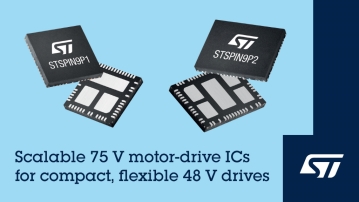
ST Launches 75V Drive IC Targeting 48V Industrial Motor Driving
ST Microelectronics has unveiled the 'STSPIN9P' series of 75V motor drive ICs tailored for 48V-class industrial drive system design. The new product family is characterized by half-bridge and full-bridge configurations that enable design scalability according to motor type and output conditions. Power supply circuits, protection functions, and current sensing circuits are integrated on-chip to simplify system configuration, and the devices are designed to support applications up to 500W maximum. The company plans to provide reference designs and demo boards to support development and evaluation in industrial automation, robotics, pumps, fans, lighting, and textile machinery.
2026.03.26by 배종인 기자
Nordic supports security updates for the entire lifecycle of IoT devices at a single fixed cost
Nordic Semiconductor, a global leader in low-power wireless connectivity solutions, has unveiled a single fixed-cost licensing model that delivers FOTA (Firmware Over-the-Air) and device management capabilities throughout the device lifecycle via nRF Cloud, and introduced a new firmware update solution to prepare for the enforcement of the European Union's Cyber Resilience Act (CRA).
2026.03.26by 배종인 기자
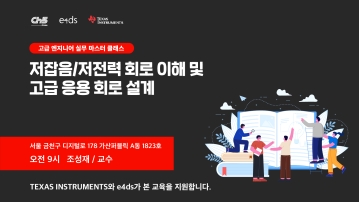
Practical Training in Low-Noise, Low-Power Circuit Design All in One Place… Training Fee Support
The "2026 Advanced Engineer Practical Masterclass" to strengthen competencies in high-sensitivity analog circuit and sensor-based system design will be held on April 16 at the e4ds Conference Center in Gasan-dong, Seoul. This program will be conducted as an offline paid hands-on training session, not online, and is targeted at engineers seeking on-site intensive learning. Texas Instruments will provide educational support for this training, allowing participation at 150,000 won, a 100,000 won discount from the original price of 250,000 won.
2026.03.26by 배종인 기자











