



[Interview] “Significantly reducing size and power loss with high-speed ADC adopting RF sampling”
 Published2017.06.23 20:20
Supports high-density systems such as MIMO, beamforming, and radar array
As data rates and bandwidth requirements to satisfy high-bandwidth communication systems increase, interest in fast RF sampling is also increasing.
The problem is that there are many obstacles to overcome for fast and distortion-free RF sampling. For example, in a typical RF receiver, the RF frequency must be down-converted to the IF band through a mixer stage and a quadrature demodulator must be used, which inevitably causes unnecessary time and space as well as signal distortion.
Accordingly, there is a trend toward RF sampling receivers that eliminate quadrature modulators and synthesizers and replace them with RF ADCs that sample at high frequencies and sampling rates. Above all, it has the advantage of supporting high signal bandwidth and being able to directly sample the RF band.

Regarding the RF sampling structure, ARROW Korea’s Manager Sang-hyeok Han said, “By eliminating the RF mixer and synthesizer and the baseband components, the product size can be reduced, which in turn improves power loss.” He also said, “Bandwidth flexibility can be improved, which can support high-density systems such as MIMO, beamforming, and radar array.”
TI's ADC32RF45 is a 14-bit resolution ADC that uses RF sampling, providing faster and more flexible functions than conventional IF sampling. This ADC has 14-bit resolution and a sampling rate of 3 gigabits per second on dual channels, and supports bypass mode and full DDC mode. Also, the ADC32RF80 has 14-bit resolution and 3 gigabit-per-second sampling rate in dual channels, the same as the ADC32RF45, but the difference is that it only supports DDC mode.
In particular, TI's RF ADC, which applies the interleaving method, utilizes ADC cores with excellent SNR and SFDR performance and combines each ADC core to achieve high sampling speed and high bandwidth performance.
Regarding the problems that can occur due to interleaving, Manager Han explained, “Offset errors, amplitude errors, or phase errors can occur, but errors and noise can be reduced by performing continuous digital interleave correction in the digital correction block.”
The ADC 32RF45 has low power consumption and can reduce PCB size by up to 80% compared to the IF.
관련뉴스
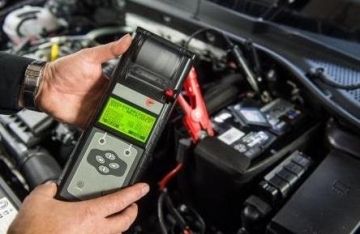
What is important in a battery analysis system is the ADC
As portable devices have proliferated, battery-powered systems have become commonplace. Since battery defects occur frequently, it has become important to identify and replace battery defects early. Whether individual batteries used in mobile phones or battery banks for storing renewable energy, any battery defect can lead to system downtime. A precision analog-to-digital converter (ADC) is used as a key component in battery analysis systems that can assess battery health status. Depending on key specifications of the ADC such as speed, resolution, and latency, battery health status can be analyzed more accurately. Looking at the Randles lead-acid battery model in Figure 1, we can see how critical ADC performance is.
2017.04.18by 김지혜 기자

[Interview] Accurate Data Collection Depends on Which ADC You Choose
데이터의 중요성이 높아지면서 ADC(아날로그-디지털 컨버터)를 선택하는 엔지니어의 고민도 깊어지고 있다. 다양한 산업과 분야의 전자기기 디바이스에 필수적으로 쓰이는 ADC가 속도와 정밀도에 많은 영향을 미치고 있기 때문이다. 엔지니어는 여러 종류의 ADC와 특정 회사의 제품을 두고 분해능과 정밀도, 속도, 환경 변화에 따른 반응 등을 꼼꼼히 따져봐야 한다. 현재 폭넓게 쓰이고 있는 ADC는 SAR(축차비교형) ADC와 델타-시그마 ADC를 꼽을 수 있다. SAR ADC는 속도가 빠르지만, 10~12비트 정도로 분해능이 떨어진다는 단점이 있고 반면 델타-시그마 ADC는 오버 샘플링을 통해 오차를 줄여 평균적으로 24비트(bit)의 분해능을 제공하지만 샘플링 속도가 느리다는 지적이다. 예를 들어, 공장자동화나 로봇 개발에는 더욱 정밀한 디지털멀티미터(DMM)의 중요성이 높아지면서 ADC의 역할도 중요해지고 있다. 이럴 때는 정밀도와 신호대잡음비(SNR) 성능이 높은 델타시그마 ADC를 사용하는 게 적합하다.
2017.05.16by 김자영 기자
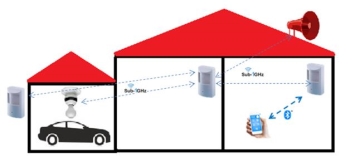
Try using MCU and RF solutions on a single chip.
모션 감지기는 지정된 구역에 사람이 있는 것을 감지해 알려주는 기기이다. 주택, 업무용 빌딩, 기타 설비에서 사용되고 있다. 감지기는 제어 패널, 경보기, 클라우드 시스템 같은 다양한 장치에 소리나 빛, 유/무선 알림으로 전송할 수 있다. 무선 모션 감지기는 벽을 통해 배선할 필요가 없기 때문에 설치 및 확장이 쉽다. 일반적인 감지 기법으로는 PIR(passive infrared), 초음파 이미터(emitter), 마이크로파 이미터 등이 있다. 실내나 실외에 설치되어 주로 침입 감지 시스템으로 사용되는 무선 모션 감지기는 무선 주파수(RF) 성능이 우수하고 전력 소모와 비용이 낮기 때문에, 일반적으로 Sub-1GHz 무선 기술을 사용한다. TI의 시스템온칩(SoC) Sub-1GHz 솔루션(CC13x0 무선 MCU)은 단일칩으로 저전력이면서 풍부한 기능의 MCU와 RF 솔루션을 통합했다. 센서 시스템(그림 1)에서 이 저전력 무선 MCU는 시스템의 메인 MCU로 센서와 직접 인터페이스하거나 증폭기, 필터, 비교기를 통해서 동작할 수 있다. 또한 CC1350 및 CC1310 무선 MCU는 주변장치 제어를 위한 I2C, UART, SPI를 통합하고 있으며, 아날로그 신호 샘플링을 위한 12bit 아날로그-디지털 컨버터(ADC)도 내장되어 있다.
2017.05.26by 김지혜 기자
Intel Unveils Next-Generation 'Core Ultra Series 3' and vPro Platform for Enterprise PCs
Intel has officially unveiled the "Intel Core Ultra Series 3" for next-generation enterprise PCs and the latest vPro platform, addressing a wide range of demands from enterprise notebooks to high-performance workstations.
2026.03.26by 배종인 기자
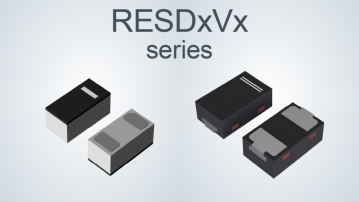
ROHM Launches ESD Protection Diode Compatible with High-Speed Interfaces of 10Gbps or Higher
반도체 전문 기업 로옴(ROHM)이 10Gbps를 넘어서는 차세대 고속 데이터 통신 환경에 대응할 수 있는 ESD(정전기 방전) 보호 다이오드 ‘RESDxVx 시리즈’를 개발하며, 고속 인터페이스에서 요구되는 신호 품질 유지와 IC 보호 성능을 동시에 끌어올렸다.
2026.03.26by 배종인 기자











