



Demonstration of next-generation automotive driver assistance and infotainment systems at CES 2012
 Published2012.01.09 22:38
The Ethernet AVB Development Kit enables the construction of the first fully open network standard system optimized for automotive audio/video applications.
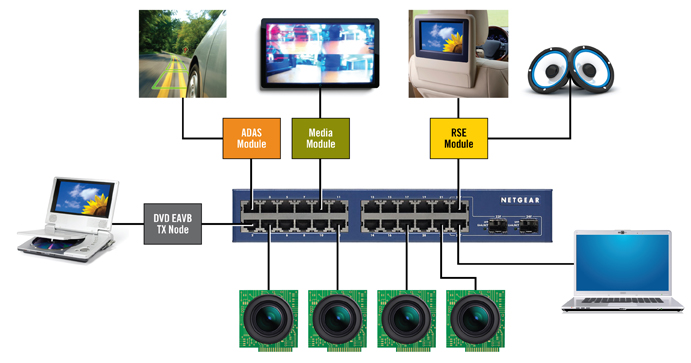
Xilinx Korea (Country Manager Ahn Heung-sik) January 6, 2012 – Xilinx plans to unveil the world's first FPGA-based Ethernet Audio/Video Bridging (EAVB) network optimized for carrying high-speed data traffic within vehicles at the 2012 Consumer Electronics Show (CES). As consumer expectations for high-resolution display graphics in driver assistance, navigation, and passenger entertainment systems rise, so too do challenges regarding content transfer within vehicles. In this demonstration, Xilinx will showcase a new EAVB development kit co-developed with Digital Design Corp. (DDC), a member of the Xilinx Alliance program, providing automotive system designers with frameworks and tools to develop applications for drivers and passengers.
The EAVB demonstration, which enables simultaneous streaming of multi-camera driver assistance and infotainment A/V sources over a single network, can be viewed at the Xilinx booth (#MP25556). In addition, the 3D vehicle surround view demonstration built on the Spartan-6 FPGA also clearly demonstrates Xilinx's continuous efforts toward real-time, multi-camera driver assistance solutions.
Nick DiFiore, Director of Automotive at Xilinx, stated, “The IEEE 802.1 EAVB standard is attracting the attention of many leading automotive manufacturers even though the specification is not yet finalized. It is hard to resist the appeal of a fully open, flexible, and ubiquitous network standard like Ethernet, enhanced to meet the real-time media streaming requirements of automotive systems.” He added, “As a founding member of the AVnu Alliance®, which provides an ecosystem of compatible EAVB solutions for the reliable transmission of audio and video content, Xilinx is further expanding this goal in DDC. This is a natural step in our effort to provide complete vehicle connectivity options that enable automotive consumers to keep up with rapidly evolving consumer information technology.”
The EAVB solution extends the previously released Xilinx Ethernet AVB endpoint LogiCORE® IP into a full network interface solution while providing the flexibility to meet customers' unique application interface requirements. Furthermore, this solution offers maximum integration potential in environments where Xilinx FPGAs are already commonly used. This includes existing infotainment connectivity as well as driver assistance (DA) applications, where the FPGA primarily performs image processing for surround view, blind spot detection, and real-time lane tracking.
Scott Keane, a visual systems engineer at DDC, stated, “Drivers and passengers want higher-resolution display graphics quality, but they also want critical information displayed in real-time so that drivers can make immediate decisions.” He added, “This development kit demonstrates that EAVB can provide passengers with the world’s best audio and video quality while utilizing the same Xilinx FPGA devices already used in numerous driver assistance systems. Since the modular IP included in this kit can be licensed separately, customers can optimize the solution to meet their specific application needs.”
The latest IEEE 802.1 AS, QAT, and QAV standards are fully implemented in the Xilinx/DDC EAVB solution, enabling perfectly deterministic audio/video transmission over 100Mb/1Gb Ethernet LANs with high reliability and low latency. In an automotive environment, this means that various infotainment and DA data content, including system control and audio/video information, can be transmitted using only a single uniform LAN configuration. Furthermore, system designers can scale the total network bandwidth as needed regardless of the network topology established (e.g., star, tree, combination) and reserve up to 75% of the bandwidth at specific connections to maintain the quality of service for media streaming. The DDC IP core includes A/V data packetization facilities, media extraction, media clock recovery and stream reservation protocols, and generic data processing or command/control processing for legacy Ethernet traffic.
In the Xilinx/DDC demo, video data from four cameras is streamed to the FPGA via an EAVB network, and additional DA video and graphics processing can be performed (e.g., 3D vehicle surround view). Additionally, separate infotainment A/V source streaming to a remote display on the same network is executed simultaneously. Low-latency MJPEG video compression was also implemented to further manage network bandwidth.
Spartan-6 FPGA for Automotive
The EAVB development kit is based on the Xilinx Automotive (XA) Spartan®-6 FPGA, which provides leading system integration capabilities and low total cost for the latest high-volume automotive applications. The XA Spartan-6 family features logic cell densities scaled from 3,840 to 101,261, up to 180 parallel DSP MAC engines, and comprehensive I/O function speeds scaled up to 3.125 GHz. Built on 45nm low-power copper interconnect process technology that perfectly balances cost, power, and performance, the XA Spartan-6 family offers efficient dual-register 6-input look-up table (LUT) logic configurations and a rich selection of built-in system-level blocks.
XA is a programmable engine perfectly suited for numerous modern infotainment applications, including infotainment, driver assistance, and driver information systems, and its use is steadily increasing in the latest next-generation systems. With superior reliability and flexibility, XA-compliant devices enhance the driving experience while meeting demanding automotive quality requirements.

관련뉴스

Intel Unveils Next-Generation 'Core Ultra Series 3' and vPro Platform for Enterprise PCs
Intel has officially unveiled the "Intel Core Ultra Series 3" for next-generation enterprise PCs and the latest vPro platform, addressing a wide range of demands from enterprise notebooks to high-performance workstations.
2026.03.26by 배종인 기자

ROHM Launches ESD Protection Diode Compatible with High-Speed Interfaces of 10Gbps or Higher
반도체 전문 기업 로옴(ROHM)이 10Gbps를 넘어서는 차세대 고속 데이터 통신 환경에 대응할 수 있는 ESD(정전기 방전) 보호 다이오드 ‘RESDxVx 시리즈’를 개발하며, 고속 인터페이스에서 요구되는 신호 품질 유지와 IC 보호 성능을 동시에 끌어올렸다.
2026.03.26by 배종인 기자
ST Launches 75V Drive IC Targeting 48V Industrial Motor Driving
ST마이크로일렉트로닉스가 48V급 산업용 구동 시스템 설계에 맞춘 75V 모터 드라이브 IC ‘STSPIN9P’ 시리즈를 공개했다. 새 제품군은 하프 브리지와 풀 브리지 구조로 구성돼 모터 종류와 출력 조건에 따라 설계를 확장할 수 있도록 한 것이 특징이다. 전원 회로와 보호 기능, 전류 감지 회로를 칩에 통합해 시스템 구성을 단순화했으며, 최대 500W급 애플리케이션까지 대응하도록 설계됐다. 회사는 레퍼런스 디자인과 데모 보드도 함께 제공해 산업 자동화, 로보틱스, 펌프, 팬, 조명, 섬유 기계 등에서 개발과 평가를 지원할 계획이다.
2026.03.26by 배종인 기자

Nordic supports security updates for the entire lifecycle of IoT devices at a single fixed cost
Nordic Semiconductor, a global leader in low-power wireless connectivity solutions, has unveiled a single fixed-cost licensing model that delivers FOTA (Firmware Over-the-Air) and device management capabilities throughout the device lifecycle via nRF Cloud, and introduced a new firmware update solution to prepare for the enforcement of the European Union's Cyber Resilience Act (CRA).
2026.03.26by 배종인 기자

Practical Training in Low-Noise, Low-Power Circuit Design All in One Place… Training Fee Support
고감도 아날로그 회로와 센서 기반 시스템 설계 역량을 강화할 수 있는 ‘2026 고급 엔지니어 실무 마스터 클래스’가 오는 4월16일 서울 가산동 e4ds 컨퍼런스 센터에서 열린다. 이번 과정은 온라인이 아닌 오프라인 유료 실습 교육으로 진행되며, 현장 중심의 심화 학습을 원하는 엔지니어를 대상으로 한다. 이번 교육은 텍사스 인스트루먼트(Texas Instruments)가 교육비를 지원해 정가 25만원에서 10만원 할인 된 15만원에 참가할 수 있다.
2026.03.26by 배종인 기자











