


KT LTE & Satellite Hybrid – No More TV Interruptions Even on High-Speed Bus Tunnels
 Published2017.07.12 14:19
As the autonomous driving era based on 5G networks arrives, the population enjoying dramas and movies while driving is expected to surge dramatically. In response to this trend, media "mobile service" is anticipated to undergo major upgrades. KT and KT Skylife have joined forces to introduce a hybrid media service that delivers uninterrupted high-definition real-time video even in fast-moving automobiles and premium buses.
KT and KT Skylife held the "Skylife LTE TV" launch event on the 12th (Wednesday) at KT Square in Gwanghwamun, Seoul, and announced that they are introducing the world's first next-generation hybrid media service that allows viewers to enjoy high-definition broadcasts without interruption while on the move.
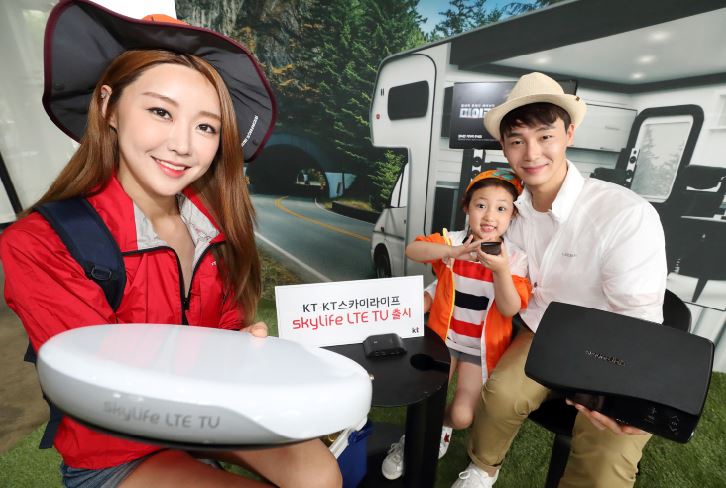
Skylife LTE TV (SLT) is a service that combines KT's LTE technology with KT Skylife's satellite broadcasting to provide high-definition video regardless of driving conditions. It provides real-time broadcasts via satellite, but switches to LTE broadcast signals when satellite signals weaken due to heavy rain or tunnel entry. Key features include satellite broadcasting's high definition, wide coverage, affordable usage fees, and the advantages of uninterrupted LTE network service.
Existing express buses experienced interruptions in real-time broadcasts when entering tunnels or during adverse weather conditions, drawing complaints from passengers. To resolve this issue, the two companies developed and applied "B.U.S." technology.
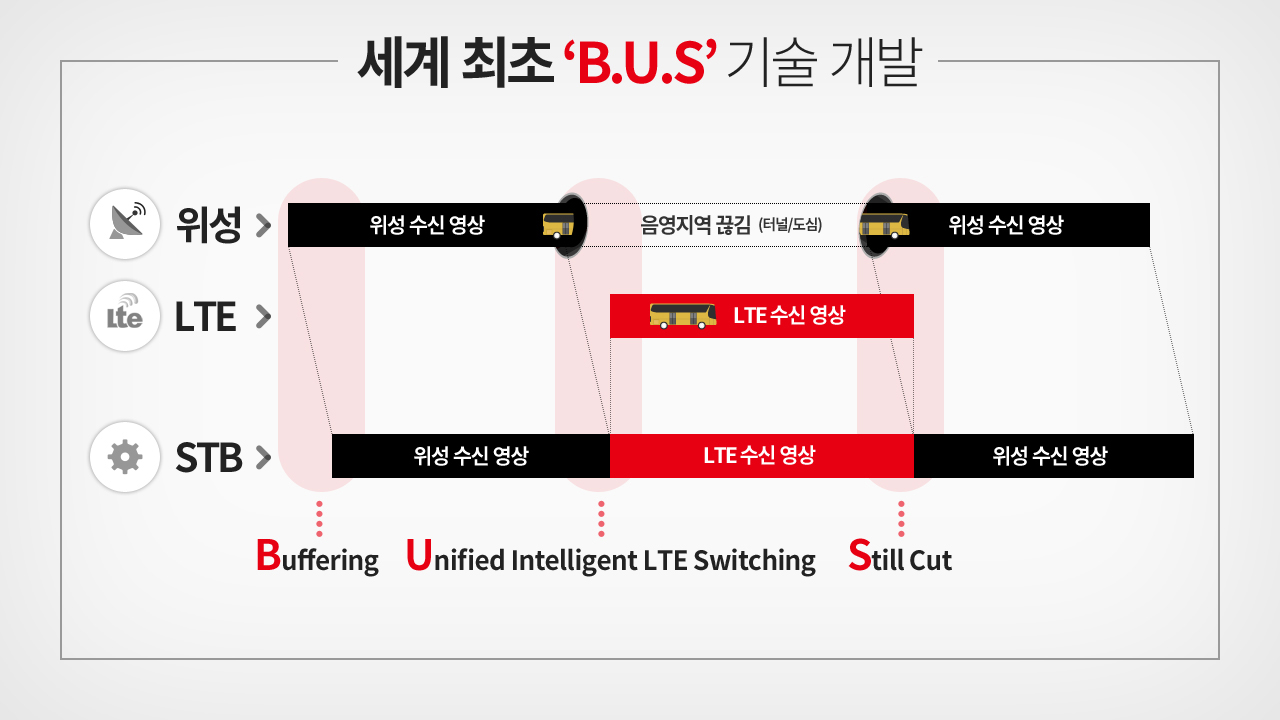
BUS is an acronym for Buffering, Unified Intelligent LTE Switching, and Still Cut. Buffering is a technology that delays the received satellite signal by approximately 5 seconds in the set-top box before playback. This ensures that video does not interrupt when entering or exiting shadow areas such as tunnels, even when the broadcast signal switches between satellite and LTE networks.
The Unified Intelligent LTE Switching technology switches broadcast signal reception from satellite to LTE in approximately 1 second when satellite signals are poor, and reverts the reception method from LTE back to satellite when satellite signals improve. Still Cut technology ensures smooth screen continuity by displaying the last frame of the broadcast being viewed at the moment the reception method switches between satellite and LTE.
SLT is evaluated as a media service that overcomes the challenging environment of domestic expressways with numerous tunnel sections. As of the end of last year, 9.8% of domestic expressways (total length 8,876 km) consist of tunnel sections (total length 871 km). The recently opened East-West Expressway (Seoul-Yangyang section) is approximately 60% comprised of tunnels.
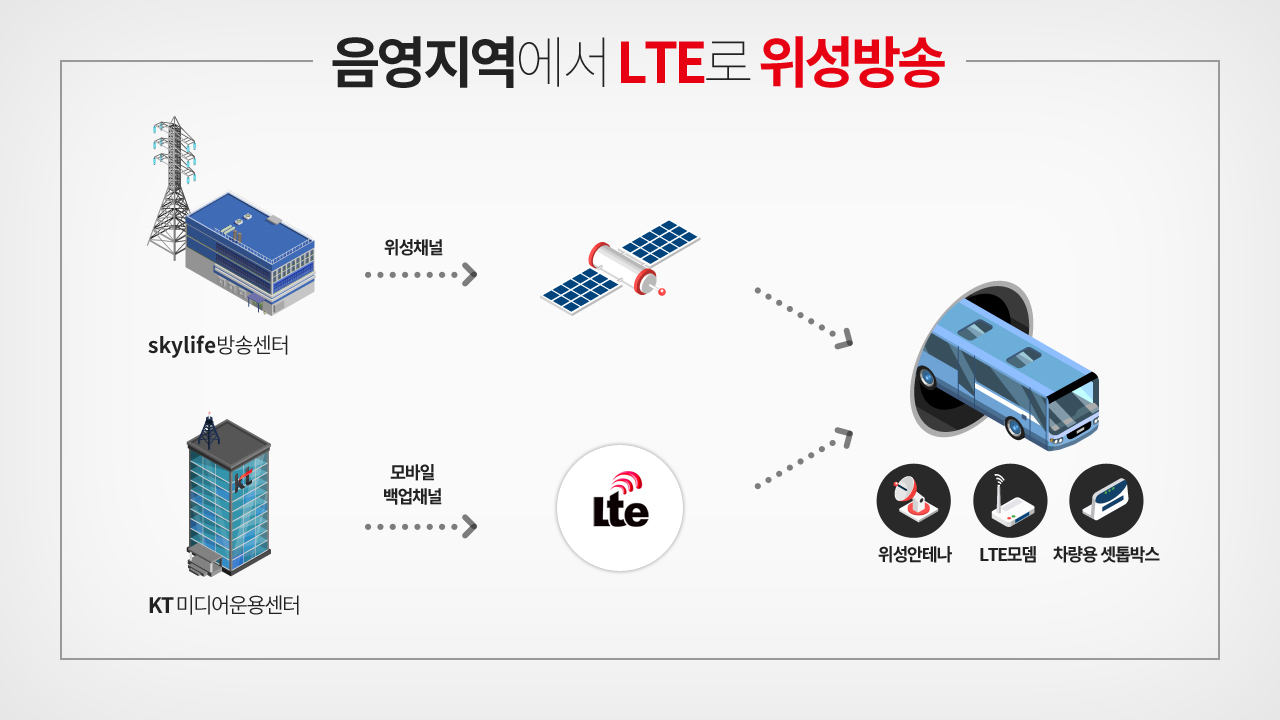
Prior to SLT's launch, KT and KT Skylife conducted road tests using 7 vehicles over a 2-month period starting in May on major expressways nationwide including Gyeongbu, Jungang, and Yeongdong routes. The tests successfully achieved uninterrupted real-time broadcast viewing in tunnels where satellite broadcasting and DMB were previously unavailable. Additionally, they plan to update RET (Retransmission) technology this year to overcome temporary packet loss.
RET (Retransmission) is a technology that analyzes screen information stored in the set-top box for 5 seconds and, when the screen becomes corrupted, transmits the corrupted image information from the broadcast center via the LTE network to provide a clean image. It is automatically applied upon set-top box upgrade without hardware modifications.
Along with the SLT launch, KT and KT Skylife are pursuing satellite antenna upgrades. The SLT antenna is reduced to one-fifth the size of existing antennas (45×15cm), measuring 30×4.2cm. The ultra-thin SLT antenna scheduled for launch at year-end measures 25×3cm.
A KT official stated that KT plans to apply its B.U.S. solution and RET technology not only to vehicles but also to high-speed trains like KTX and SRT, and is planning to export the technology overseas.
Related news

LG Electronics Launches Power Phone Capable of Watching DMB for Two Days on a Single Charge
LG Electronics is launching the LG X500 (319,000 won), a value-oriented smartphone featuring the largest battery capacity of any domestically released smartphone to date, through all three mobile carriers on the 9th. The LG X500 is a Korea-exclusive product based on the globally acclaimed LG X Power2, which was first unveiled at MWC 2017 held in early this year. It adds HD DMB with 12 times better picture quality compared to standard DMB and features 32GB of storage capacity. The device is equipped with a large-capacity 4,500mAh battery that enables up to two days of use on a single charge. It can continuously play video for approximately 20 hours on one charge, and internet browsing is possible for approximately 20 hours of continuous use. With fast charging that is twice as quick as conventional charging, the battery can be charged to 50% in approximately one hour. The display screen measures 5.5 inches. The LG X500 features a 5-megapixel front wide-angle camera that enables group selfies without requiring a selfie stick. Additionally, an LED flash is mounted on the front to enable bright and clear selfies in low-light conditions. The 13-megapixel rear camera with high image quality has zero shutter lag applied, allowing photography to be captured simultaneously with button press. Lee Sang-kyu, Senior Executive of LG Electronics' Korea Mobile Group, stated, "This will be a suitable phone for consumers who want to work on smartphones for extended periods or enjoy content without worrying about battery life, and LG Electronics will continue to introduce value-oriented lineups."
2017.06.05by 김자영 기자
KT Launches LG's High-Capacity Battery 'Power Phone' on Olleh Shop
KT announced that it will launch LG Electronics' budget-friendly smartphone LG X500 through KT stores nationwide and its official online store KT Olleh Shop. The LG X500 is a budget-friendly smartphone equipped with a 5.5-inch large HD display, high-performance front and rear cameras (front wide-angle), and a large-capacity battery of up to 4500mAh, the largest in Korea. It features HD DMB functionality, allowing users to enjoy HD DMB channels with enhanced picture quality.
2017.06.08by 김자영 기자
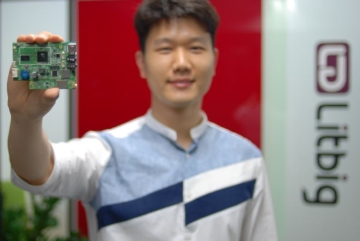
Litvik Develops Module to Convert Existing Automotive DMB to High Definition
Litbig, a venture company developing automotive infotainment solutions, announced on the 10th that it has developed a "high-definition DMB broadcasting solution and connectivity module." The newly launched module allows users to enjoy high-definition DMB broadcasting simply by installing the module into the AVN already installed in existing vehicles.
2017.07.10by 신윤오 기자
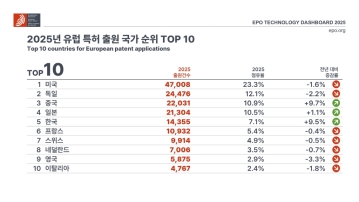
European Patent Applications Surpass 200,000 for the First Time… South Korea Maintains 5th Place, Led by Batteries and Telecommunications
According to the European Patent Office (EPO)'s 'Technology Dashboard 2025', European patent applications last year reached 201,974, surpassing 200,000 for the first time. Korean companies and inventors filed 14,355 applications, representing a 9.5% increase from the previous year and maintaining 5th place by country. Battery, digital communication, and semiconductor technologies led the growth, with Samsung ranking as the top EPO applicant for the second consecutive year and LG reaching 3rd place. The presence of major domestic cities such as Seoul, Suwon, and Yongin was also confirmed. It was also revealed that Korea's European patent strategy is expanding beyond individual technologies to span the entire industry.
2026.03.24by 명세환 기자
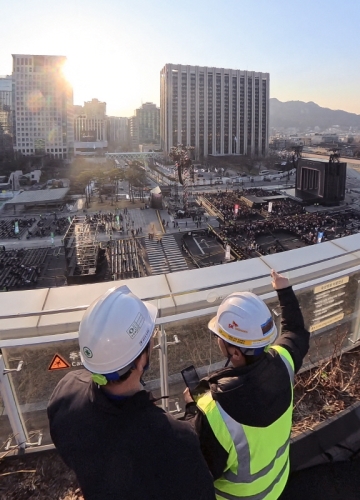
SK Telecom First Applies AI-Based Network Operations at Gwanghwamun K-Pop Concert
SK Telecom announced that it applied an AI-based network operation system for the first time at a large-scale K-pop concert held in the Gwanghwamun area of Seoul on March 21st, managing communication quality throughout the event. Mobile data usage during the three hours before and after the concert reached 12.15TB, approximately doubling compared to the same time slot the previous weekend. SK Telecom monitored traffic using the AI system 'A-One' in five-minute and 50-meter units to respond to potential overload situations, while also operating temporary communication facilities and on-site personnel in parallel. This case is interpreted as confirmation of the practical applicability of AI-based autonomous network operation in an environment where demand from dense events and foreign users increases simultaneously.
2026.03.23by 명세환 기자











