



A new Xtrinsic touch sensor platform that efficiently combines capacitive and resistive touch technologies on a single chip for the first time in the industry
 Published2012.02.01 18:16
A solution that enables faster and easier enhancement of interface functions in medical, consumer electronics, and automotive applications
February 1, 2012, Seoul – Freescale Semiconductor (NYSE: FSL, www.freescale.co.kr ) announced the Xtrinsic touch sensor platform, a new device that combines capacitive touch sensors and resistive on-screen motion recognition technology into a single IC for the first time in the industry. This touch sensor solution is ideal for applications such as control panels, Human-Machine Interfaces (HMI), keyboard replacements, automotive, POS terminals, signature capture devices, and unmanned information terminals.
The Xtrinsic touch sensor platform not only provides capacitive touch capabilities but also includes motion recognition features for resistive screens to address markets and situations where capacitive screens are not a practical option. Resistive touch screens can be implemented more cheaply than capacitive screens and are an excellent alternative in cases where the use of gloves is essential for medical, climate, or security reasons.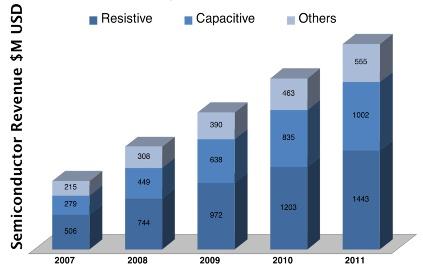
The extensible touch sensor platform also expands Freescale’s Ready Play solution portfolio. Freescale Ready Play solutions are technologies that enable customers to add features while reducing development costs and simplifying design cycles by integrating certified application capabilities, thereby supporting scalability for applications and systems. With both capacitive and resistive technologies implemented in a single turnkey device, customers can add additional features to their products while reducing software development costs, board space, and time-to-market.
"Freescale's extrinsic capacitive and resistive touch sensor platform is the first device capable of integrating motion recognition without complex hardware or screen modifications," said Geoff Lees, Senior Vice President of Freescale's Industrial and Mixed Markets MCU business unit. "This platform provides a simple and affordable solution for customers looking to develop advanced user interfaces targeting markets where touch sensor technology has not previously been integrated, and will have a significant impact on mobile medical applications, automotive, netbooks, and smart mobile devices."
By utilizing the extensible touch sensor platform, up to four capacitive electrodes can be added to customer systems in a single 5x5mm, 32-pin QFN package. This platform includes standard XY resistive touchscreen sensing capabilities, and calibration and pressure sensing options for resistive screens are provided. Motion sensing features include user-configurable screen resolution, along with slide, 2-contact pinch and zoom, and 2-contact rotation functions for four touchscreen-independent capacitive electrodes utilizing I2C and UART communication protocols.
A proven leader in sensor solutions
Continuing over 30 years of sensor innovation, Freescale’s Xtrinsic sensor solutions optimally combine high-performance sensor capabilities, processing power, and custom software to support the development of differentiated smart sensor applications. Freescale’s vision for its Xtrinsic sensor solutions is to provide a diversified and differentiated product portfolio that meets the demands of the automotive, consumer electronics, and industrial sectors. Extrinsic solutions provide a unique combination of functionality and intelligence designed to differentiate and succeed in highly competitive markets.
Price and supply situation
The Extensible Capacitive and Resistive Touch Sensor Platform (CRTouch) will be included in the Tower System LCD development board to support advanced features across the Freescale portfolio. Sample quantities of this cost-effective development board are scheduled to be available in the first quarter of 2012 at a price of $85 (USD). Linux and Android drivers will be available at http://www.freescale.com/PEG along with a free demo GUI (Graphical User Interface) and Freescale PEG graphics library examples.

관련뉴스
Intel Unveils Next-Generation 'Core Ultra Series 3' and vPro Platform for Enterprise PCs
Intel has officially unveiled the "Intel Core Ultra Series 3" for next-generation enterprise PCs and the latest vPro platform, addressing a wide range of demands from enterprise notebooks to high-performance workstations.
2026.03.26by 배종인 기자
ROHM Launches ESD Protection Diode Compatible with High-Speed Interfaces of 10Gbps or Higher
반도체 전문 기업 로옴(ROHM)이 10Gbps를 넘어서는 차세대 고속 데이터 통신 환경에 대응할 수 있는 ESD(정전기 방전) 보호 다이오드 ‘RESDxVx 시리즈’를 개발하며, 고속 인터페이스에서 요구되는 신호 품질 유지와 IC 보호 성능을 동시에 끌어올렸다.
2026.03.26by 배종인 기자
ST Launches 75V Drive IC Targeting 48V Industrial Motor Driving
ST마이크로일렉트로닉스가 48V급 산업용 구동 시스템 설계에 맞춘 75V 모터 드라이브 IC ‘STSPIN9P’ 시리즈를 공개했다. 새 제품군은 하프 브리지와 풀 브리지 구조로 구성돼 모터 종류와 출력 조건에 따라 설계를 확장할 수 있도록 한 것이 특징이다. 전원 회로와 보호 기능, 전류 감지 회로를 칩에 통합해 시스템 구성을 단순화했으며, 최대 500W급 애플리케이션까지 대응하도록 설계됐다. 회사는 레퍼런스 디자인과 데모 보드도 함께 제공해 산업 자동화, 로보틱스, 펌프, 팬, 조명, 섬유 기계 등에서 개발과 평가를 지원할 계획이다.
2026.03.26by 배종인 기자

Nordic supports security updates for the entire lifecycle of IoT devices at a single fixed cost
Nordic Semiconductor, a global leader in low-power wireless connectivity solutions, has unveiled a single fixed-cost licensing model that delivers FOTA (Firmware Over-the-Air) and device management capabilities throughout the device lifecycle via nRF Cloud, and introduced a new firmware update solution to prepare for the enforcement of the European Union's Cyber Resilience Act (CRA).
2026.03.26by 배종인 기자

Practical Training in Low-Noise, Low-Power Circuit Design All in One Place… Training Fee Support
고감도 아날로그 회로와 센서 기반 시스템 설계 역량을 강화할 수 있는 ‘2026 고급 엔지니어 실무 마스터 클래스’가 오는 4월16일 서울 가산동 e4ds 컨퍼런스 센터에서 열린다. 이번 과정은 온라인이 아닌 오프라인 유료 실습 교육으로 진행되며, 현장 중심의 심화 학습을 원하는 엔지니어를 대상으로 한다. 이번 교육은 텍사스 인스트루먼트(Texas Instruments)가 교육비를 지원해 정가 25만원에서 10만원 할인 된 15만원에 참가할 수 있다.
2026.03.26by 배종인 기자











