



Launch of 32-bit MCU Family for Industrial Applications
 Published2012.02.06 09:25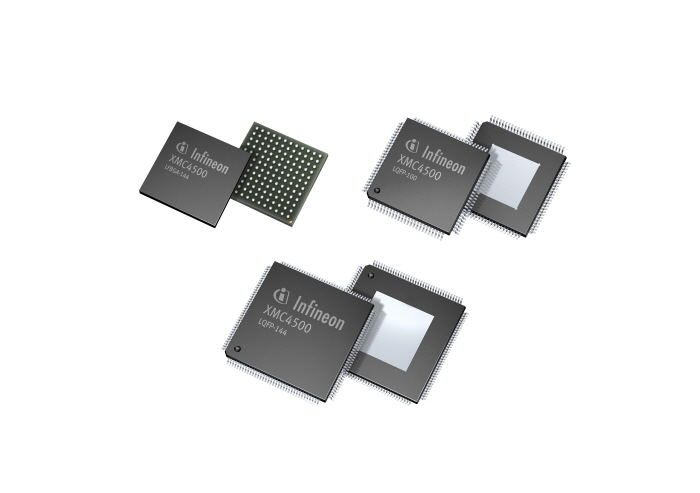
February 1, 2012, Seoul – Infineon Technologies (Korea Representative Director Seung-soo Lee) has launched the XMC4000 32-bit microcontroller family based on ARM®’s Cortex™-M4 processor. In the design of the XMC4000 family, Infineon has applied the technological expertise accumulated over the past 30 years in microcontroller development, application-optimized peripherals, and outstanding real-time performance, combining the various advantages of widely used core architectures. The XMC4000 family supports three major trends in industrial applications: improving energy efficiency, supporting multiple communication standards, and reducing software complexity during development. Target applications for the XMC4000 family include electric drives, solar inverters, and automation of manufacturing facilities and buildings.
Peter Bauer, CEO of Infineon Technologies, said, “Energy conservation plays a crucial role in meeting the increasing energy demand driven by the growing global population. Infineon’s market-leading power semiconductor products and the new ARM-based microcontroller family, the XMC4000, enable energy-efficient control in various types of industrial applications.”
XMC4000 Product Family – Providing diverse solutions on a single platform
XMC stands for “Cross-Market Microcontroller,” which means that the XMC4000 family features configurability and can be used in various types of industrial applications. Infineon aims to bridge the performance gap between the 16-bit XE166 family and the 32-bit TriCore™ family with the XMC4000 family. The XMC4000 family is designed to provide a variety of scalable and compatible solutions and a high level of software reusability. The XMC4000 family includes five series (XMC4100, XMC4200, XMC4400, XMC4500, and XMC4700), classified according to core frequency, memory capacity, peripheral features, and the number of I/Os.
The XMC4000 family provides a powerful CPU subsystem, DSP capabilities, a floating-point unit, high-speed flash memory with 22ns read times and ECC (error correction code) capabilities, large SRAM, and expanded peripheral capabilities. Comprehensive peripherals include a new timer module, up to four parallel 12-bit A/D converters with a sampling rate of 70ns and a conversion time of 500ns, up to two 12-bit D/A converters, up to four high-resolution PWM channels (150ps), an integrated delta-sigma demodulator module, and a touch button module. Additionally, robust communication performance is achieved by providing IEEE 1588 compliant Ethernet MAC (Media Access Control for Ethernet, with time stamping capabilities), USB 2.0, CAN, and SD/MMC interfaces, and up to six serial communication channels (each of these channels can be configured via software as UART, SPI, Quad SPI, IIC, IIS, or LIN). In addition, the XMC4000 family provides high-speed external bus interfaces that support synchronous standards such as SDRAM and Burst Flash, as well as asynchronous standards such as SRAM, NAND Flash, and NOR Flash.
DAVE™ 3 and Third-Party Tools – Efficient Development with XMC4000
The integrated development environment DAVE™ 3 enables fast, convenient, and application-oriented software development. By adding third-party tools, you can extend the Eclipse-based environment, which includes a free GNU compiler, debugger, and data display utilities. DAVE 3 also enables automatic code generation based on predefined software components called “DAVE Apps.” DAVE Apps can be configured in a user-friendly manner on a graphical user interface. Therefore, DAVE 3 allows developers of industrial applications to fully utilize the capabilities of the XMC4000 microcontroller with minimal programming effort. The generated code can be compiled, debugged, and displayed directly in DAVE 3, or imported into third-party tools for further processing. Infineon collaborates with over 20 partners that provide a variety of development tools, software solutions, training, and consulting services available for the XMC4000 family.
Dr. Stephan Zizala, Senior Director of Industrial and Multi-Market Microcontrollers at Infineon Technologies, said, “Infineon’s XMC4000 family combines peripherals optimized for industrial applications with the widely adopted ARM architecture. Industrial customers can benefit from Infineon’s years of accumulated application experience, which enables flexible timers, high-speed ADCs, fast and robust flash memory, and an extended temperature range of up to 125°C.” "In addition, by using a development environment called DAVE, you will be able to design XMC4000 products quickly and conveniently in a familiar way," he said.
XMC4500 for mid-range industrial applications
The first product to be released in the 32-bit XMC4000 family is the XMC4500 series, which provides a 120MHz CPU, up to 1MB of embedded flash memory, 160KB of RAM, and comprehensive peripheral and interface capabilities. These peripherals include modules consisting of four parallel high-speed 12-bit A/D converter modules, two D/A converters, four delta-sigma demodulator modules, six capture/compare units (CCU4 and CCU8), two positioning interface modules, and eight touch buttons. Communication capabilities include Ethernet, USB, and SD/MMC interfaces. Additionally, the XMC4000 family provides three CAN modules, six serial communication channels, and one external bus interface for communication functions. These products are available in LQFP-144, LQFP-100, and LFBGA-144 packages.
Supply timing for XMC4500 and other series
XMC4500 series samples and DAVE 3 are scheduled to be available starting March 2012, with mass production scheduled for May 2012. To support development, a modular design kit is provided, allowing up to three additional application boards to be connected to the base design board depending on the application requirements. Sample supply for the XMC4400, XMC4200, and XMC4100 series is scheduled to begin in the fourth quarter of 2012.

관련뉴스

Intel Unveils Next-Generation 'Core Ultra Series 3' and vPro Platform for Enterprise PCs
인텔이 차세대 기업용 PC를 위한 ‘인텔 코어 Ultra 시리즈 3’와 최신 vPro 플랫폼을 공식 발표하며, 기업용 노트북부터 고성능 워크스테이션까지 폭넓은 수요 충족에 나섰다.
2026.03.26by 배종인 기자

ROHM Launches ESD Protection Diode Compatible with High-Speed Interfaces of 10Gbps or Higher
반도체 전문 기업 로옴(ROHM)이 10Gbps를 넘어서는 차세대 고속 데이터 통신 환경에 대응할 수 있는 ESD(정전기 방전) 보호 다이오드 ‘RESDxVx 시리즈’를 개발하며, 고속 인터페이스에서 요구되는 신호 품질 유지와 IC 보호 성능을 동시에 끌어올렸다.
2026.03.26by 배종인 기자
ST Launches 75V Drive IC Targeting 48V Industrial Motor Driving
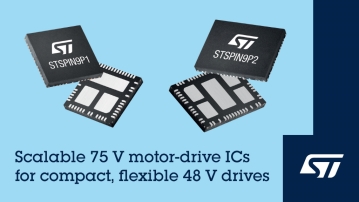
ST마이크로일렉트로닉스가 48V급 산업용 구동 시스템 설계에 맞춘 75V 모터 드라이브 IC ‘STSPIN9P’ 시리즈를 공개했다. 새 제품군은 하프 브리지와 풀 브리지 구조로 구성돼 모터 종류와 출력 조건에 따라 설계를 확장할 수 있도록 한 것이 특징이다. 전원 회로와 보호 기능, 전류 감지 회로를 칩에 통합해 시스템 구성을 단순화했으며, 최대 500W급 애플리케이션까지 대응하도록 설계됐다. 회사는 레퍼런스 디자인과 데모 보드도 함께 제공해 산업 자동화, 로보틱스, 펌프, 팬, 조명, 섬유 기계 등에서 개발과 평가를 지원할 계획이다.
2026.03.26by 배종인 기자

Nordic supports security updates for the entire lifecycle of IoT devices at a single fixed cost
Nordic Semiconductor, a global leader in low-power wireless connectivity solutions, has unveiled a single fixed-cost licensing model that delivers FOTA (Firmware Over-the-Air) and device management capabilities throughout the device lifecycle via nRF Cloud, and introduced a new firmware update solution to prepare for the enforcement of the European Union's Cyber Resilience Act (CRA).
2026.03.26by 배종인 기자

Practical Training in Low-Noise, Low-Power Circuit Design All in One Place… Training Fee Support
고감도 아날로그 회로와 센서 기반 시스템 설계 역량을 강화할 수 있는 ‘2026 고급 엔지니어 실무 마스터 클래스’가 오는 4월16일 서울 가산동 e4ds 컨퍼런스 센터에서 열린다. 이번 과정은 온라인이 아닌 오프라인 유료 실습 교육으로 진행되며, 현장 중심의 심화 학습을 원하는 엔지니어를 대상으로 한다. 이번 교육은 텍사스 인스트루먼트(Texas Instruments)가 교육비를 지원해 정가 25만원에서 10만원 할인 된 15만원에 참가할 수 있다.
2026.03.26by 배종인 기자











