


Smart glasses, fatigue management devices, and other industrial wearables are 'notable'
 Published2017.08.23 06:23
High capital costs and limited support for existing platforms are obstacles.
The development of industrial wearable technology is accelerating.
Industrial wearables are receiving increasing attention as the Internet of Things emerges and workers demand real-time data, monitoring, and tracking. Devices such as hats, goggles, and wrist-worn devices with advanced sensors, voice recognition technology, visual assistance, and touch support ensure user safety and facilitate data access.
Frost & Sullivan's Wearable Technologies for Industrial Applications report, published by Frost & Sullivan, explores key wearable technologies and market players across applications such as manufacturing shop floor and product assembly, quality assurance, product pick-up and move, and delivery scheduling.
“Technologists are designing wearable devices that are lightweight, portable, and easy to handle, along with longer battery life and advanced sensor technologies to improve ergonomics and reduce fatigue-related issues,” said Frost & Sullivan TechVision Research Analyst Ranjana Lakshmi Venkatesh Kumar. “The trend toward miniaturization and advancements in materials will give rise to wearable devices with tiny sensors and electronic components that can become part of the human body.”
The scope of wearable devices is rapidly expanding, but high capital costs and limited support from existing platforms are hindering their adoption for industrial use. Companies are also concerned about the technological capabilities to seamlessly integrate them into existing workflows. Many technology developers may not even have access to the technology required to incorporate ergonomics and user experience into their product designs.
“The wearables market is expected to see some very disruptive developments over the next two to five years,” said Kuma. “More digitalization will transform current industries into smart industries with HMIs (Human-Machine Interfaces) that connect internal users and external customers to supply chain processes and improve productivity, user awareness, and work environments.”
Wearable devices currently in use or being evaluated in the industry include smartwatches, activity or health trackers (fitness bands), wearable mobile cameras, smart glasses, and head-mounted displays with augmented reality (AR) capabilities. Other potential technologies include ring sensors for controlling the environment, electronic skin wearables for display, and headbands that track brain activity for calmness and focus.
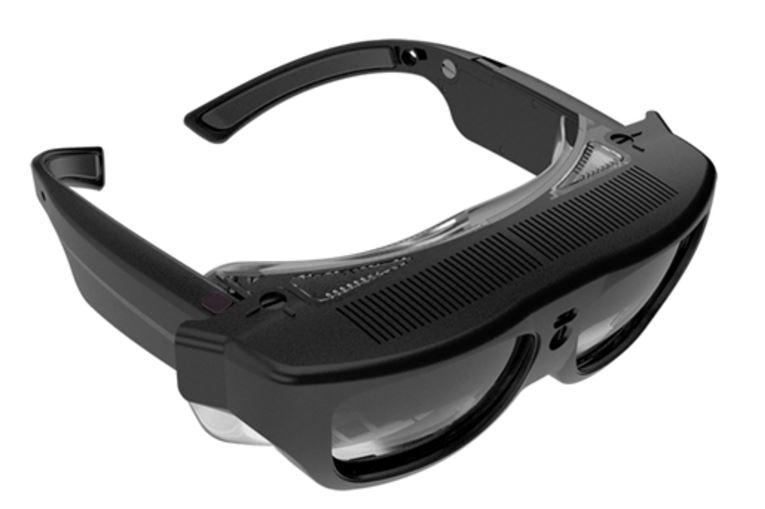
Some of the more notable companies in the wearable tech space for industrial applications include Epson, ODG, and OptAlert. Epson (UK) offers lightweight smart glasses with a stunning OLED display. The device has a camera that projects secondary AR images. Their advanced sensors and processors read the user’s environment and provide appropriate recommendations. ODG (Osterhout Design Group, USA) smart glasses are mobile computers with two stereoscopic HD displays that run at 80 frames per second with a 40-degree field of view. These smart glasses are designed for industrial and medical use. OptAlert (Australia) has developed a fatigue management device that detects a user’s drowsiness based on real-time eye movements. They feature unique Bluetooth features with multiple layers of protection to ensure device safety.
관련뉴스
[Promising Future Technologies ④] Future Displays Evolving Toward Human Interaction
Over the next decade, displays will provide users with completely new experiences and will feature various sizes and designs rather than conventional rectangular formats. Additionally, implementation will be possible anywhere and anytime, capable of displaying whatever users imagine. The emergence of flexible display technology has brought innovation to the display industry. The glass substrates of conventional flat-panel displays have been replaced with plastic. Flexible displays are being gradually applied to smartphones and TVs, and are being closely watched globally as a key component for application in wearable devices, which are currently actively progressing in the IT market.
2017.01.23by 신윤오 기자
Will Biometrics Become the Killer Application for Healthcare Wearable Devices?
MIT Technology Review reported that China is leading the way in facial recognition technology, which is attracting attention as a next-generation biometric technology. China stated that it has already been able to distinguish people entering buildings using facial recognition, track criminals, and even process payments.
2017.03.20by 김지혜 기자
[Shut Up and Try It] Mixed Reality Applied to Architecture, This Is a 'Gem'
On the 27th of last month, Trimble, a specialized company in construction 3D BIM technology, published an article stating plans to introduce wearable holographic technology to the construction industry through collaboration with Microsoft. Based on the number of views and survey responses, it was possible to gauge how intense readers' interest in mixed reality, virtual reality, and augmented reality was. Therefore, this time the reporter set out to experience hologram 'mixed reality' firsthand.
2017.04.10by 김자영 기자
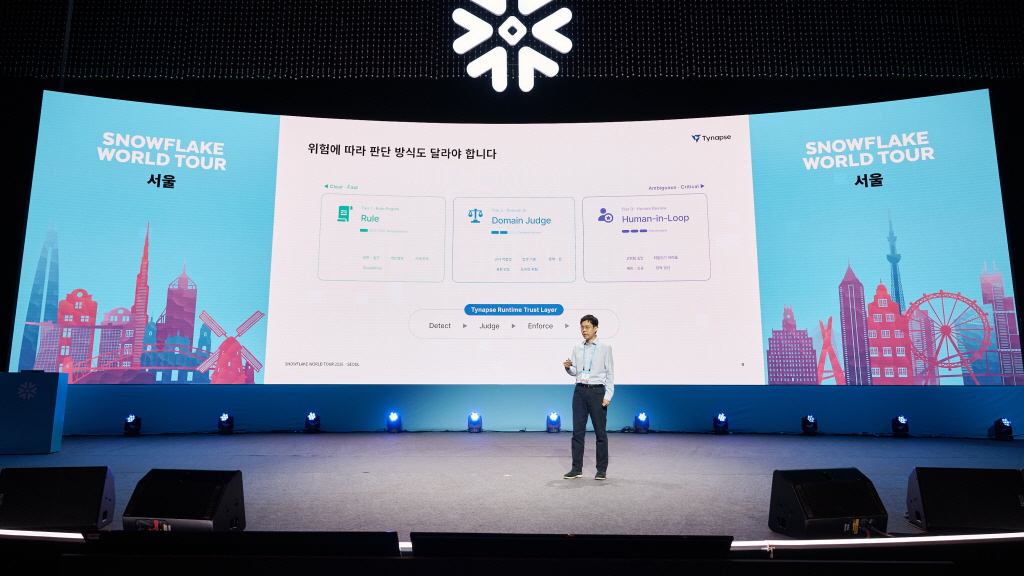
The Problem with AI is Not Performance, but Trust
CEO Kang Min-seung emphasized at Snowflake's World Tour Seoul that generative AI has entered a phase where "trust" rather than accuracy becomes the key competitive advantage. As AI is applied to various tasks including consultation, risk management, and operational automation, incorrect data, erroneous responses, and bias are creating actual business risks. He pointed out that enterprises must build a trust layer above AI. To achieve this, accurate data management, semantic structuring, governance, and prompt security are essential. He explained that AI is not merely an automation tool but a technology that reorganizes the entire organization's workflows and decision-making systems. Snowflake provides a platform that supports this trust-based AI operation, emphasizing that enterprises should build "trustworthy AI" rather than "intelligent AI."
2026.08.28by 배종인 기자
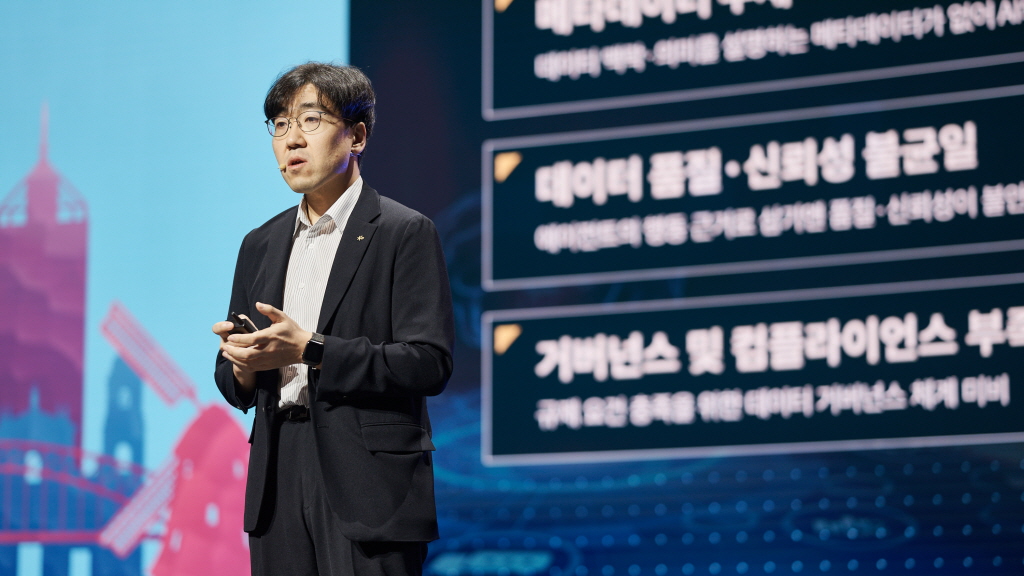
The Decisive Factor for AI Agents in Finance: "Trustworthy Data Infrastructure"
The key to spreading AI agents in the financial sector is establishing a trustworthy data system. KB Kookmin Bank is operating over 100 AI agents by 2025 and is promoting expansion to 300. AI is automating repetitive tasks across various areas such as consultation, risk management, wealth management, and relationship management. However, if data quality, governance, and semantic structuring are insufficient, errors and risks increase. KB is building an AI-Ready organization through a multi-model strategy of GPT, Gemini, and Claude, as well as a Snowflake-based data system. The bank emphasized that AI has entered a phase where it restructures not just simple automation but the entire work process and decision-making system.
2026.08.28by 배종인 기자











