


KT to Relay Ultra-Low Latency Traffic Through International Submarine Cable Complex
 Published2017.09.26 14:44
Currently, submarine cables with a total capacity of 1,500 Tbps and a length of 1.3 million km have been constructed around the world, and 954 terrestrial countries are connecting their land-based communication networks with submarine cables. Among them, KT manages, controls, and operates seven submarine cables connecting major countries such as the United States, Japan, and China, with a total capacity of 179 Tbps, or approximately 12%.
Additionally, KT is responsible for 80% of the international traffic generated in Korea, and is the only global 'traffic relay operator (IPX Provider, IP Exchange Provider)' in Korea that relays and transmits international traffic between countries.
To this end, KT has integrated the functions of the International Submarine Cable Integrated Control Center (SNOC, Submarine Network Operation Center), which transmits and receives international traffic and controls the submarine cable network, and the Global Telecommunication Service Center (GTSC, Global Telecommunication Service Center), which provides services such as international calls, roaming, internet, and broadcasting, into the International Submarine Cable Complex.
Typically, when a content company located in the United States transmits video to a telecommunications company in Hong Kong using a third-country traffic relay operator, the traffic is transmitted to a land station located on the coast of the third country, and then this traffic is then transferred to a service processing facility located inland, where it has to go through the process of reconfiguring the route once more before being transmitted to Hong Kong, which inevitably results in a delay of about 10ms or more.
Accordingly, KT announced that it is capable of providing an ultra-low latency traffic relay service that reduces the delay of international traffic received in the United States to 1ms. This is because the international submarine cable complex can process service and designate new routes simultaneously in the same space as reception, reducing delays caused by global traffic relay operators.
A KT official said that the international traffic relay time of the International Submarine Cable Complex is the best among the 25 global traffic relay operators around the world, and predicted that the advantage of ultra-low latency will greatly contribute to attracting domestic construction of data centers of global companies that require fast network connections and to leaping forward as the number one traffic relay operator.
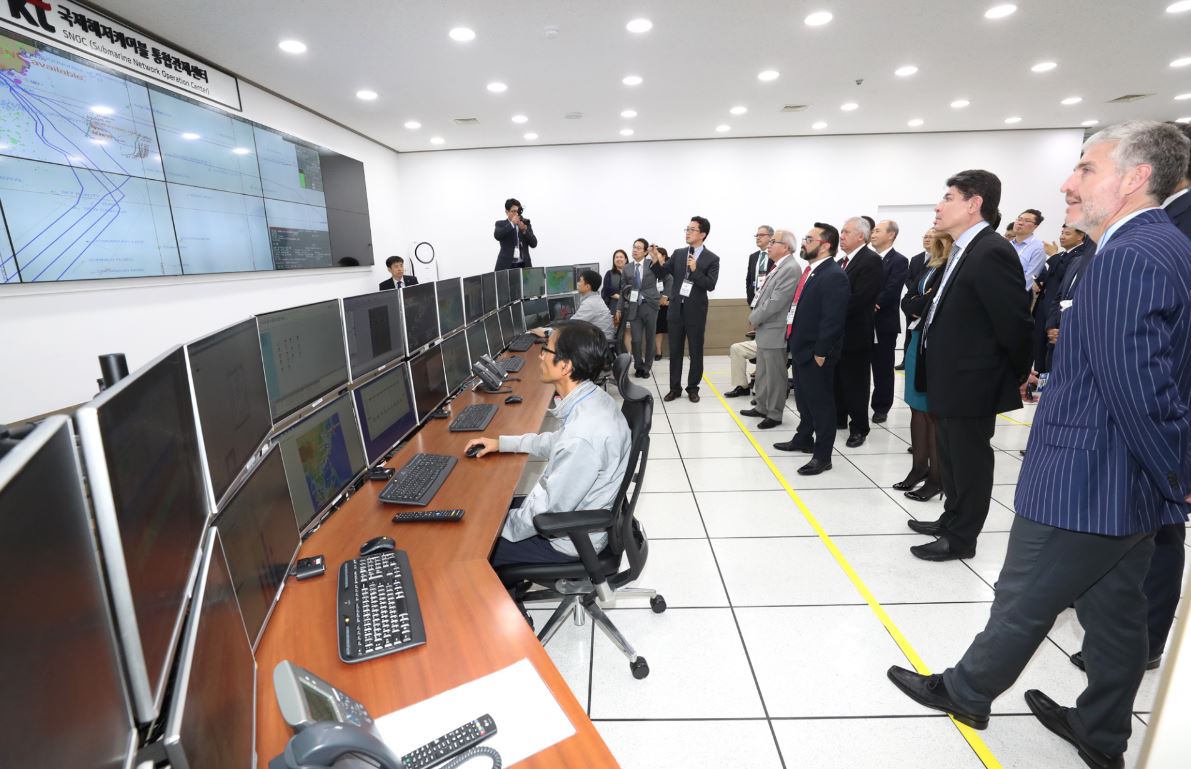
KT has introduced the 'Submarine Cable Vessel Surveillance System,' an enhanced submarine cable integrated protection solution, to the International Submarine Cable Complex to reliably transmit game footage and data from important events such as the Olympics and World Cup to the world.
KT's submarine cable vessel surveillance system is a solution that uses four 'dedicated submarine cable surveillance vessels' located in Busan, Geoje, and Jeju to transmit territorial waters images captured by CCTV and maritime conditions analyzed by surveillance radar to the international submarine cable complex using LTE and satellite communications.
The International Submarine Cable Complex monitors information transmitted by the 'Submarine Cable Vessel Surveillance System' 24 hours a day. Commercial ships and fishing boats approaching within 4km of a submarine cable are notified by radio of the risk of cable disconnection, and when they approach within 500m, a nearby submarine cable monitoring vessel is dispatched to guide them to move.
In addition, KT is providing the 'Submarine Cable Alarm System', a display device that displays the submarine cable route based on GPS and informs the distance between the submarine cable and the vessel, to approximately 2,200 fishing boats that mainly engage in fishing activities near the submarine cable route to protect the submarine cable.
KT predicted that the submarine cable vessel monitoring system and submarine cable alarm system will be able to drastically reduce the submarine cable failure rate, as submarine cable cuts caused by anchors during fishing boat activities and commercial ship mooring operations account for 94% of the causes of failures (underwater earthquakes 6.3%, simple failures 0.4%).
Meanwhile, KT presented its differentiated ICT technologies, including a demonstration of the ultra-low latency traffic transmission service between Korea and the United States on the International Submarine Cable Complex, submarine cable control technology, '5G Bus', and 'GiGAeyes' to 16 Central and South American IT ministers and vice ministers from 11 countries, including Costa Rica and Peru, attending the Busan ITU Telecom World on the 25th.
Oh Seong-mok, President of KT’s Network Division, said, “With the completion of a global communications forward base capable of relaying data with an ultra-low latency of 1ms, Korea’s ICT status has been elevated to a higher level,” and “KT has completed all preparations to ensure that viewers around the world can enjoy high-quality matches based on its 5G pilot service and international submarine cable complex.”
관련뉴스
Fast, wireless KT Giga Wire improves internet environment in downtown Boston
KT's innovative technology 'Giga Wire' has made its first appearance in the US market. Giga Wire is a technology that achieves maximum internet speeds of 1Gbps using only copper wires without optical cables. Following KT's signing of a Memorandum of Understanding (MOU) with the City of Boston in June for Giga Wire deployment, KT has now begun full-scale construction of Giga Wire infrastructure in downtown Boston. On the 15th (Friday), KT held an opening ceremony for Giga Wire at Hibernian Hall in downtown Boston and announced that it has begun providing Giga Wire services in downtown Boston.
2017.09.18by 김자영 기자
KT Receives Presidential Commendation in Recognition for Renewable Energy Supply Activities
KT가 21일 일산 킨텍스에서 진행된 한국신재생에너지대상 시상식에서 신재생에너지 기술개발 및 확산에 대한 공로를 인정받아 단체로는 최고 등급인 대통령표창을 수상했다. KT는 세계 최초 에너지 통합관제 플랫폼 ‘KT-MEG(Micro Energy Grid)’ 및 태양광/ESS 관련 국내 특허 등록 등 기술개발 활동, 신재생에너지 발전소 구축 사업 등의 공적을 인정 받아 대통령 표창을 수상했다고 밝혔다.
2017.09.21by 김자영 기자
KT, “Intelligent Networks Are the Core of the Fourth Industrial Revolution”
KT는 25일 부산 BEXCO에서 국제전기통신연합(ITU)이 주관하는 세계 최대의 정보통신 포럼 ‘ITU 텔레콤 월드(Telecom World) 2017’에서 기조연설을 통해, 인공지능과 5G의 융합을 통한 ‘지능형 네트워크’로의 진화가 4차산업혁명 선도의 핵심이라고 발표했다. 전홍범 KT 인프라연구소장은 이날 ‘인공지능, 통신사, 그리고 지능형 네트워크(AI, Telcos & Intelligent Network)세션의 기조연설에서, KT의 인공지능 기반 통신망 기술을 발표하고 5G시대를 실현하기 위한 비전을 국제사회에 전했다.
2017.09.25by 김자영 기자
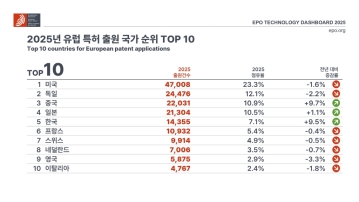
European Patent Applications Surpass 200,000 for the First Time… South Korea Maintains 5th Place, Led by Batteries and Telecommunications
According to the European Patent Office (EPO)'s 'Technology Dashboard 2025', European patent applications last year reached 201,974, surpassing 200,000 for the first time. Korean companies and inventors filed 14,355 applications, representing a 9.5% increase from the previous year and maintaining 5th place by country. Battery, digital communication, and semiconductor technologies led the growth, with Samsung ranking as the top EPO applicant for the second consecutive year and LG reaching 3rd place. The presence of major domestic cities such as Seoul, Suwon, and Yongin was also confirmed. It was also revealed that Korea's European patent strategy is expanding beyond individual technologies to span the entire industry.
2026.03.24by 명세환 기자
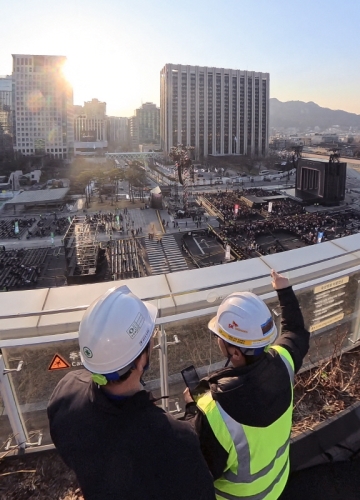
SK Telecom First Applies AI-Based Network Operations at Gwanghwamun K-Pop Concert
SK텔레콤이 3월 21일 서울 광화문 일대에서 열린 대형 K-팝 공연에 AI 기반 네트워크 운영 시스템을 처음 적용해 통신 품질을 관리했다고 밝혔다. 공연 전후 3시간 동안 모바일 데이터 사용량은 12.15TB로 직전 주말 같은 시간대보다 약 2배 늘었다. SK텔레콤은 AI 시스템 ‘A-One’을 활용해 5분 단위, 50m 단위로 트래픽을 감시하며 과부하 가능성에 대응했고, 임시 통신 시설과 현장 인력 운영도 병행했다. 밀집 행사와 외국인 이용 수요가 동시에 늘어나는 환경에서 AI 기반 자율 네트워크 운영의 현장 적용 가능성을 확인한 사례로 해석된다.
2026.03.23by 명세환 기자











