


Freescale Selects QorIQ Converge Small Cell SoC Technology for Its First LTE Picocell Base Station
 Published2012.02.23 10:05
QorIQ, a leader in the small cell sector, leverages the scalability, performance, and multimode capabilities of its Qonverge single-chip processors for base stations.
February 23, 2012, Seoul, Korea — Freescale Semiconductor (NYSE: FSL, www.freescale.com )’s QorIQ Converge PSC9132 processor is used in the latest small cell base stations of ip.access, a leading provider in the wireless infrastructure market. The ip.access E-100 access point announced today targets the enterprise market and is the company’s first LTE product to support simultaneous 3G and LTE transmission.
Scott Aylor, General Manager of Freescale’s Wireless Access business unit, stated, "IP Access has realized cutting-edge technology in small cell network infrastructure equipment," adding, "This design adoption further highlights the strong market recognition Freescale’s CoreIQ Converge products have demonstrated since their launch last year."
The QorIQ Qonverge PSC9132 processor provides data transfer speeds of up to 150 Mbps for LTE users and 42 Mbps for 3G users. Based on this performance, the E-100 AP is designed to enable mobile network operators to provide high-speed data and high-quality voice services to subscribers in offices, shops, hotels, and other indoor locations where reception is difficult.
Dr. Nick Johnson, CTO (Chief Technology Officer) of IP Access "After an extensive review of quotes, it was clearly revealed that Freescale is the best partner to supply the processors defining our dual-mode 3G/LTE AP products," said Nick Johnson. "The Freescale QorIQ Qonverge family is a state-of-the-art system-on-chip solution that provides exceptional scalability, performance, and multimode capabilities."
ip.access plans to exhibit a demo product using Freescale devices at the Mobile World Congress held in Barcelona at the end of this month (Hall 1, Stand E02).
IP Access provides comprehensive small cell infrastructure solutions that address coverage issues in mobile networks and increase network capacity for home, enterprise, or public use. IP Access’s nanoGSM® and nano3G® picocell solutions can provide 2G and 3G services to offices, shops, stations, and remote power areas, as well as to passenger aircraft and ships, and are currently installed and operating in over 60 networks worldwide, including AT&T, T-Mobile, Telefónica O2, TeliaSonera, and Bharti Airtel. In 2011, IP Access achieved the milestone of deploying 500,000 3G small cells and is the company that supported the Oyster 3G® femtocell technology used in AT&T’s 3G MicroCell, the world’s largest small cell solution for general consumers.
The QorIQ Qonverge single-chip product family for base stations is based on a common architecture and is a solution that integrates communication processing, digital signal processing, and wireless acceleration technologies into a single system-on-chip with various configurations optimized for next-generation femtocell, picocell, metrocell, and macrocell base stations. In addition, thanks to advanced process technology and excellent integration, it has become possible to integrate various functions previously performed by separate FPGAs, ASICs, DSPs, and processors into a single device. This integration has reduced the number of components, power consumption, cost, and footprint of base stations. Furthermore, since a common architecture is used from femtocells to macrocells, R&D investment and software reusability can be optimized.
Freescale developed the QorIQ Qonverge family by leveraging its extensive R&D scale, deep application knowledge in the wireless field, and broad IP portfolio. This processor combines multiple Power Architecture® cores and high-performance StarCore DSPs with MAPLE multimode baseband accelerators, packet processing acceleration engines, interconnect fabrics, and next-generation node process technology. This portfolio family supports numerous standards, including GSM, LTE – FDD & TDD, LTE-Advanced, HSPA+, TD-SCDMA, and WiMAX. Furthermore, thanks to its flexible architecture, it can support newly developed standards through software upgrades.

관련뉴스

Intel Unveils Next-Generation 'Core Ultra Series 3' and vPro Platform for Enterprise PCs
인텔이 차세대 기업용 PC를 위한 ‘인텔 코어 Ultra 시리즈 3’와 최신 vPro 플랫폼을 공식 발표하며, 기업용 노트북부터 고성능 워크스테이션까지 폭넓은 수요 충족에 나섰다.
2026.03.26by 배종인 기자

ROHM Launches ESD Protection Diode Compatible with High-Speed Interfaces of 10Gbps or Higher
반도체 전문 기업 로옴(ROHM)이 10Gbps를 넘어서는 차세대 고속 데이터 통신 환경에 대응할 수 있는 ESD(정전기 방전) 보호 다이오드 ‘RESDxVx 시리즈’를 개발하며, 고속 인터페이스에서 요구되는 신호 품질 유지와 IC 보호 성능을 동시에 끌어올렸다.
2026.03.26by 배종인 기자
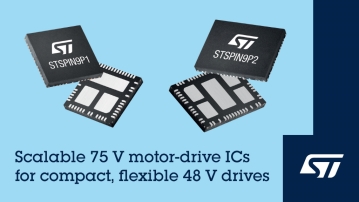
ST Launches 75V Drive IC Targeting 48V Industrial Motor Driving
ST마이크로일렉트로닉스가 48V급 산업용 구동 시스템 설계에 맞춘 75V 모터 드라이브 IC ‘STSPIN9P’ 시리즈를 공개했다. 새 제품군은 하프 브리지와 풀 브리지 구조로 구성돼 모터 종류와 출력 조건에 따라 설계를 확장할 수 있도록 한 것이 특징이다. 전원 회로와 보호 기능, 전류 감지 회로를 칩에 통합해 시스템 구성을 단순화했으며, 최대 500W급 애플리케이션까지 대응하도록 설계됐다. 회사는 레퍼런스 디자인과 데모 보드도 함께 제공해 산업 자동화, 로보틱스, 펌프, 팬, 조명, 섬유 기계 등에서 개발과 평가를 지원할 계획이다.
2026.03.26by 배종인 기자

Nordic supports security updates for the entire lifecycle of IoT devices at a single fixed cost
Nordic Semiconductor, a global leader in low-power wireless connectivity solutions, has unveiled a single fixed-cost licensing model that delivers FOTA (Firmware Over-the-Air) and device management capabilities throughout the device lifecycle via nRF Cloud, and introduced a new firmware update solution to prepare for the enforcement of the European Union's Cyber Resilience Act (CRA).
2026.03.26by 배종인 기자

Practical Training in Low-Noise, Low-Power Circuit Design All in One Place… Training Fee Support
고감도 아날로그 회로와 센서 기반 시스템 설계 역량을 강화할 수 있는 ‘2026 고급 엔지니어 실무 마스터 클래스’가 오는 4월16일 서울 가산동 e4ds 컨퍼런스 센터에서 열린다. 이번 과정은 온라인이 아닌 오프라인 유료 실습 교육으로 진행되며, 현장 중심의 심화 학습을 원하는 엔지니어를 대상으로 한다. 이번 교육은 텍사스 인스트루먼트(Texas Instruments)가 교육비를 지원해 정가 25만원에서 10만원 할인 된 15만원에 참가할 수 있다.
2026.03.26by 배종인 기자











