

.png)

OMAP 5 Platform Spotlighted at Mobile World Congress (MWC 2012)
 Published2012.03.02 12:01
TI Korea (CEO Kent Jeon, www.ti.com/ww/kr ) March 2, 2012 – At the Mobile World Congress (MWC 2012), TI focused on its OMAP™ 5 platform and showcased the outstanding performance of the highly anticipated new addition to the OMAP processor family through a live demo. Available for use in a wide range of markets, from smartphones to automotive and smart homes, the OMAP 5 platform enables users to capture, edit, save, and share content across various finished products, enabling the realization of an outstanding digital hub that delivers high-quality content. Consequently, rich, multimedia multitasking-intensive visuals can be achieved without compromising performance.
The Differentiation of Smart Multicore
TI's OMAP platform has long provided superior application processing performance at optimal power consumption by adopting a balanced system known as the Smart Multicore Architecture. As this architecture evolves to form the core of the OMAP 5 platform, it is revolutionizing what is possible with mobile computing and, combined with TI's mobile-optimized 28nm process, enables the delivery of an outstanding user experience. Furthermore, the following benefits are achieved by basing this architecture on:
Overall CPU Performance: Mobile applications can achieve smooth processing and rapid response by distributing interdependent tasks across multiple processors. However, in reality, it is impossible to partition them across multiple CPU cores within a single platform because most of these applications are single-threaded or contain tasks or processes that are largely single-threaded. Considering the reality of this market, the OMAP5430 processor adopts two ARM® Cortex™-A15 cores as cores that provide the best single-thread performance among ARM CPUs.
Alleviating Real-Time Processing Burden: A unique feature of the OMAP 5 Smart Multicore Architecture is that it complements two ARM Cortex-A15 cores using two ARM Cortex-M4 cores. By appropriately allocating real-time control processing for multimedia tasks, such as video encoding and decoding, to these M-class cores, the workload on the main CPU cores can be relieved to handle high-level operating system tasks. This workload alleviation not only minimizes the interrupt rate of the Cortex-A15 cores but also saves valuable power. For example, up to 10% of system power can be saved when encoding and decoding high-resolution H.264 content.
Best-in-Class GPU: In a market where graphics performance is a critical factor, increasing this performance without increasing power consumption is the way to achieve a competitive edge in the performance of any application. The OMAP 5 platform features several upgrades over previous OMAP processor products, one of which is the introduction of a secondary GPU. By adopting Imagination Technologies' dual-core PowerVR SGX544 GPU, the OMAP5430 processor achieves up to four times better performance than competitors in major industry graphics benchmarks. Imagination Technologies has differentiated its SGX544 cores using a tile-based deferred rendering architecture, enabling reduced bandwidth utilization and minimized power consumption compared to competitor solutions. TI enables outstanding graphics performance by complementing these GPUs with proprietary OMAP platform features and allowing the cores to run at a maximum limit of 532MHz.
Hossein Yassaie of Imagination Technologies said, “Imagination and TI have maintained a long-standing partnership and achieved many milestones that have earned the label of ‘industry first.’ The OMAP 5 platform enables the achievement of an exceptional user experience with the best graphics performance by running dual-core applications and high-performance PowerVR GPUs at maximum performance.”
Composition Engine Advantages: In addition to the SGX544 core, it adopts a dedicated 2D hardware-accelerated composition engine as another unique OMAP architecture feature. This dedicated engine can support high-resolution compositions of up to 8 layers without the need for external memory. By assigning composition tasks to the composition engine, the smart multicore system can reduce power consumption by up to 1/10 of the power consumed when processing the same 8-layer composition tasks. Since there is no need to transfer data back to memory, this memory bandwidth can be used to perform other multitasking functions.
Thermal Budget: Mobile platforms are limited by a fixed thermal budget. Otherwise, the device could become too hot in the user's hand. If the processor exceeds this limit, the temperature must be controlled. This process can limit the actual operation of the device. The OMAP 5 platform optimizes achievable performance under such thermal constraints to skillfully address these challenges. As a result, it achieves 35% better effective MIPS than the latest generation quad-core solutions. The OMAP smart multicore architecture, combined with TI's 28nm process, achieves a level of performance that cannot be achieved by any other processor using CPUs of the same or different numbers and types, for the actual thermal budget constraints of handheld devices.
Industry-leading imaging performance: Today, users expect DSLR-level performance from their mobile devices. The OMAP 5 platform's image processor can capture 16MP incredibly quickly in just 0.5 seconds, enabling 24MP capture at 30fps with zero shutter latency and providing enhanced performance in low-light environments. Additionally, the adoption of four simultaneous camera sensors enables the implementation of new end-user applications. For example, users of OMAP 5 processor-powered devices can take 12MP still photos while simultaneously capturing 1080p 60fps video. TI's enhanced camera API also supports new features such as night photography, enhanced HDR, and digital refocusing, which allows focus adjustment even after a photo has been taken.
Remi El-Ouazzane, TI’s Vice President and General Manager of the OMAP Platform Business Unit, stated, “We are enabling superior designs with the OMAP 5 platform and are setting a new standard with the OMAP 5 platform itself. Today’s market demands unprecedented performance with power consumption of less than 2W to meet the requirements of devices and applications.” “The OMAP 5 platform is the industry’s only application processing platform capable of meeting such demands, enabling not only to achieve an outstanding end-user experience in response to the rapidly changing market but also setting new standards to lead the future,” he said.
Wireless display adopting the OMAP 5 platform
Customers visiting the TI booth at MWC 2012 were able to experience cutting-edge applications demonstrating the advanced performance of the OMAP5430 processor. These experiences are made possible through the TI WiLink™ 8.0 solution for Wi-Fi connectivity. At this exhibition, the following demos adopting the OMAP 5 platform were demonstrated.
• SPB's multi-layer fluid 3D graphic user interface utilizing graphics and composition engines
• A game with beautiful visuals boasting crisp graphics in Full HD resolution
• Web/HTML5 acceleration enabling even faster page loads, video playback, 3D conversion, and web games
• Full HD video playback via wireless display connection to a 46-inch TV screen
Related Information
• TI's MWC 2012 Participation Information: www.ti.com/mwc2012
• TI's OMAP 5 Platform: www.ti.com/omap5
• News regarding TI's participation in MWC 2012:
o TI Wireless Blog: Mobile Momentum blog
o TI Event Blog: TI Live @ blog
o Twitter: @TXInstruments
o Facebook: www.facebook.com/texasinstruments

관련뉴스

Intel Unveils Next-Generation 'Core Ultra Series 3' and vPro Platform for Enterprise PCs
Intel has officially unveiled the "Intel Core Ultra Series 3" for next-generation enterprise PCs and the latest vPro platform, addressing a wide range of demands from enterprise notebooks to high-performance workstations.
2026.03.26by 배종인 기자

ROHM Launches ESD Protection Diode Compatible with High-Speed Interfaces of 10Gbps or Higher
반도체 전문 기업 로옴(ROHM)이 10Gbps를 넘어서는 차세대 고속 데이터 통신 환경에 대응할 수 있는 ESD(정전기 방전) 보호 다이오드 ‘RESDxVx 시리즈’를 개발하며, 고속 인터페이스에서 요구되는 신호 품질 유지와 IC 보호 성능을 동시에 끌어올렸다.
2026.03.26by 배종인 기자
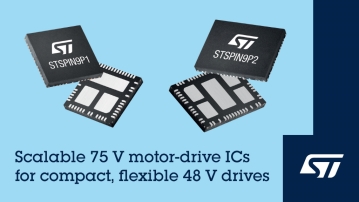
ST Launches 75V Drive IC Targeting 48V Industrial Motor Driving
ST마이크로일렉트로닉스가 48V급 산업용 구동 시스템 설계에 맞춘 75V 모터 드라이브 IC ‘STSPIN9P’ 시리즈를 공개했다. 새 제품군은 하프 브리지와 풀 브리지 구조로 구성돼 모터 종류와 출력 조건에 따라 설계를 확장할 수 있도록 한 것이 특징이다. 전원 회로와 보호 기능, 전류 감지 회로를 칩에 통합해 시스템 구성을 단순화했으며, 최대 500W급 애플리케이션까지 대응하도록 설계됐다. 회사는 레퍼런스 디자인과 데모 보드도 함께 제공해 산업 자동화, 로보틱스, 펌프, 팬, 조명, 섬유 기계 등에서 개발과 평가를 지원할 계획이다.
2026.03.26by 배종인 기자

Nordic supports security updates for the entire lifecycle of IoT devices at a single fixed cost
Nordic Semiconductor, a global leader in low-power wireless connectivity solutions, has unveiled a single fixed-cost licensing model that delivers FOTA (Firmware Over-the-Air) and device management capabilities throughout the device lifecycle via nRF Cloud, and introduced a new firmware update solution to prepare for the enforcement of the European Union's Cyber Resilience Act (CRA).
2026.03.26by 배종인 기자
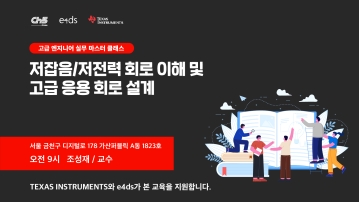
Practical Training in Low-Noise, Low-Power Circuit Design All in One Place… Training Fee Support
고감도 아날로그 회로와 센서 기반 시스템 설계 역량을 강화할 수 있는 ‘2026 고급 엔지니어 실무 마스터 클래스’가 오는 4월16일 서울 가산동 e4ds 컨퍼런스 센터에서 열린다. 이번 과정은 온라인이 아닌 오프라인 유료 실습 교육으로 진행되며, 현장 중심의 심화 학습을 원하는 엔지니어를 대상으로 한다. 이번 교육은 텍사스 인스트루먼트(Texas Instruments)가 교육비를 지원해 정가 25만원에서 10만원 할인 된 15만원에 참가할 수 있다.
2026.03.26by 배종인 기자











