



Announcement of the industry's most flexible and developer-friendly 32-bit mixed-signal MCU
 Published2012.03.16 22:20
March 6, 2012 – Silicon Laboratories Inc. (Country Manager Jong-Chan Lee), a leader in high-performance analog-intensive mixed-signal ICs, today announced the new Precision32™ microcontroller (MCU) family, which offers unprecedented design flexibility to the 32-bit market. Based on the ARM® Cortex™-M3 processor, the Precision32 family includes 32 SiM3U1xx and SiM3C1xx MCU products with footprint-compatible USB and non-USB options. Offering high integration and a flexible architecture, along with a rich set of peripherals, ultra-low power features, and free-to-download Eclipse-based development tools, the Precision32 family is suitable for a wide range of applications, including portable medical devices, POS peripherals, motor control, industrial monitoring, barcode scanners, optical touchscreen interfaces, sensor controllers, and home automation systems.
The Precision32 product family provides a very high level of peripheral integration, enabling developers to reduce system costs, design complexity, and component count, saving up to $1.34 on the bill of materials (BOM). The following on-chip peripherals significantly lower component count and system costs:
• A precision oscillator with an integrated advanced phase-locked loop (PLL) eliminates the need for an expensive 8MHz crystal by providing the clocking accuracy required for crystal-less USB while operating the core independently at any frequency between 1 and 80MHz.
• Since it has a built-in 5V voltage regulator, this MCU can be powered directly from USB, or it can use 5V power without an external rectifier.
• The six high-drive I/Os (up to 300mA each) not only function as boost converter controllers but can also directly drive high-power LEDs, small motors, buzzers, and power MOSFETs.
• With up to 16 capacitive touch channels, there is no need to use a separate touch sensor IC in applications requiring buttons, sliders, or wheels.
While most MCUs require external USB pull-up resistors and termination circuits, the Precision32 family provides a complete USB 2.0 PHY and analog front-end interfacing directly to the USB connector.
Today, embedded developers face the challenge of addressing complex and frequently changing design requirements while meeting demanding cost and power budget demands under tight deadlines and design schedules aligned with aggressive time-to-market goals. Many current 32-bit MCU products make design work more difficult due to a lack of sufficient architectural flexibility, particularly regarding pinout and peripheral placement. The Precision32 family offers developers a more flexible alternative through fully customizable I/O systems and pinout layouts.
Using Silicon Labs' patented dual-crossbar and drag-and-drop GUI, developers can easily select analog and digital peripherals and pin locations. Competing MCUs often have fixed peripheral locations and pin layouts, forcing developers to modify their designs or use larger, more expensive packages. Silicon Labs’ Crossbar design and GUI-based AppBuilder software enable developers to optimize peripheral mix and pin placement, prevent pin conflicts by positioning peripherals close to connected components, simplify PCB routing, and minimize PCB layers, ultimately lowering system costs.
Analog peripherals in the Precision32 product family are tested to operate under overtemperature and overvoltage conditions (down to 1.8V). These high-performance analog peripherals are highly stable and can replace standalone analog components. Furthermore, Precision32 analog peripherals are freely configurable, allowing developers to simplify designs and optimize performance for various embedded applications.
Silicon Labs developed the Precision32 family to achieve industry-leading power efficiency in both active mode and sleep mode. These MCUs utilize Silicon Labs’ superior low-power patented design technology, which reduces power consumption in every MCU design block, to achieve an active current 33% lower than competing 32-bit solutions (22mA or 275µA/MHz at 80MHz) and a sleep current 100 times lower (0.35µA with RTC enabled, maintaining 4kB RAM). In addition, by utilizing various power modes and clocking options, developers can optimize embedded designs to achieve the lowest power consumption at a given performance level.
Linley Gwennap, a senior analyst at the Linley Group, said, “Silicon Labs has applied its proprietary analog/mixed-signal expertise to its new 32-bit MCUs, enabling it to provide precision analog peripherals and flexible I/O. While some competitors offer some of these features, they cannot match the performance of Silicon Labs’ full mixed-signal MCU package. Designers who have previously worked with major MCU vendors should keep an eye on this new product in the 32-bit market.”
Fast and easy development environment
Silicon Labs provides a wealth of hardware and software tools, including a Unified Development Platform (UDP), to efficiently develop embedded applications based on the Precision32 family. This platform features interchangeable MCUs, wireless components, and other subsystems designed to meet developers' application needs. The UDP includes a single motherboard, modular plug-in boards, and ample space for prototyping, expansion, and system integration. The UDP also supports MCU code and firmware development, network arrays and protocol stacks, and USB drivers. For rapid sub-GHz RF design, Silicon Labs offers RF test cards for the UDP that support its new Si446x EZRadioPRO® transceivers.
Silicon Labs’ Eclipse-based integrated development environment (IDE), provided free of charge, includes a compiler and a debugger, along with software libraries containing example code and online dashboards for information critical to applications, such as datasheets, diagrams, PCB footprints, app notes, active version tracking, and automatic updates. The core of the IDE is Silicon Labs’ GUI-based AppBuilder software, which allows developers to quickly and graphically select their peripheral mix and properties to set clocking modes, customize pin layouts, and generate source code without the need to write code directly or read datasheets.
The Precision32 family also enables developers to fully benefit from a vast ecosystem of software and development tools optimized for ARM architecture, including the Keil and IAR toolchains. Silicon Labs provides CMSIS (Cortex Microcontroller Software Interface Standard) compliant code to accelerate development and rapidly port code from competing MCU platforms. ARM software interfaces for common peripherals enable the reuse of peripheral drivers and simple porting from other ARM-based MCUs.
"We developed the Precision32 family to provide embedded engineers with a better 32-bit alternative that offers outstanding design flexibility, peripheral integration, analog performance, and ultra-low power at a very competitive price," said Mike Salas, General Manager of the MCU Products Business Unit at Silicon Labs. "By providing a highly integrated yet comprehensive hardware and software ecosystem along with free software tools, we are supporting developers in rapidly prototyping and developing based on 32-bit MCU architectures that feature the best flexibility and ease of use in the embedded industry."
Price and supply
Silicon Labs’ Precision32 MCUs are currently available in five lead and leadless package types with 32 to 256kB of flash memory, ranging from the 6mm x 6mm QFN-40 for space-constrained applications to the LGA-92 for maximum I/O configurations. Pricing starts at $2.20 for the SiM3C1xx non-USB MCUs and $2.68 for the SiM3U1xx USB MCUs in 10,000 units. Silicon Labs plans to introduce additional new Precision32 32-bit MCU products in the future that take power conversion and precision analog performance to new levels.
Silicon Labs' UDP hardware tools include the affordable SiM3U1xx-B-DK and SiM3C1xx-B-DK development kits at a suggested retail price of $99. Advanced development kits (SiM3U1xx-B-EDK and SiM3C1xx-B-EDK), featuring I/O expansion cards and additional demos for a deeper development experience, are priced at $349 and $299 (suggested retail prices), respectively. Silicon Labs customers can download the Precision32 IDE software tool for free from the company's website. Additional information, samples, and development tools for Precision32 products can be found at www.silabs.com/pr/32bit-mcu.

관련뉴스

Intel Unveils Next-Generation 'Core Ultra Series 3' and vPro Platform for Enterprise PCs
Intel has officially unveiled the "Intel Core Ultra Series 3" for next-generation enterprise PCs and the latest vPro platform, addressing a wide range of demands from enterprise notebooks to high-performance workstations.
2026.03.26by 배종인 기자

ROHM Launches ESD Protection Diode Compatible with High-Speed Interfaces of 10Gbps or Higher
반도체 전문 기업 로옴(ROHM)이 10Gbps를 넘어서는 차세대 고속 데이터 통신 환경에 대응할 수 있는 ESD(정전기 방전) 보호 다이오드 ‘RESDxVx 시리즈’를 개발하며, 고속 인터페이스에서 요구되는 신호 품질 유지와 IC 보호 성능을 동시에 끌어올렸다.
2026.03.26by 배종인 기자
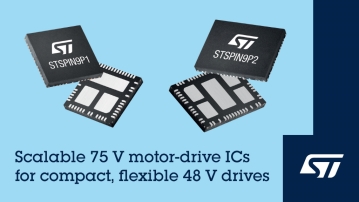
ST Launches 75V Drive IC Targeting 48V Industrial Motor Driving
ST Microelectronics has unveiled the 'STSPIN9P' series of 75V motor drive ICs tailored for 48V-class industrial drive system design. The new product family is characterized by half-bridge and full-bridge configurations that enable design scalability according to motor type and output conditions. Power supply circuits, protection functions, and current sensing circuits are integrated on-chip to simplify system configuration, and the devices are designed to support applications up to 500W maximum. The company plans to provide reference designs and demo boards to support development and evaluation in industrial automation, robotics, pumps, fans, lighting, and textile machinery.
2026.03.26by 배종인 기자

Nordic supports security updates for the entire lifecycle of IoT devices at a single fixed cost
Nordic Semiconductor, a global leader in low-power wireless connectivity solutions, has unveiled a single fixed-cost licensing model that delivers FOTA (Firmware Over-the-Air) and device management capabilities throughout the device lifecycle via nRF Cloud, and introduced a new firmware update solution to prepare for the enforcement of the European Union's Cyber Resilience Act (CRA).
2026.03.26by 배종인 기자

Practical Training in Low-Noise, Low-Power Circuit Design All in One Place… Training Fee Support
The "2026 Advanced Engineer Practical Masterclass" to strengthen competencies in high-sensitivity analog circuit and sensor-based system design will be held on April 16 at the e4ds Conference Center in Gasan-dong, Seoul. This program will be conducted as an offline paid hands-on training session, not online, and is targeted at engineers seeking on-site intensive learning. Texas Instruments will provide educational support for this training, allowing participation at 150,000 won, a 100,000 won discount from the original price of 250,000 won.
2026.03.26by 배종인 기자











