

.png)

KT Expands into Russia's Digital Healthcare Market
 Published2017.12.11 09:24
KT announced that it signed a Memorandum of Understanding (MOU) with Russian Railways to promote digital healthcare business at the 1st Healthcare Cooperation Forum hosted by the Korean Embassy in Russia.
Russian Railways is a semi-public enterprise engaged in passenger rail transport and is one of the world's top three rail transport companies. In addition to rail transport, it operates 102 hospitals with a total capacity of 18,200 beds and 71 clinics capable of accommodating 862,000 visiting patients. It also runs 10 railway cars equipped with diagnostic equipment and medical staff, as well as 5 mobile advisory diagnostic centers. In 10 cities across Russia, Russian Railways clinics are the only medical facilities.
KT plans to launch a pilot project in the first quarter of 2018 to enable effective primary care in emergency situations by installing KT digital healthcare solutions in station hospitals and trains owned by Russian Railways.
KT's digital healthcare solution is a mobile health diagnostic solution integrated with ICT technology that can rapidly diagnose diseases such as cardiovascular diseases (angina, myocardial infarction), respiratory diseases, diabetes, and prostate cancer using small amounts of blood and urine. In addition, simple ultrasound examinations can be used to check for abnormalities in abdominal organs such as the kidneys, liver, and gallbladder, perform ultrasound examinations of the fetus in pregnant women, and conduct basic tests on the musculoskeletal system and blood vessels.
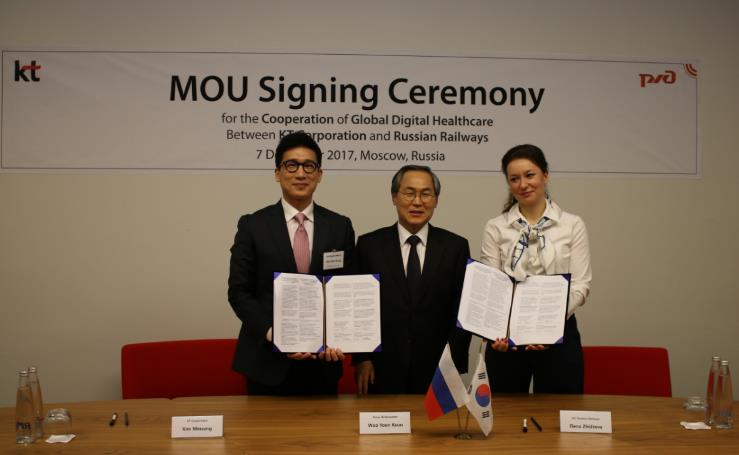
In particular, a major advantage is that the solution itself has built-in Wi-Fi and Bluetooth communication capabilities, allowing patient diagnostic data to be saved directly to the Mobile Electronic Medical Record (Mobile EMR).
The Russian government is currently promoting the 'eHealthcare Project (2010–2020)' for the informatization of the healthcare industry as a means to overcome public distrust regarding the poor medical infrastructure and services of public healthcare institutions. Recently, domestic and international healthcare and IT companies have been actively participating in research and development projects for medical systems and platforms. In Moscow, the Skolkova International Medical Special Zone has been established, and support benefits, such as exceptions to licensing and certification requirements, are being granted to medical personnel and medical devices from foreign hospitals.
In line with this trend, KT plans to fully enter the Russian market by collaborating with promising domestic and international SMEs to expand its diagnostic device lineup to include mobile stethoscopes, electrocardiographs, blood pressure monitors, and blood glucose meters, and by upgrading its KT Digital Healthcare Platform (m-Hospital), an integrated patient diagnostic data management system, to suit local needs and usability in Russia.
Ko Yun-jeon, Head of KT’s Future Business Development Group, stated, “Through the signing of this MOU with Russian Railways, we have reaffirmed the value of KT’s digital healthcare solutions and platforms. The business conducted based on this MOU will serve as an important reference for expanding KT’s digital healthcare business in the Russian market.”
관련뉴스
KT, “Now order ice cream from home by voice”
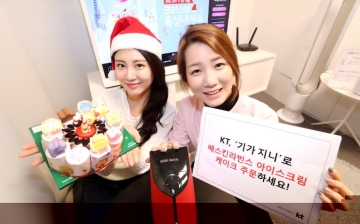
KT announced that it is launching a service that allows customers to order Baskin-Robbins ice cream by voice through its AI TV 'Giga Genie' by linking it with SPC Group's 'Happy Order'. 'Happy Order' is a mobile ordering service provided by SPC Group that enables customers to order various SPC brand products including bakery items, ice cream, hamburgers, pizza, and coffee through the 'Happy Point' app and pick them up at stores or have them delivered. KT will first provide a Baskin-Robbins ice cream cake pre-reservation service through the Happy Order service linked to Giga Genie until the 15th. For example, when a customer says "Genie, order me a Baskin-Robbins ice cream cake," a push notification message is sent to the Giga Genie app installed on the mobile device. Clicking the notification message launches the Happy Point app and connects to the Christmas ice cream cake reservation page for Giga Genie customers. Pre-ordered ice cream can be picked up at stores from the 19th to the 24th.
2017.12.04by 김지혜 기자
KT, CMB와 손잡고 이동통신/케이블 결합상품 출시한다
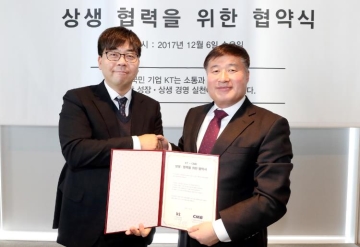
KT는 케이블방송사(SO)인 CMB와 이동통신/케이블 동등결합상품 출시를 위한 업무협약(MOU)을 체결했다고 밝혔다. 양사는 이날 오전 서울 종로구 KT 광화문빌딩 East 사옥에서 KT Mass총괄 임헌문 사장과 CMB 김태율 대표이사 등 관계자 10여 명이 참석한 가운데 협약식을 개최했다. KT는 CMB와 협력해 내년 초를 목표로 KT의 모바일 서비스와 CMB의 초고속인터넷이 결합한 동등결합상품을 출시한다는 계획이다. 50여 년의 역사를 가진 CMB는 케이블방송업계에서 강소기업으로 손꼽히는 사업자다. 서울을 비롯해 대전/대구/광주 등 광역시를 중심으로 약 160만 가입자에 서비스를 제공하고 있다.
2017.12.06by 김지혜 기자
KT and Seoul Metro to Create Safe and Clean Green Subways
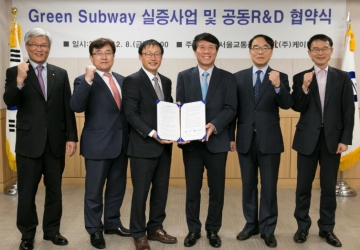
KT announced that it signed a strategic memorandum of understanding (MOU) with Seoul Metro on the 8th at the company headquarters in Seongdong-gu, Seoul for 'demonstrating a safe and clean Green Subway project and joint research on future public transportation technology.' In accordance with this agreement, the two companies plan to cooperate mutually for energy efficiency improvement, prevention of safety accidents and crime, subway air quality improvement, and research on open gate boarding without tag requirements. Seoul Metro, as the largest local public enterprise in Korea, is recognized as possessing world-class infrastructure among subway operating institutions. The company anticipates that integrating its possessed infrastructure and big data with KT's advanced communication technology will contribute to leading Korea's fourth industrial revolution.
2017.12.08by 김지혜 기자
Nvidia invests $5 billion in Intel
글로벌 AI 컴퓨팅 기술을 선도하는 엔비디아(NVIDIA)와 인텔(Intel)이 NV링크 기반 아키텍처 통합으로 최첨단 솔루션 제공에 본격 나선다. 엔비디아와 인텔은 전략적 협력을 공식 발표하고, 하이퍼스케일부터 엔터프라이즈, 소비자 시장까지 다양한 애플리케이션과 워크로드를 가속화하기 위한 맞춤형 데이터센터 및 개인용 컴퓨팅 제품을 공동 개발하며, 차세대 컴퓨팅 시대의 기반을 마련한다고 밝혔다.
2025.09.22by 배종인 기자
.jpg)
Applied Materials Launches Environmental Protection Campaign to Mark World Cleanup Day
어플라이드 머티어리얼즈 코리아(대표 박광선)가 ‘세계 청소의 날(World Cleanup Day)’을 맞아 동탄 신리천 일대에서 임직원 및 가족과 함께 환경 정화 활동을 펼치며, 기술 혁신을 넘어 지역사회와 함께하는 기업으로 거듭나고 있다.
2025.09.22by 명세환 기자











