


To reduce power consumption and make healthcare medical devices smaller
 Published2017.12.18 16:44
TI Provides Measurable Analog Front-End Solution on a Single Chip
With growing interest in health, healthcare data such as step counts and sleep patterns can be easily measured via smartphones or smartbands. In addition, healthcare medical devices are emerging that measure non-contact thermometers, blood pressure, blood sugar, and oxygen saturation.
For medical devices, accurate and high-precision results, high energy efficiency, and a small size are important. Since they are often used continuously for 24 hours, they must be capable of long-term measurements with low power consumption. This is typically required in applications for electrocardiogram (ECG) and photoplethysmography (PPG).
An electrocardiogram (ECG) electrically measures cardiac activity by determining heart rate using electrical signals generated by muscle contractions. The circuit between the patient and the electrodes can be affected by factors such as patient movement, the electrode attachment status, and respiration. In ECG devices, the signal is inconsistent due to interference from power, changes in DC values resulting from electrode attachment, muscle movement, and variations in electrode DC voltage. These issues are resolved through the use of band-pass filters via digital signal processing.

Photoplethysmography (PMP) optically measures changes in blood vessel volume, reflecting the activity status of the heart and cardiovascular system. It is a method that non-vascularly measures blood oxygen saturation by irradiating the fingertips with light of two different wavelengths. Because light reaches the skin first before reaching the blood, it can be affected by the value.
TI provides analog front-end solutions capable of measuring electrocardiograms (ECGs) and photoplethysmography (PPE) on a single chip. The ADS129x series is available for ECG measurement. The ADS1291 is a solution that integrates protection, lead-off detection, and an ADC into a single chip, making it suitable for configuring one-lead ECG systems.
The ADS1292 has two built-in ADCs and can measure up to 6 leads, while the ADS1298 is a solution that implements up to 12 leads and a WCT node on a single chip.
Photoplethysmography can be implemented using the AFE44xx solution. Basically, it is equipped with an LED driver to illuminate the LED and a function to detect the current flowing when reflected light enters the photodiode. Since the signal entering the photodiode has a high frequency, the front end receiving the signal must have a wide bandwidth.
TI's AFE4403 features four RC filters, each of which can be switched on only when desired. The DC correction DAC and second-stage amplifier are located on the rear of the TIA. The AFE4404, however, has the DC correction DAC on the front. It was installed at the front to address the potential issue where the AFE4403's large DC component could prevent the TIA from amplifying the signal. The AFE4403 features a dynamic power saving mode that can reduce power consumption by 35–70%.
1 Comments:
관련뉴스
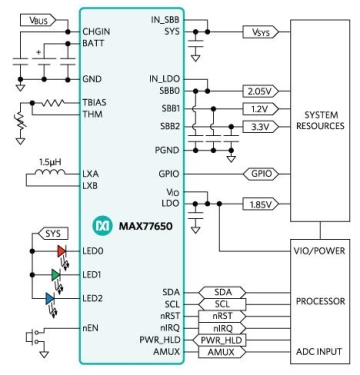
Solving wearable power issues with a compact battery-optimized solution.
일일 활동량을 기록하고 과식여부를 알려주는 스마트벨트, 가방이나 옷에 부착하고 일상 사진을 기록할 수 있는 웨어러블 카메라 등 웨어러블 디바이스가 다양한 용도로 사용되고 있다. 또 귀에 꽂아 사용하는 이어폰 형태의 웨어러블인 ‘히어러블(Hearable)’ 제품이 나오면서 기기는 더 작고, 무선의 형태로 가고 있다. 히어러블 기기는 작은 크기에 가속도 센서, 심박 센서 등 다양한 센서가 탑재되어야 하다보니 내부에 들어가는 부품도 작아져야 한다. 리튬 이온 배터리로 작동하는 대부분의 소형 기기용 PMIC에는 부스트, 벅, LDO, 레귤레이터 충전기, LED 표시기와 같은 전류 레귤레이터가 필요하다. 이에 맥심인터그레이티드는 기존의 PMIC보다 1/2 이하 크기(19.2mm2)인 소형 전력 솔루션에 사용할 수 있는 MAX77650과 MAX77651을 출시했다. 두 제품은 크기와 효율이 중요한 저전력 웨어러블에 적합하게 만들어졌다. 두 소자 모두 단일 인덕터에 독립적으로 프로그래밍할 수 있는 3개의 전원 레일과 전체 솔루션 크기를 최소화하는 SIMO 벅 부스트 레귤레이션을 갖췄다.
2017.09.29by 김지혜 기자
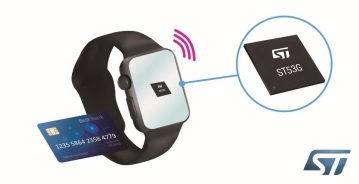
ST, 웨어러블 기기에서 비접촉식 거래 구현하는 기술 제공
ST마이크로일렉트로닉스(ST)가 시계, 장신구와 같이 인기 있는 손목밴드나 패션 제품으로 안전하고 손쉬운 비접촉식 거래를 구현하는 기술을 제공한다. SiP(System-in-Package) 솔루션 ST53G는 ST의 업계 선두의 NFC(Near Field Communication) 전문 기술과 보안 결제 칩을 결합했다. 소비자들이 스마트 기기를 사용하는 보안 결제에 점차 익숙해지면서, 기존의 카드 제조업체들은 지불, 티켓팅, 출입 통제와 같은 용도로 사용하는 비접촉식 웨어러블 제품으로의 사업 확장을 바라고 있다. 이러한 경우 비좁은 크기와 비용 제약 때문에 구현이 쉽지 않다. 기존의 NFC 무선 칩과 보안 칩은 개별적으로 추가 공간 및 복잡한 설계를 필요로 해왔기 때문이다. 또한 웨어러블 폼팩터의 특성상 소형 안테나를 사용할 수 밖에 없어 통신 성능이 제한된다. ST의 새로운 SiP 기반 ST53G는 4 x 4mm의 단일 소형 모듈에 보안 금융칩과 향상된 소형 NFC 무선 기능을 통합함으로써 이러한 문제를 해결했다. 업계 최고의 특허 기술인 ST의 부스트NFC (boostedNFC)로, 소형 안테나를 장착한 웨어러블 기기가 통상적인 비접촉 거리 이상에서 카드 리더기와 상호 작용할 때 매우 뛰어난 사용자 경험을 제공할 수 있도록 한다.
2017.10.24by 김지혜 기자
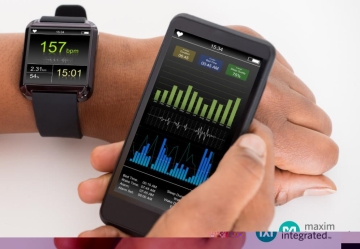
Maxim Launches Low-Power Sensors for Fitness and Disease Prevention
맥심 인터그레이티드 코리아가 질병 예방과 피트니스를 위한 웨어러블 솔루션 ‘MAX86140’, ‘MAX86141’, ‘MAX30001’을 출시했다. MAX86140/41은 광 맥박산소측정기/심박 센서, MAX30001은 심전도(ECG) 및 생체 임피던스(BioZ)를 측정하는 아날로그 프론트 엔드(AFE) 제품이다. 맥심의 초소형 저전력 솔루션을 통해 소비자는 건강 상태를 정확하게 상시 모니터링하고 질병을 예방할 수 있다. 맥심의 헬스케어?피트니스용 웨어러블 센서 포트폴리오는 다양한 핵심 생체 신호를 정확하게 모니터링하도록 지원한다. 초소형 저전력 솔루션으로 배터리 수명 연장과 사용자 편의성 모두를 고려했다.
2017.11.28by 김지혜 기자

Ecolab and K-water Discuss Innovation Collaboration in Advanced Industry Water Management
Ecolab and the Korea Water Resources Corporation jointly discussed cooperation directions for maximizing water use efficiency in advanced industries such as semiconductors and data centers and establishing sustainable water circulation. The two companies agreed to gradually develop a long-term cooperation model that combines water resource infrastructure and water management technology to promote water efficiency optimization, water reuse, and carbon reduction.
2026.08.28by 명세환 기자

에이치에너지, 녹색기술인증 획득…솔라온케어 가동률 99.82%
에이지에너지가 태양광 발전예측 및 I-V커브 이상진단 기술로 중소벤처기업부 녹색기술인증을 획득했다. AI 기반 자산관리 플랫폼 솔라온케어는 전국 3,000개 이상 발전소에 적용되어 99.82%의 시스템 가동률과 3.7% 발전성능 개선을 달성했다. 실시간 데이터 분석을 통해 모듈 노화와 부분 음영 등 미세한 손실을 조기에 감지하고 관리함으로써 발전 수익을 보호한다.
2026.08.25by 명세환 기자












기대됩니다.