



Exploring EFT to Test Rapid High-Frequency Energy Bursts
 Published2018.01.03 15:16
Semiconductor devices must undergo various certification tests beyond electromagnetic interference compatibility, electrostatic discharge, transient pulses, vibration durability, humidity, and temperature stress. These tests are performed through repeated trials in the actual application environment of the device.
Semiconductor manufacturers must pass certification requirements without wasting time and costs from PCB modifications, new construction, and continuous debugging by understanding which parts of the device to test, which standards apply to the tests, how to conduct them, what the pass/fail criteria are, and what conditions apply.
Among several tests, there is the transient pulse test, an interference measurement method used in certification standards for fields such as industrial and automotive applications. The transient pulse test evaluates how well a device or system can withstand high-voltage pulses on power and communication buses and maintain functional communication.
EFT (electrical fast transient) testing is a type of transient pulse test defined in the IEC 61000-4-4 standard. Additionally, depending on specific industry sectors, derivative EFT standards based on IEC 61000-4-4 are being defined. For example, the European standard 55024 defines requirements for information technology equipment used in the European Union.
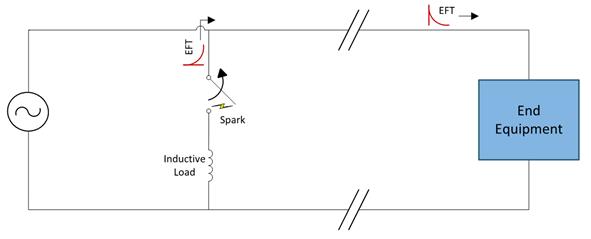
EFT is faster compared to other transient pulse tests. By using pulse waveforms with high peak voltage, fast rise time, and high repetition rate, it can simulate fast high-frequency energy bursts generated by inductive load switching such as back EMF (electromotive force) from relay contactors or motors. Since this type of pulse is very common in industrial environments, such testing is essential to verify that devices maintain proper operation.
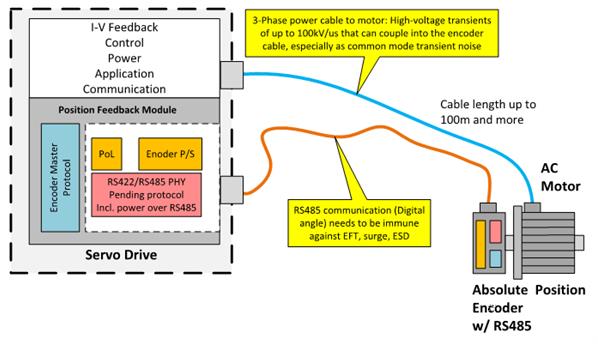
Some RS-485 transceivers must pass this type of test. RS-485 communication interfaces are commonly used in industrial environments due to their excellent noise immunity and capability for long-distance operation. Devices in many systems using RS-485 contact many parts of the application, making them vulnerable to fast transients. An example is motor control, where RS-485 transceivers provide an interface between motor encoders and microcontrollers. Because transceivers connect to motor encoders, transients enter not only through the main AC and DC power shared with the motor but also through communication and control signals.
The occurrence of transients along with communication waveforms is inevitable. Therefore, RS-485 devices must not be damaged by these strikes and must be able to quickly recover communication. This prevents messages sent to or received from the microcontroller from being interrupted or misinterpreted.
TI's RS-485 transceiver THVD1550 is designed with emphasis on EFT and ESD protection functions to operate robustly in demanding industrial environments. It provides an RS-485 interface reference design with excellent EMC immunity for absolute encoders.
Related news
Easy way to turn wired sensors into wireless ones
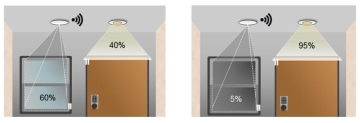
For building automation, attention must be paid to changes in surrounding environmental factors. Sensors are used to collect environmental data, but adding sensors creates a problem: extensive cables and wiring are required to provide power and communication. Internet of Things (IoT) devices equipped with wireless sensors can solve this wiring problem. Some applications still require wiring, such as ambient light sensors and door and window sensors. Implementing existing wired applications wirelessly is not as difficult as one might think. Ambient light sensors used in commercial buildings detect the intensity of light in a specific space and maintain balance of the overall ambient light in a given work area. Typically, light sensors are connected by wire to lighting controlled by the sensor. To implement a wireless solution, connect the lighting to a smart controller through wireless connectivity and install a wireless light sensor near the window. Additionally, wireless sensing nodes make it easier to build smarter systems.
2017.07.19by 김지혜 기자
Electronic fuses provide complete protection of downstream circuits
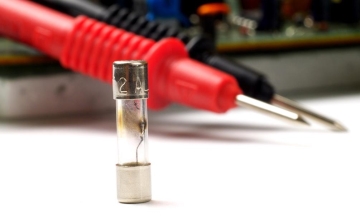
When purchasing a TV, the brand of the product is one of the important selection factors. Brand reliability has an impact on product dependability. Since various manufacturers maintain different quality standards, there are inevitably brands that experience relatively frequent failures. When a product malfunctions, the manufacturer must also spend time and cost on repairs. Identifying and replacing the faulty component in the TV and documenting the root cause of the failure involves considerable time, as well as incurring replacement costs and labor expenses for restoration.
2017.07.27by 김지혜 기자

Using Self-Charging Electronic Lock System for Public Bicycles
Public bicycles have begun appearing in major cities over the past few years. Anyone can rent a bicycle from a docking station installed throughout the city and return it, with payment available via credit card or mobile phone. In London, bicycle users rent and return bicycles at docking station kiosks at designated locations as shown in Figure 1. While this method works well for bicycle tourists, it is inconvenient for commuters who do not have a nearby docking station. If a system were established where bicycles could be rented and returned anywhere, it would be efficient and convenient for commuters.
2017.08.08by 김지혜 기자

Intel Unveils Next-Generation 'Core Ultra Series 3' and vPro Platform for Enterprise PCs
Intel has officially unveiled the "Intel Core Ultra Series 3" for next-generation enterprise PCs and the latest vPro platform, addressing a wide range of demands from enterprise notebooks to high-performance workstations.
2026.03.26by 배종인 기자
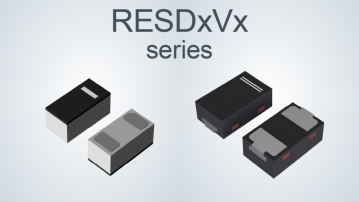
ROHM Launches ESD Protection Diode Compatible with High-Speed Interfaces of 10Gbps or Higher
Semiconductor specialist ROHM has developed the 'RESDxVx series' of ESD (electrostatic discharge) protection diodes capable of responding to next-generation high-speed data communication environments exceeding 10Gbps, simultaneously enhancing both signal quality maintenance required in high-speed interfaces and IC protection performance.
2026.03.26by 배종인 기자











