



Virtex-7 X690T FPGA, which increases transceiver capacity to enable groundbreaking network communications systems, is now shipping.
 Published2012.04.03 10:58
Xilinx, Inc. (NASDAQ: XLNX) today announced the availability of the Virtex®-7 X690T FPGA, which combines the industry’s most reliable high-speed serial transceivers with the highest system bandwidth and market-optimized FPGA resources. The Virtex-7 X690T FPGA is the first device in the 7 series to address high-performance, advanced wired communications applications that require a low-power, single-solution solution. These devices enable fast, scalable, and easy-to-implement chip-to-chip serial interfaces and robust 10GBASE-KR backplanes that maximize bandwidth while supporting distances between diverse boards in next-generation communications systems. They also enable everything from high signal-integrity interfaces to the latest optical modules qualified to support cable distances up to 80 km. Customers requiring greater system capacity and bandwidth can simply migrate to the X1140T FPGA, built with Virtex-7 3D Stacked Silicon Interconnect technology on the 7 Series FPGA scalable optimized architecture. A footprint-compatible Virtex-7 X1140T FPGA with 96 GTH transceivers is expected to ship in May.
“Xilinx has many years of experience in serial transceivers, and to date, we have shipped 75% of all FPGAs that include serial transceivers,” said Tim Erjavec, senior director of FPGA platforms at Xilinx. “And by combining this with our innovative low-power 28nm 7-series FPGA architecture, we have created a product family that is highly optimized for the wired communications market,” he said. “Customers can now confidently implement their designs with the Virtex-7 X690T FPGA and then move up to larger FPGAs with market-optimized resource ratios when higher levels of integration are required.”
Next-Generation Devices Enabled by Virtex-7 X690T FPGAs
By 2015, global IP network data is expected to surpass the zettabyte threshold, representing a compound annual growth rate (CAGR) of 32% higher than in 2010. In particular, demand for IP-based video services is growing exponentially, driving the development of next-generation Layer 2 network switch equipment with the low latency and improved Quality of Service (QoS) performance required to meet this demand.
Equipment manufacturers serving cable operators are tasked with developing next-generation EdgeQAM equipment that is cost-effective, power-efficient, and capable of supporting full-spectrum switching digital video to deliver high-definition video on demand (VOD) directly to the home.
Ross Q. Smith, CEO of RADX Technologies, Inc. “As customers increasingly demand narrow-cast services from cable operators, equipment manufacturers are challenged to deliver solutions that can accommodate evolving and emerging standards,” said Mr. Smith. “The EdgeQAM solution being developed by Xilinx and RADX leverages the compatibility, flexibility and integration of the Virtex-7 X690T FPGA to significantly increase QAM channel density while staying within existing power envelopes.”
The Virtex-7 X690T and X1140T FPGAs deliver the highest throughput and bandwidth per watt of any FPGA, enabling advanced packet processing, FEC, QoS, switching, and traffic management algorithms, as well as next-generation EdgeQAM. Engineers can design with confidence using the industry's most advanced dynamic control GTH serial transceivers. These include a fully programmable 3-tap FIR, enabling transmitter de-emphasis to handle a wide variety of environments, and a fully adaptive 7 fixed and 4 sliding tap receiver Decision Feedback Equalization (DFE) circuit—the most DFE taps in the industry—to ensure maximum margin across different topologies. To accelerate design and debug, each GTH transceiver also includes non-destructive, high-resolution 2D eye scan circuitry, enabling designers to view and measure the receiver eye pattern within the FPGA. The Virtex-7 X690T FPGA, featuring 80 GTH transceivers running at up to 13.1 Gbps, is the first FPGA to break the 2 Tbps single FPGA device bandwidth barrier. The advanced 7 Series FPGA architecture built on the TSMC 28HPL processor enables customers to achieve total power savings of more than 25% over competing FPGAs with similar density, while achieving the integration required to build next-generation systems that meet performance and low-power requirements.

관련뉴스

Intel Unveils Next-Generation 'Core Ultra Series 3' and vPro Platform for Enterprise PCs
Intel has officially unveiled the "Intel Core Ultra Series 3" for next-generation enterprise PCs and the latest vPro platform, addressing a wide range of demands from enterprise notebooks to high-performance workstations.
2026.03.26by 배종인 기자

ROHM Launches ESD Protection Diode Compatible with High-Speed Interfaces of 10Gbps or Higher
반도체 전문 기업 로옴(ROHM)이 10Gbps를 넘어서는 차세대 고속 데이터 통신 환경에 대응할 수 있는 ESD(정전기 방전) 보호 다이오드 ‘RESDxVx 시리즈’를 개발하며, 고속 인터페이스에서 요구되는 신호 품질 유지와 IC 보호 성능을 동시에 끌어올렸다.
2026.03.26by 배종인 기자
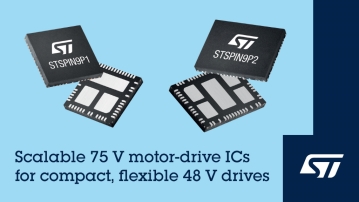
ST Launches 75V Drive IC Targeting 48V Industrial Motor Driving
ST Microelectronics has unveiled the 'STSPIN9P' series of 75V motor drive ICs tailored for 48V-class industrial drive system design. The new product family is characterized by half-bridge and full-bridge configurations that enable design scalability according to motor type and output conditions. Power supply circuits, protection functions, and current sensing circuits are integrated on-chip to simplify system configuration, and the devices are designed to support applications up to 500W maximum. The company plans to provide reference designs and demo boards to support development and evaluation in industrial automation, robotics, pumps, fans, lighting, and textile machinery.
2026.03.26by 배종인 기자

Nordic supports security updates for the entire lifecycle of IoT devices at a single fixed cost
Nordic Semiconductor, a global leader in low-power wireless connectivity solutions, has unveiled a single fixed-cost licensing model that delivers FOTA (Firmware Over-the-Air) and device management capabilities throughout the device lifecycle via nRF Cloud, and introduced a new firmware update solution to prepare for the enforcement of the European Union's Cyber Resilience Act (CRA).
2026.03.26by 배종인 기자

Practical Training in Low-Noise, Low-Power Circuit Design All in One Place… Training Fee Support
The "2026 Advanced Engineer Practical Masterclass" to strengthen competencies in high-sensitivity analog circuit and sensor-based system design will be held on April 16 at the e4ds Conference Center in Gasan-dong, Seoul. This program will be conducted as an offline paid hands-on training session, not online, and is targeted at engineers seeking on-site intensive learning. Texas Instruments will provide educational support for this training, allowing participation at 150,000 won, a 100,000 won discount from the original price of 250,000 won.
2026.03.26by 배종인 기자











