



This year's R&D policy focuses on researcher-centered initiatives and creation of an open-ended ecosystem
 Published2018.01.19 16:54
Expanding new budget allocations for ultra-small IoT and blockchain
The Ministry of Science and ICT held a briefing session explaining this year's R&D promotion direction.
The Ministry allocated a total budget of 4 trillion 695 billion won across five plans: basic research, fundamental research, commercialization, human resource development, and infrastructure development. According to Yun Cheon-won, Senior Aide to the Minister, "We are entering a new normal era where low growth is becoming entrenched. Any short-term policies China has already caught up on. We need to focus on areas where the private sector finds it difficult to venture into and seek out policies that will make us 'first movers' over the long term."
In this R&D initiative, the key promotion directions are set as follows: ▲Researcher-centered challenging and creative R&D innovation ▲Responding to the Fourth Industrial Revolution and fostering innovation growth drivers ▲Solving social problems and creating jobs through R&D ▲Expanding the foundation for science and technology and ICT R&D.
To strengthen long-term and stable research support centered on researchers, a new "Basic Research for Life" support plan enabling focused research in a single area is being planned for implementation starting in 2019. Additionally, support for "Basic Research Laboratories" will be provided for long-term research execution in ICT strategic technology fields.
Attention is also given to developing high-value-added technologies and creating new markets in preparation for the Fourth Industrial Revolution. To create advanced ICT-based jobs, laboratory job creation through startup and technology transfer as well as early commercialization are being encouraged. The approach involves increasing research institute enterprises within R&D special zones where technology and management jointly invest and nurture development.
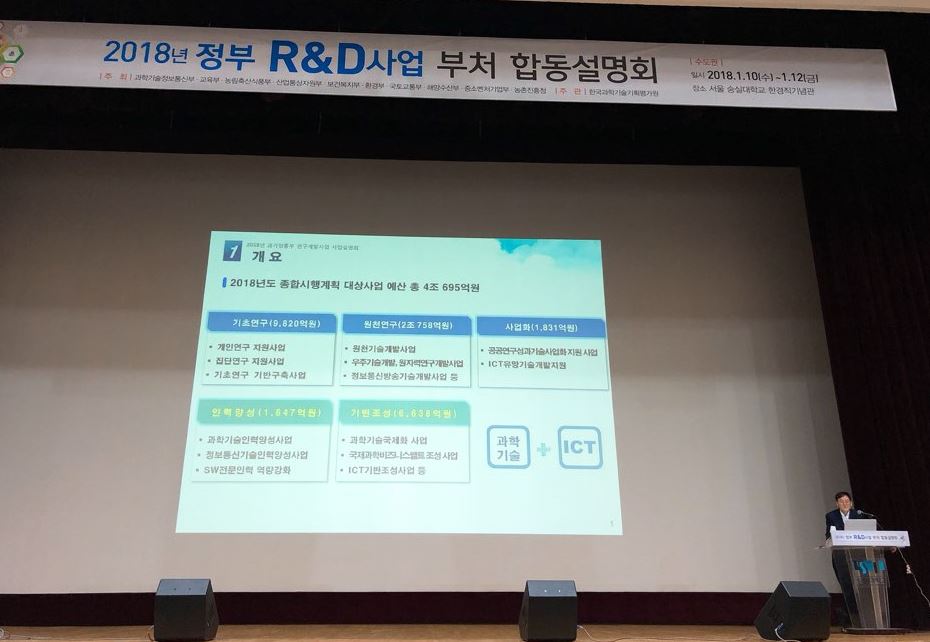
According to Lee Byeong-jin, Secretary at the Ministry of Science and ICT, "The Fourth Industrial Revolution creates new industries and services through the convergence of basic technology and industry," and "We must implement a people-centric Fourth Industrial Revolution." Emphasizing the need for "national response" spanning science, technology, industry, economy, society, and institutions, the Ministry unveiled a vision to secure technological competitiveness in intelligent technology competition and foster innovation growth drivers, thereby solving social problems as well as driving industrial innovation through intelligence.
As a mid to long-term R&D innovation strategy, the existing pursuing-type industrial development R&D investment is being repositioned toward goal-oriented investment direction. The control and management system is also being reorganized with a researcher-friendly focus to achieve effective results. The previously exclusive and closed ecosystem is being transformed into an environment to enhance private sector self-sufficiency.
4.9% decrease compared to previous year; voucher system expanded to private R&D enterprises
As a result, this year's total ICT R&D investment scale is 942.4 billion won, down 4.9% from the previous year. Of this, 665.9 billion won is invested in technology development, 23.7 billion won in standardization, 38.1 billion won in technology commercialization, 81.3 billion won in human resource development, and 133.4 billion won in infrastructure development.
Notably, this year the budget for grant-type R&D to expand researcher investment through measures such as waiving interim evaluations and self-accounting to ensure researcher autonomy has increased to 900 million won. In particular, new investments have been increased, with 4.7 billion won allocated for ultra-small IoT and 4.5 billion won for blockchain. To strengthen the competitiveness of small and medium enterprises, the existing voucher system, previously available only to non-profit institutions, is being expanded to private R&D enterprises. New budget allocation for this expansion is 22.104 billion won.
Furthermore, to create an open and cooperative ecosystem, the "AI Open Innovation Hub" to provide machine learning data, open APIs, and computing power is planned to be completed in the first quarter.
For ten strategic technology fields in response to the Fourth Industrial Revolution, new budget allocations are set as follows: mobile communications 16.3 billion won, networks 3.1 billion won, radio frequency/satellite 2.7 billion won, foundational software/computing 15.4 billion won, software 27.7 billion won, broadcasting/smart media 3.5 billion won, digital content 1.8 billion won, information security 20.8 billion won, ICT devices 6.8 billion won, and convergence services 13.1 billion won.
To solve social problems and secure fundamental technologies, 34.3 billion won is allocated to support research and development at research institutes (ETRI), and 27.4 billion won in new budget is invested in the cross-ministerial Giga Korea project for 5G convergence services and commercialization.
The Ministry of Science and ICT announced its future schedule, indicating that project announcements will begin accepting applications in February, new plan selection evaluation will be conducted in March, and project agreements and full-scale research will commence starting in May.
Related news
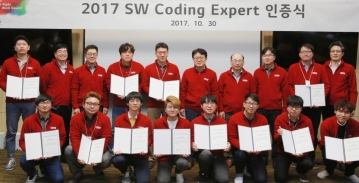
LG Electronics "Coding is an Essential Competency for the Fourth Industrial Revolution Era"
LG Electronics is actively cultivating in-house coding experts to lead the fourth industrial revolution era. LG Electronics held a Software Coding Expert certification ceremony on the 30th at the Seocho R&D Campus in Yangjaedong, Seoul. CTO (Chief Technology Officer) President Ahn Seung-kwon, Vice President Park Il-pyung, Head of Software Center, and Executive Director Cho Taek-il of the Convergence Research Institute attended the event. LG Electronics selected a total of 14 coding experts this year. In the process of selecting coding experts, approximately 1,000 software developers from domestic and overseas research institutes engaged in fierce competition. From May to September, LG Electronics held a coding competition called "Code Jam" and selected outstanding talent with exceptional coding abilities.
2017.10.31by 김지혜 기자
Fourth Industrial Revolution, Standards as the Core of Technology Convergence
As the era of the Fourth Industrial Revolution unfolds, various technologies including 5G, IoT, AI, and big data are being recognized as key drivers. Rather than single products or services, there is a trend of convergence between systems and industries, such as 'autonomous vehicles' and 'smart factories'. The most critical element in technology convergence is standards. In response, the Ministry of Science and ICT held the 'Global ICT Standards Conference 2017' at The K Hotel in Yangjae from the 28th over two days. This event was organized for domestic standardization experts to gather and share global standardization trends and achievements, and to promote the importance of standards. In particular, a 'standardization tutorial' program was prepared to enhance public understanding of standards, and presentations on ICT standards R&D project status and standardization case studies were arranged for corporate participants.
2017.11.29by 김지혜 기자
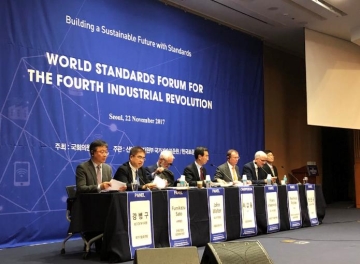
Making it the 'standard' for a sustainable future society
"International standards are necessary to minimize uncertainty in the Fourth Industrial Revolution, where boundaries across all physical and digital fields are becoming blurred." The pace of the Fourth Industrial Revolution is advancing faster than any previous revolution. Beyond the positive aspects of technological advancement, changes are occurring in unpredictable areas, including negative aspects such as social inequality and intensifying polarization. In this uncertain environment, the role of standards is to ensure interoperability and provide certainty. There are opinions that decentralized standardization systems need to be innovated and measures must be established to link R&D with standardization. Accordingly, the 'Fourth Industrial Revolution International Forum' was held under the sponsorship of Member Kim Tae-nyeon and the Korean Standards Association. Panel discussions were conducted on topics including standard policy for sustainable society, innovation of standardization systems, and standard-based smart cities.
2017.12.08by 김지혜 기자
Nvidia invests $5 billion in Intel
NVIDIA and Intel, leaders in global AI computing technology, are now forging ahead in providing cutting-edge solutions through NVLink-based architecture integration. NVIDIA and Intel have officially announced a strategic partnership and stated that they will jointly develop customized data center and personal computing products to accelerate diverse applications and workloads ranging from hyperscale to enterprise and consumer markets, thereby laying the foundation for the next generation computing era.
2025.09.22by 배종인 기자
.jpg)
Applied Materials Launches Environmental Protection Campaign to Mark World Cleanup Day
Applied Materials Korea (CEO Park Kwang-seon) is carrying out environmental cleanup activities with employees and their families around the Dongtan Sinricheon area on the occasion of World Cleanup Day, evolving into a company that engages with the local community beyond technological innovation.
2025.09.22by 명세환 기자











