



Systran Builds AI Automatic Translation System for Classical Literature
 Published2018.01.22 12:36
Expansion of the project to develop automatic translation models for various classical texts
Systran International announced that it has successfully completed the 'Establishment of an AI-based Automatic Translation System for Classical Literature' project for the Korean Institute of Classical Translation, which is a task of the Ministry of Science and ICT (Korea Information Society Agency)'s '2017 ICT-based Public Service Promotion Project' that has been underway since last June.
Systran explained, “This AI-based automatic translation solution for classical texts, being introduced for the translation of classical and modern literature, is considered one of the examples of the convergence of humanities/social sciences with science and technology, and is expected to contribute to securing Korea’s future growth engines and academic assets.”
This translation system was completed through the training of more than 30 AI-based automatic translation models based on a total of 350,000 corpora from the Seungjeongwon Ilgi provided by the Institute for Classical Translation covering the reign of King Yeongjo from the year of his accession to the throne until March of the fourth year, as well as Systran's own corpus.

Neural network translation technology applied to automatic translation systems identifies unique patterns of correlation between the source text and the translation, and generates a translation model based on that data. This translation model autonomously learns information on the correspondence relationships between the source text and the translation, and generates the final translation by searching for and determining the most suitable equivalent word relationships during the actual translation process.
In addition, Systran has developed and integrated a tokenizer for classical literature into the system that separates classical Chinese characters into meaning units so that the AI translation engine can easily recognize classical literature. Furthermore, by 2018, Systran plans to add a corpus of classical literature and expand the machine learning length of translation texts so that long sentences from classical literature can be smoothly utilized in the initial translation process.
Systran plans to carry out continuous advancement projects, such as expanding the automatic translation model for classical literature targeting the original text and translation databases of the Annals of the Joseon Dynasty, Ilseongnok, and literary collections currently serviced in the Korean Classics Comprehensive DB, to assist classical translators with their initial translations and to implement an automatic translation service that can be used in the work and research processes of institutions and academic departments related to classical literature translation in the future.
Systran CEO Ji Lucas stated, “Systran is highlighting the company’s potential by successfully completing not only translation between languages but also the translation industry that connects the past and the present,” and explained, “As the world’s No. 1 intelligent language processing company, we will continue to strive for the advancement of various research fields, including historical research, and strengthen our business capabilities.”
관련뉴스
Saltlux Dreams of a Future Powered by Artificial Intelligence with "Adam"
Before Google DeepMind's AlphaGo surprised us with Go, there was 'IBM Watson'. Watson participated in the quiz show Jeopardy! in 2011 and defeated the all-time champion and record holder, demonstrating the potential of artificial intelligence by taking first place. Following this, Korea also began developing artificial intelligence technology called Exo Brain SW starting in 2013. Exo Brain, meaning an artificial brain outside one's body, is software that enables computers to understand human language—that is, natural language—and provide answers to questions. Companies that participated in this project include ETRI and KAIST. One of them is 'SALTLUX'. Since its founding in 2000, SALTLUX has secured core artificial intelligence technologies including natural language processing, semantics, and reasoning. Based on its natural language processing engine, the company sells enterprise search solutions and translation software.
2017.11.06by 김지혜 기자
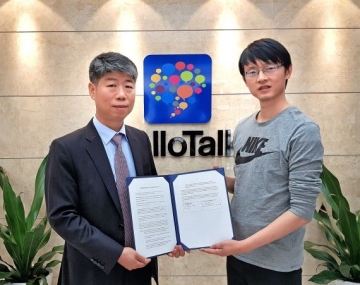
Systran Signs MOU with China's HelloTalk to Enhance Translation Services
시스트란 인터내셔널은 ‘딥러닝 솔루션과 크라우드소싱 휴먼 번역이 통합된 기반 번역플랫폼 개발’ 이라는 SW컴퓨팅산업원천기술개발사업의 GCS(Global Creative Software) 정부과제의 일환으로 전 세계 800만 이상의 회원을 보유한 중국의 대표적 외국어 학습 및 소셜 네트워크 서비스 업체 헬로톡과 번역 품질 및 서비스 향상을 위한 MOU(양해각서)를 체결했다. 헬로톡은 소셜 네트워킹기반 외국어 학습 및 언어교환 애플리케이션을 제공하며, 사용자가 다른 원어민에게 본인이 배우고자 하는 언어에 대해 첨삭지도를 받을 수 있는 것이 특징이다. 헬로톡은 무료 가입 후 사용자가 학습을 원하는 1개 언어를 기본으로 선택할 수 있으며 별도 결제 방식을 통해서 2개 이상의 언어를 추가로 선택할 수 있다.
2017.12.21by 김지혜 기자
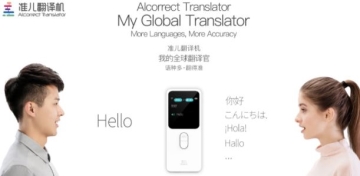
Babel Technology, 인공지능 번역기 'AIcorrect Translator' 공개
Babel Technology가 CES 2018에서 공개한 인공지능 제품인 AIcorrect Translator가 세계 바이어와 전시업체의 관심을 받았다. AIcorrect Translator는 중국어/영어와 다른 30가지 언어간에 다양한 상황에서 실시간으로 상호 번역을 지원하며, 의사소통 문제를 해결한다.
2018.01.18by 김학준 기자

ST Microelectronics and NUS Establish Joint Research Center 'HELIX' for Edge AI
ST Microelectronics and the National University of Singapore have established the 'HELIX' joint research center aimed at implementing embedded AI in edge environments. Over a four-year period, the center will conduct research across the entire technology stack from algorithms to silicon, focusing on memory-centric architecture leveraging ST's 18nm FD-SOI technology and embedded PCM. The core objective is to implement intelligence directly in physical devices such as robots and drones while minimizing energy consumption.
2026.08.28by 배종인 기자

ams, 디지털 포토닉스로 휴머노이드 로봇 감각·소통 기능 지원
ams OSRAM이 디지털 포토닉스 기술을 활용해 휴머노이드 로봇의 감각·소통 기능을 강화하는 솔루션을 공개했다. dToF 센서, 광학식 힘 센서, 구조광 이미터 등으로 주변 환경 인식과 정밀 조작을 구현하며, EVIYOS·ALIYOS 플랫폼으로 LED 기반 비언어 소통을 지원한다. 시장조사에 따르면 휴머노이드 로봇 시장은 2025년 6억 달러에서 2035년 510억 달러로 성장할 전망이며, 로봇의 감각 능력 향상이 핵심 성장 동인으로 작용할 것으로 예상된다.
2026.08.27by 배종인 기자











