


OpenCL Program for Altera's FPGA Delivers Dramatic Development Time Reduction for Early Customers
 Published2012.04.12 17:56
The two companies integrated Altera's expertise in FPGA technology with goHDR's deep knowledge of HDR (high-dynamic range) to leverage OpenCL as a common language that enabled goHDR to rapidly develop HDR-enabled television solutions. The solution implements goHDR's proprietary video codec algorithm on Altera FPGA, enabling conventional televisions to display HDR video content at real-time speeds of at least 25fps (frames per second). By using the OpenCL standard, goHDR was able to work entirely in a C-level environment and rapidly perform multiple design iterations on their FPGA design.
Alan Chalmers, Director of Innovation at goHDR, stated, "HDR video requires massive data and computation, which presents significant technical challenges when processing video on platforms such as televisions or set-top boxes. FPGAs provide a highly competitive alternative to traditional multi-core CPUs and GPUs, but we were not experienced VHDL programmers." He continued, "Altera's OpenCL solution was very well suited to our HDR television application and made it very easy to implement. By working with Altera's OpenCL program for FPGA, we were able to build and deploy our system in less than a week and meet the performance requirements of our project within the limited development timeframe."
goHDR provides advanced data compression algorithms to customers developing HDR technology. The encoding/decoding software developed by goHDR supports the adoption of HDR video across various fields including motion pictures, television, computer games, security, and mobile communication devices.
Altera announced its OpenCL program for FPGA in November 2011. As part of the program, Altera has begun working with early customers, universities, and standards groups to define and develop OpenCL solutions for FPGA. OpenCL for FPGA integrates the OpenCL parallel programming language with FPGA's parallel performance capabilities to deliver higher performance compared to multi-core CPU and CPU/GPU-based systems while reducing development time.
Alex Grbic, Director of Software, DSP, and IP Marketing at Altera, stated, "Through our OpenCL program for FPGA, we are enabling designers to more easily accelerate their designs through FPGA." He continued, "OpenCL for FPGA provides significant productivity advantages to designers who have traditionally modeled their algorithms in C and then converted them to HDL. The OpenCL for FPGA solution is further accelerating FPGA adoption across diverse markets including military, medical, computing, and broadcast."
Online learning materials for Altera's OpenCL program, including videos and white papers, as well as information on registering for or receiving additional information about Altera's OpenCL program, can be found at http://www.altera.com/OpenCL.

Related news

Intel Unveils Next-Generation 'Core Ultra Series 3' and vPro Platform for Enterprise PCs
Intel has officially unveiled the "Intel Core Ultra Series 3" for next-generation enterprise PCs and the latest vPro platform, addressing a wide range of demands from enterprise notebooks to high-performance workstations.
2026.03.26by 배종인 기자

ROHM Launches ESD Protection Diode Compatible with High-Speed Interfaces of 10Gbps or Higher
Semiconductor specialist ROHM has developed the 'RESDxVx series' of ESD (electrostatic discharge) protection diodes capable of responding to next-generation high-speed data communication environments exceeding 10Gbps, simultaneously enhancing both signal quality maintenance required in high-speed interfaces and IC protection performance.
2026.03.26by 배종인 기자
ST Launches 75V Drive IC Targeting 48V Industrial Motor Driving
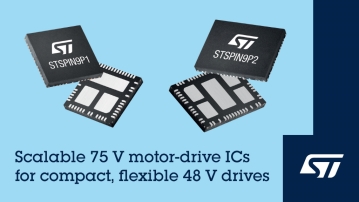
ST Microelectronics has unveiled the 'STSPIN9P' series of 75V motor drive ICs tailored for 48V-class industrial drive system design. The new product family is characterized by half-bridge and full-bridge configurations that enable design scalability according to motor type and output conditions. Power supply circuits, protection functions, and current sensing circuits are integrated on-chip to simplify system configuration, and the devices are designed to support applications up to 500W maximum. The company plans to provide reference designs and demo boards to support development and evaluation in industrial automation, robotics, pumps, fans, lighting, and textile machinery.
2026.03.26by 배종인 기자

Nordic supports security updates for the entire lifecycle of IoT devices at a single fixed cost
Nordic Semiconductor, a global leader in low-power wireless connectivity solutions, has unveiled a single fixed-cost licensing model that delivers FOTA (Firmware Over-the-Air) and device management capabilities throughout the device lifecycle via nRF Cloud, and introduced a new firmware update solution to prepare for the enforcement of the European Union's Cyber Resilience Act (CRA).
2026.03.26by 배종인 기자

Practical Training in Low-Noise, Low-Power Circuit Design All in One Place… Training Fee Support
The "2026 Advanced Engineer Practical Masterclass" to strengthen competencies in high-sensitivity analog circuit and sensor-based system design will be held on April 16 at the e4ds Conference Center in Gasan-dong, Seoul. This program will be conducted as an offline paid hands-on training session, not online, and is targeted at engineers seeking on-site intensive learning. Texas Instruments will provide educational support for this training, allowing participation at 150,000 won, a 100,000 won discount from the original price of 250,000 won.
2026.03.26by 배종인 기자











