



Microchip launches new MCU with intelligent analog integration to simplify design
 Published2018.03.06 11:49
Microchip Technology announced the launch of two new microcontroller product families designed with a focus on customer innovation.
The new PIC16F18446 product family is ideal for use in sensor nodes. Designed with flexibility in mind, the PIC16F18446 integrates ADC2 (Analog-to-Digital Converter with Computation) functionality and operates at 1.8V~5V, making it compatible with most analog output sensors and digital sensors.
The 12-bit ADC2 automatically performs filtering, delivering more accurate analog sensor readings and ultimately providing superior quality end-user data. The ADC2 can wake the core only when needed rather than on a predetermined schedule, reducing system power consumption and making it well-suited for battery-powered applications. Additionally, these power-saving features enable sensor nodes to operate on small batteries, reducing end-user maintenance costs and overall design footprint.
The ATmega4809 is a new megaAVR microcontroller series designed for fast response command and control applications. It integrates a high-speed ADC that provides excellent processing performance, enabling faster analog signal conversion and achieving deterministic system response.
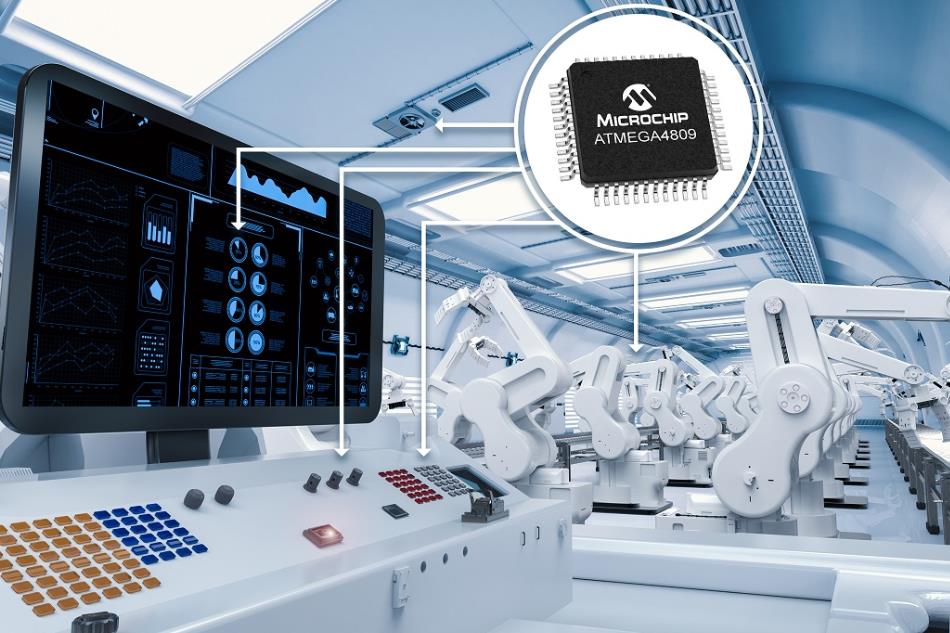
The ATmega4809 is also the first megaAVR product with built-in CIP (Core Independent Peripherals) functionality, allowing tasks to be executed through hardware rather than software. This reduces code size and significantly decreases software overhead, further shortening time-to-market.
With the CCL (Configurable Custom Logic) peripheral, the ADC can be hardware-connected to customized external trigger combinations without impacting the core, improving response time and reducing power consumption. Additionally, adding the ATmega4809 to a system can reduce the workload of more complex microprocessor (MPU)-based designs. When using CIP to execute command and control tasks on the MCU instead of the MPU, the risk of response latency is reduced, providing greater convenience for end-users.
The ATmega4809 has been selected as the onboard microcontroller for the next-generation Arduino board. With the addition of ATmega4809 to this board, developers can reduce the time spent on coding and dedicate more time to development. Through hardware-based CIP features, design work efficiency is enhanced, and migration from project to production phase becomes incomparably easier.
Steve Drehobl, Vice President of Microchip's 8-bit MCU business unit, stated, "With the adoption of ATmega4809 in the next-generation Arduino board, the partnership between our two companies is strengthened, and the benefits of CIP and intelligent analog can now be leveraged on the Arduino platform."
The new PIC16F18446 microcontroller is compatible with MPLAB PICkit™ 4 (PG164140), Microchip's latest in-circuit tool for low-cost programming and debugging. Development with these MCU products can also be initiated using the Curiosity development board (DM164137), a versatile and rapid prototyping platform.
Both development tools are supported in the MPLAB X integrated development environment (IDE) and the cloud-based MPLAB Xpress IDE. Additionally, MPLAB Code Configurator (MCC) is a free software plug-in that provides a graphical interface for configuring peripherals and functions for all applications. Developers looking to start development work immediately can download quick-start code examples, and the MPLAB Xpress PIC16F18446 development board is offered free for a limited time.
Related news
Microchip launches SE device adding hardware-based security
Microchip Technology announced the launch of the ATECC608A CryptoAuthentication device. The ATECC608A is a Secure Element (SE) device that enables developers to add hardware-based security to their designs. Additionally, Microchip has launched the Security Design Partner Program, which establishes partnerships between partner companies and developers to enhance and accelerate secure design. The foundation of secure communication lies in generating, protecting, and authenticating a device's unique and trusted ID. The ATECC608A isolates the device's private key from the system and stores it separately within a secure area, applying advanced cryptographic techniques to provide a high level of security applicable to most design types.
2017.11.21by 김지혜 기자

Microchip Develops MCU for Aerospace Applications
Microchip Technology has introduced a new microcontroller (MCU) that supports specific radiation-hardened performance and low-cost development based on COTS (Commercial Off-The-Shelf) devices. The ATmegaS64M1 is the second 8-bit megaAVR MCU from Microchip, utilizing a development approach that transitions from COTS to radiation-hardened products. The ATmega64M1 is a validated automotive-qualified device available as a pin-compatible version in both high-reliability plastic packages and aerospace-grade ceramic packages. This device is designed to meet radiation-hardened requirements with the following target performance characteristics.
2017.12.19by 김지혜 기자
Microchip Launches In-Circuit Debugger Offering Fast and Wide Voltage Range
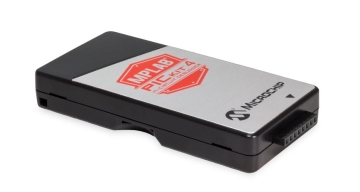
Microchip Technology has announced the launch of the MPLAB PICkit 4 In-Circuit Debugger to provide an enhanced development experience. The cost-effective PICkit 4 in-circuit programming and debugging development tool offers 5x faster programming, a wider voltage range (1.2V~5V), enhanced USB connectivity, and more debugging interface options, and is expected to replace the currently widely-used PICkit 3 programmer. Additionally, this tool supports debugging and programming of Microchip's PIC microcontroller (MCU) and dsPIC digital signal controller (DSC), as well as the CEC1702 hardware-cryptography-capable device family.
2018.02.28by 김지혜 기자

Intel Unveils Next-Generation 'Core Ultra Series 3' and vPro Platform for Enterprise PCs
Intel has officially unveiled the "Intel Core Ultra Series 3" for next-generation enterprise PCs and the latest vPro platform, addressing a wide range of demands from enterprise notebooks to high-performance workstations.
2026.03.26by 배종인 기자

ROHM Launches ESD Protection Diode Compatible with High-Speed Interfaces of 10Gbps or Higher
Semiconductor specialist ROHM has developed the 'RESDxVx series' of ESD (electrostatic discharge) protection diodes capable of responding to next-generation high-speed data communication environments exceeding 10Gbps, simultaneously enhancing both signal quality maintenance required in high-speed interfaces and IC protection performance.
2026.03.26by 배종인 기자











