



KT Launches Commercialization of Korean-Style Bike-Sharing Service
 Published2018.04.04 14:14
KT and ofo to Jointly Develop Network Infrastructure and NB-IoT-Based Smart Lock Devices
KT announced that it has signed a business agreement with ofo, Shinhan Card, and NHN KCP for "commercialization of Korean-style bike-sharing service."
Kim Jun-geun, head of KT's GiGA IoT Business Division, Yanqi Zhang (En-chi Zhang), co-founder and COO of ofo, Lee Chan-hong, head of Shinhan Card's Platform Business Group, and Park Jun-seok, CEO of NHN KCP, among other stakeholders attended the signing and agreed to collaborate on commercialization and market expansion of Korean-style bike-sharing services based on each company's ICT and financial capabilities.
ofo operates over 10 million shared bicycles in approximately 250 cities across 20 countries worldwide. Korea is ofo's 21st market, and the company is currently running a pilot project in Busan. Beginning with this partnership, ofo plans to accelerate its business operations in Korea. Recently, ofo has secured 866 million dollars in investment and is expanding its business.
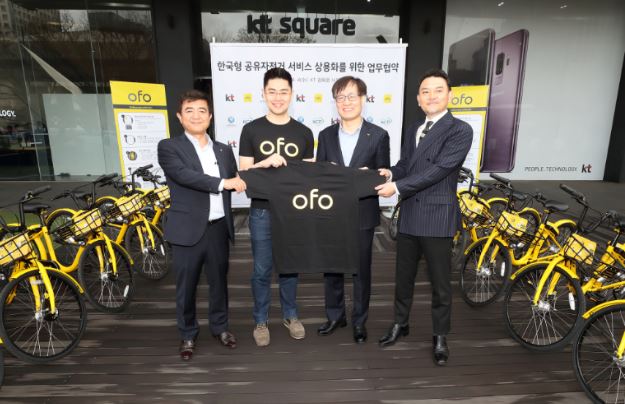
Through the business agreement, KT and ofo agreed to cooperate on ▲utilization of KT's network and infrastructure for bike-sharing business, ▲joint development of NB-IoT-based smart lock devices, and ▲joint marketing to expand the market.
The two companies plan to cooperate on commercializing NB-IoT-based smart locks and installing smart lock devices manufactured by domestic IoT companies on shared bicycles. In particular, they will conduct joint marketing targeting local governments considering bike-sharing introduction but requiring budgets and operational expertise.
ofo Chief Operating Officer Yanqi Zhang stated, "Since launching a free pilot service in Busan, we have been receiving favorable feedback from users," and added, "We look forward to creating synergy for local community development through ofo's bike-sharing model."
Kim Jun-geun, head of KT's GiGA IoT Business Division, said, "This business agreement will not end with simply supplying IoT services and joint marketing," and added, "We will make stepwise efforts to combine KT's big data capabilities, such as floating population analysis, with ofo's bike-sharing service expertise to contribute to addressing environmental issues such as reducing fine dust."
Meanwhile, at the signing ceremony, ofo and Shinhan Card plan to link ofo's bike-sharing service within the 'Shinhan FAN' platform and conduct joint marketing. NHN KCP plans to provide general payment services including credit cards, account transfers, and mobile payment, as well as simple payment services such as PayCo.
Additionally, through IoT, real-time monitoring of bicycle conditions is possible, allowing management of only bicycles requiring repairs and redistribution, thereby improving efficiency. Since equipment capable of bicycle communication exists, when bicycle users leave their usage area, batteries are depleted, parked bicycles are moved without authorization, or unauthorized impacts occur, location and status information are transmitted to the control center, enabling operations managers to identify bicycles requiring maintenance.
Comments
Related news

KT Launches 'Hi Five! KT 5G' 5G Campaign
KT announced the launch of a new campaign 'Hi Five! KT 5G' introducing KT's 5G service that can be enjoyed throughout South Korea right now. The campaign slogan 'Hi Five! KT 5G' is a double entendre expressing both 'high-five,' the action where two people touch their palms together as a sign of cheering and celebration, and a greeting to welcome 5G (Hi, Five).
2018.03.28by 김지혜 기자
.jpg)
KT-Green Car “Development of AI Car Sharing Service”
KT, which secured 700,000 subscribers within 1 year and 2 months of launching 'Giga Genie', is now integrating AI technology into car-sharing services. Users will be able to make car-sharing reservations through Giga Genie by the first half of this year at the earliest. KT announced that it has signed a 'Business Agreement for Artificial Intelligence Car-Sharing Service Cooperation' with Green Car. KT's AI Business Division Head Kim Chae-hee and Green Car CEO Kim Jwa-il attended the agreement signing ceremony along with officials from both companies. Going forward, the two companies will pursue ▲providing Green Car search and reservation services through Giga Genie ▲jointly developing customer-customized car-sharing services ▲marketing cooperation. The Green Car search and reservation service through Giga Genie is scheduled to launch in the first half of this year, with the goal of developing innovative service models that combine telecommunications and car-sharing. KT's 'Giga Genie', which recently surpassed 700,000 subscribers, provides not only voice but also audiovisual information simultaneously. It has the advantage of allowing convenient access to various information such as shopping, education, finance, and information search, making it possible to expand services into diverse sectors.
2018.04.02by 김학준 기자
KT Reduces Gigabit Internet Deployment Time with SDN Technology
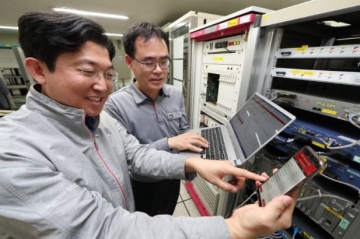
KT announced that it has developed and will commercialize an 'Internet Access Network Automation Solution' that remotely and automatically controls network equipment based on SDN. Using this solution significantly reduces the time required for gigabit internet construction and service activation. Until now, configuring gigabit internet access networks has been done manually by numerous personnel, requiring considerable time. However, by leveraging the Internet Access Network Automation Solution, gigabit ethernet switches are automatically detected remotely and all network settings required for internet service are completed automatically, thereby reducing network configuration time. Additionally, to provide gigabit internet, the process of migrating hundreds of internet users connected to existing optical access equipment to high-performance optical access equipment (large-capacity OLT: Optical Line Terminal) is also automatically applied. Upon completion of commercialization, the time required for gigabit switch installation and subscriber accommodation change operations can be reduced by over 80%.
2018.04.03by 김학준 기자
European Patent Applications Surpass 200,000 for the First Time… South Korea Maintains 5th Place, Led by Batteries and Telecommunications
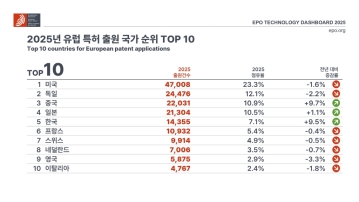
According to the European Patent Office (EPO)'s 'Technology Dashboard 2025', European patent applications last year reached 201,974, surpassing 200,000 for the first time. Korean companies and inventors filed 14,355 applications, representing a 9.5% increase from the previous year and maintaining 5th place by country. Battery, digital communication, and semiconductor technologies led the growth, with Samsung ranking as the top EPO applicant for the second consecutive year and LG reaching 3rd place. The presence of major domestic cities such as Seoul, Suwon, and Yongin was also confirmed. It was also revealed that Korea's European patent strategy is expanding beyond individual technologies to span the entire industry.
2026.03.24by 명세환 기자

SK Telecom First Applies AI-Based Network Operations at Gwanghwamun K-Pop Concert
SK Telecom announced that it applied an AI-based network operation system for the first time at a large-scale K-pop concert held in the Gwanghwamun area of Seoul on March 21st, managing communication quality throughout the event. Mobile data usage during the three hours before and after the concert reached 12.15TB, approximately doubling compared to the same time slot the previous weekend. SK Telecom monitored traffic using the AI system 'A-One' in five-minute and 50-meter units to respond to potential overload situations, while also operating temporary communication facilities and on-site personnel in parallel. This case is interpreted as confirmation of the practical applicability of AI-based autonomous network operation in an environment where demand from dense events and foreign users increases simultaneously.
2026.03.23by 명세환 기자











