



Gartner: It's Time to Let Go of Full Relational DBMS
 Published2018.07.27 15:04
More companies are expected to adopt the latest solutions

Gartner has recommended that companies replace their in-house Prerelational Database Management Systems (PDS) for IT modernization. Prerelational DBMS is an aging technology, and the number of applications using such systems is on the decline. The market share of Prerelational DBMS is also continuing to downward. According to Gartner, revenue from Prerelational DBMS is expected to account for less than 1% of the total DBMS market in 2020.
Donald Feinberg, Vice President and Chief Research Analyst at Gartner, stated, “The decline of fully relational DBMS will continue, and more companies will adopt modern solutions.” He added, “Adopting modern DBMS offers various benefits, including reduced maintenance costs, improved system flexibility and agility, and an expanded technology base. The adoption of modern systems and databases is urgent.” "I recommend starting right now," he said.
It is slow, expensive, and has low compatibility.
The most important factor and motivation for replacing a fully relational DBMS is that the technology is outdated. Fully relational DBMSs were designed to handle database sizes in the megabyte and gigabyte range. Feinberg stated, “Not only is it insufficient to manage today’s big data systems with technology from decades ago, but the management and access tools for these large-scale systems do not support fully relational DBMSs,” adding, “To use big data systems, you must move data to a modern DBMS and secure additional latency.”
In contrast, modern relational DBMSs are designed to handle multiterabyte online transaction processing applications where thousands of users access the system simultaneously. These DBMSs provide all the features of fully relational DBMSs while offering additional scalability, flexibility, and functionality.
Feinberg emphasized, “The cloud is also a factor that must be considered,” adding, “While the cloud did not exist during the era of full-relational DBMS, various systems and applications, such as Software as a Service (SaaS), are now utilizing cloud resources. Services that extract cloud data or connect it to full-relational DBMS are hard to find, and combining cloud and full-relational technologies in an effective and cost-effective manner is also virtually impossible. Database Platform as a Service (dbPaaS) products are a valid, modern alternative.”
Companies wishing to continue using a fully relational DBMS must allocate additional budget for maintenance and consulting. If the established infrastructure shrinks, vendors must increase maintenance and support costs to compensate for the reduced base. Feinberg stated, “The weakening of the technical foundation supporting fully relational DBMS technology means that the cost burden is rising,” adding, “Universities no longer teach this technology. Personnel who previously dedicated themselves to this technology within IT departments have transitioned to external consulting roles and are providing services at higher prices.”
Alternative options
Corporate data and analytics personnel must carefully review various options to replace full relational applications and DBMS platforms and select the optimal option for migrating or replacing each system.
Data and analytics professionals must establish a migration plan based on platform options and actual estimated costs. Gartner believes that migration costs can be offset by reduced maintenance costs, mitigated downsizing of the technology base, and enhanced overall scalability and functionality of the new platform. If the necessary in-house personnel are unavailable, there are many consultants capable of supporting these migration projects, but consulting fees will apply.
Gartner's customers can view more details through a research report titled "Outdated Relational Database Management Systems Must Now Be Replaced."
관련뉴스
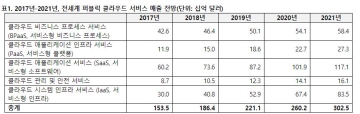
Gartner Forecasts 21.4% Growth in Global Public Cloud Revenue in 2018
Gartner forecasted that the global public cloud services market would reach $186.4 billion in 2018, representing 21.4% growth from the previous year's $153.5 billion. The fastest-growing segment in the public cloud services market is Cloud System Infrastructure Service (Infrastructure as a Service, hereinafter IaaS), which is expected to record $40.8 billion with 35.9% growth in 2018. Gartner projected that the market share of the top 10 cloud service providers reached 50% in 2016 but would account for 70% of the IaaS market by 2021. Sid Nag, Gartner principal research director, stated, "Driven by the expanding trend of multi-cloud adoption, enterprises are expected to seek easy ways to freely move across multiple cloud vendors' IaaS solutions and transfer workloads, applications, and data."
2018.04.13by 김학준 기자

히타치 밴타라, 데이터 복구에 특화된 플랫폼 출시
효성인포메이션시스템은 히타치 밴타라(Hitachi Vantara)가 데이터 복구에 특화된 최신 플랫폼 ‘HDID’(Hitachi Data Instance Director) v6.5를 출시했다고 밝혔다. HDID v6.5는 이미 고객이 최신 스냅샷 및 복제 기술을 사용해 중요 데이터베이스 및 애플리케이션을 보호할 수 있도록 지원하고 있다. 이 최신 버전은 조직에서 기본 운영 환경에 영향을 주지 않으면서 비정형 백업 데이터를 재사용하고 수익을 창출할 수 있도록 지원한다.
2018.05.23by 김지혜 기자
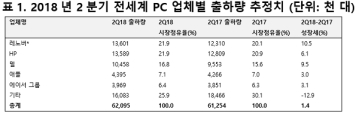
Gartner: Global PC Shipments in Q2 2018 Record Growth for the First Time in 6 Years
2012년 1분기 이후 첫 전년 동기 대비 PC 출하량 증가, 윈도우 10 교체 절정기 지나면 PC 모멘텀 약화될 것
2018.07.13by 명세환 기자
.jpg)
SalePoint Signs Multi-Year Partnership Agreement with AWS… Promoting Identity Security that Integrates Even AI Agents
세일포인트가 AWS와 다년간의 전략적 협력 계약을 체결하고, 인간과 비인간 아이덴티티를 함께 관리하는 통합 거버넌스 체계 구축에 나선다. AI 에이전트가 업무 수행 주체로 늘어나는 환경에서 접근 권한을 일관되게 관리하고, 최소 권한 원칙과 자동화된 정책 집행을 적용하겠다는 구상이다. 양사는 AWS 환경에서 AI 에이전트를 포함한 다양한 주체의 아이덴티티를 하나의 레이어에서 관리하는 기능을 공동 확대할 계획이다. 이번 협력은 AI 도입이 확대되는 기업 환경에서 보안과 거버넌스를 함께 설계하려는 움직임으로 해석된다.
2026.03.26by 배종인 기자
.png)
Databricks Unveils Open AI Security Monitoring 'Lakewatch'
데이터브릭스가 3월 24일 개방형 에이전틱 SIEM ‘레이크워치’를 공개하며 보안 시장에 진입했다. 이 제품은 보안, IT, 비즈니스 데이터를 단일 환경에서 통합 분석해 AI 기반 위협 탐지와 조사를 지원하는 것이 핵심이다. 회사는 고비용 구조 때문에 일부 데이터를 포기해온 기존 보안관제의 한계를 줄이고, 개방형 형식과 생태계를 바탕으로 대규모 데이터 분석과 자동화를 가능하게 한다고 설명했다. 레이크워치는 현재 프라이빗 프리뷰로 제공되며, 어도비와 드롭박스 등이 초기 고객으로 언급됐다. 데이터브릭스는 앤트로픽과 협력을 확대하고 안티매터, SiftD.ai 인수도 함께 발표했다.
2026.03.26by 배종인 기자











